






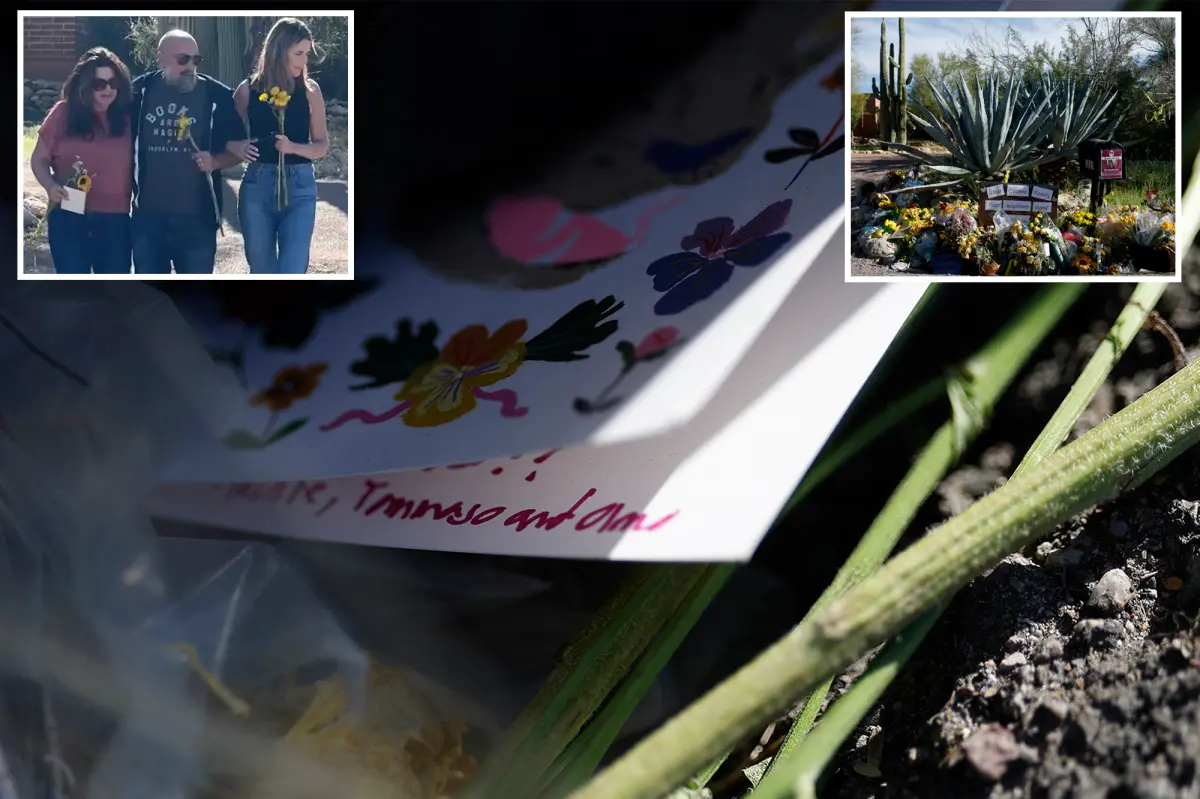
Savannah Guthrie, the familiar face from NBC News who has anchored countless important moments for millions of viewers, found herself in a deeply personal and heart-wrenching scene last Monday. It was a moment far removed from the bright lights of television studios, where she and her siblings stood together outside their mother’s modest Tucson home, surrounded by a makeshift memorial that symbolized their shared grief. Nancy, an 84-year-old woman known for her warmth and quiet strength, had been missing for a full month since vanishing from her Arizona residence on February 1. The family, clutching flowers and supporting each other arm-in-arm, approached the site sobbing softly, their steps heavy with the weight of uncertainty. In that quiet, suburban neighborhood, the Guthries transformed a simple space into a place of remembrance, where handwritten notes and symbols of love were scattered like fragile petals in the wind. Savannah, often composed on camera, could no longer hold back the raw emotion that had been building inside her. Her siblings, equally affected, leaned on each other, their collective pain a testament to the unbreakable bonds of family forged over decades of shared memories. The air was thick with the scent of blooming Arizona flowers, a cruel contrast to the sorrow that hung over them, as they prepared to leave a message that captured the depths of their aching hearts for their missing mother. This wasn’t just a public tribute; it was a private outpouring, a way to bridge the painful gap between hope and despair, reminding everyone that behind the headlines, there are real people grappling with unimaginable loss.
As they drew closer, the memorial came into sharper focus—a poignant display of love amid the community’s efforts to keep Nancy’s story alive. Placards, ribbons, and photographs adorned the area outside her home, each item placed with care by neighbors, friends, and strangers who had heard about her disappearance. It was a sea of yellow ribbons tied to fences and trees, symbolizing the search efforts that had spanned Tucson and beyond, turning neighbors into impromptu detectives and volunteers. The Guthries moved slowly, their arms linked as if to draw strength from one another, carrying bouquets that trembled slightly in their hands. Savannah’s voice was soft, choked with emotion as she whispered to her siblings, memories of their mother flooding back—Nancy’s laughter during family dinners, her gentle guidance through life’s challenges, her unwavering presence at every milestone. They paused at the base of the memorial, flowers brushing against the ground like forgotten promises, and there, in the scorched earth that lay beneath their feet—a reference to the arid Arizona landscape, but also a metaphor for the devastation in their souls—they placed their tribute. Tommaso Cioni, Savannah’s brother-in-law, stood by their side, his presence a steady anchor, reminding them that love could extend beyond bloodlines. The group sobbed openly now, no longer constrained by the public eye; this was their sanctuary, a place where vulnerability was not a weakness but a profound strength. The tears flowed freely as they honored Nancy, transforming individual sorrow into a collective cry for her return. In that moment, surrounded by the remnants of hope, the family felt the encroaching darkness of not knowing, yet they clung to the light they carried within—each other. It’s heartbreaking to imagine the courage it must take to face such a void, to stand in the place where your loved one last walked, and admit that the world feels forever changed without them.
The handwritten card they left behind was more than just words on paper; it was a lifeline thrown into the abyss of their grief, a heartfelt declaration crafted with trembling hands during quiet hours of reflection. “Momma, We miss you so much! Our hearts are broken. We are standing on ash, scorched earth!” the note began, its simple yet powerful language echoing the desolation they felt in that moment. Each stroke of the pen seemed to carry the echo of Nancy’s own voice—her Southern charm, her storytelling prowess that had captivated her family for years. Savannah and her siblings had poured their souls into it, drawing from the well of cherished memories: Nancy teaching them to dance in the living room, her patient encouragement during school struggles, the way she lit up a room with her infectious smile. Yet, the note didn’t end there; it shifted into a beacon of resilience, a reminder that even in the darkest times, love persists. “But, mom, though we are surrounded by so much darkness and uncertainty, our love burns bright,” it continued, encapsulating the family’s unyielding faith in their mother’s spirit and the bond that no absence could sever. Tommaso, who had become an integral part of this grieving extended family, added his own quiet assent, his presence at the memorial underscoring how loss unites people in profound ways. As they read the words aloud to each other before placing the card, fresh tears mingled with soft nods of understanding, each family member finding solace in the shared language of heartache. This tribute wasn’t meant for public consumption alone; it was a private vow, a way to whisper to Nancy that she was not forgotten, that her legacy of kindness continued to inspire them. In a world where disappearances often fade from headlines, this note served as a defiant stand against oblivion, humanizing the story of a missing 84-year-old woman into something deeply relatable— a mother’s love transcending time and space.
The emotional outpouring at the memorial was palpable, a raw display that stripped away the facades we often wear in public. Savannah, typically the voice of calm professionalism, let her guard down completely, her sobs mingling with those of her siblings in a symphony of shared pain. Arm-in-arm, they moved as one entity, like branches of a tree bending under a fierce storm but refusing to break. Flowers, symbols of renewal and fragility, were gently laid at the site, their petals quivering in the breeze as if mirroring the family’s unsteady breaths. One could hear the muffled cries, the whispered pleas for strength, as they navigated this deeply personal ritual. It’s hard not to feel the human element here—the vulnerability of a daughter who has spent her career comforting others through tragedies, now facing her own. Nancy’s absence had created a void that no words could fully fill, yet this act of remembrance brought a flicker of connection, a way to channel the overwhelming tide of emotions into something tangible. Tommaso Cioni, with his steadfast support, embodied the quiet heroism of family allies, standing tall amidst the tears and offering silent embraces that spoke volumes. The scene was richly evocative, from the dry Tucson air carrying whispers of distant thunder to the palpable weight of untold stories etched on each family member’s face. In sharing their grief publicly, the Guthries invited empathy from those who might witness or hear about it, reminding us all that behind every missing person case lies a tapestry of human relationships shattered and yearning to be mended.
Delving a bit into the backdrop, Nancy’s disappearance on February 1 had sent shockwaves through her community and her family, a stark reminder of how quickly life can shift from routine to bewildering uncertainty. At 84, she had been living independently in Tucson, a city she called home after years of nurturing her children and watching her grandchildren grow. Savannah and her siblings, scattered across the country but always connected by an invisible thread of love, had rallied immediately upon learning of her vanishing, coordinating with local authorities and search teams. Police had combed the area, reviewed surveillance footage, and followed leads, yet the mystery persisted, leaving the family in a limbo of waiting and wondering. Was it an accident? A memory lapse in her senior years? Or something more sinister that defied explanation? The memorial visits, like this one in March, became ritualistic acts of defiance against despair, a way to keep Nancy’s essence alive amid the unknown. Savannah, drawing from her experience in journalism, had used her platform subtly to raise awareness, but this personal tribute was her raw, unfiltered voice. The family’s sobs echoed not just their pain but also the broader human experience of loving someone who has slipped away without a trace, highlighting the resilience required to face each day without resolution. Tommaso Cioni’s participation added layers, showing how grief extends to those who choose to stand by, integrating layers of compassion into the narrative.
In reflecting on this emotional journey, the Guthries’ act at the memorial underscores the enduring power of familial love, even in the face of profound loss and uncertainty. Savannah, her siblings, and Tommaso didn’t just leave a note; they left a piece of their souls in that scorched earth, a testament to Nancy’s lasting impact on their lives. Her disappearance, a month into this agonizing ordeal, serves as a poignant reminder that every missing person story carries real heartache—raw, unfiltered, and deeply human. As they walked away that Monday, flowers in hand and tears drying on their cheeks, the family carried with them a flicker of hope fueled by that burning love. In a world that often feels disconnected, their story bridges the gap, inviting us to empathize and remember that beneath the surface of news headlines lies the timeless struggle of people longing for answers. Nancy, wherever she might be, would surely be proud of the strength her children exhibited, their message a lullaby for her return. Grief like this doesn’t fade quickly; it evolves, teaching lessons in compassion and connection. And in moments of darkness, it’s the bright burn of love that lights the way forward.