





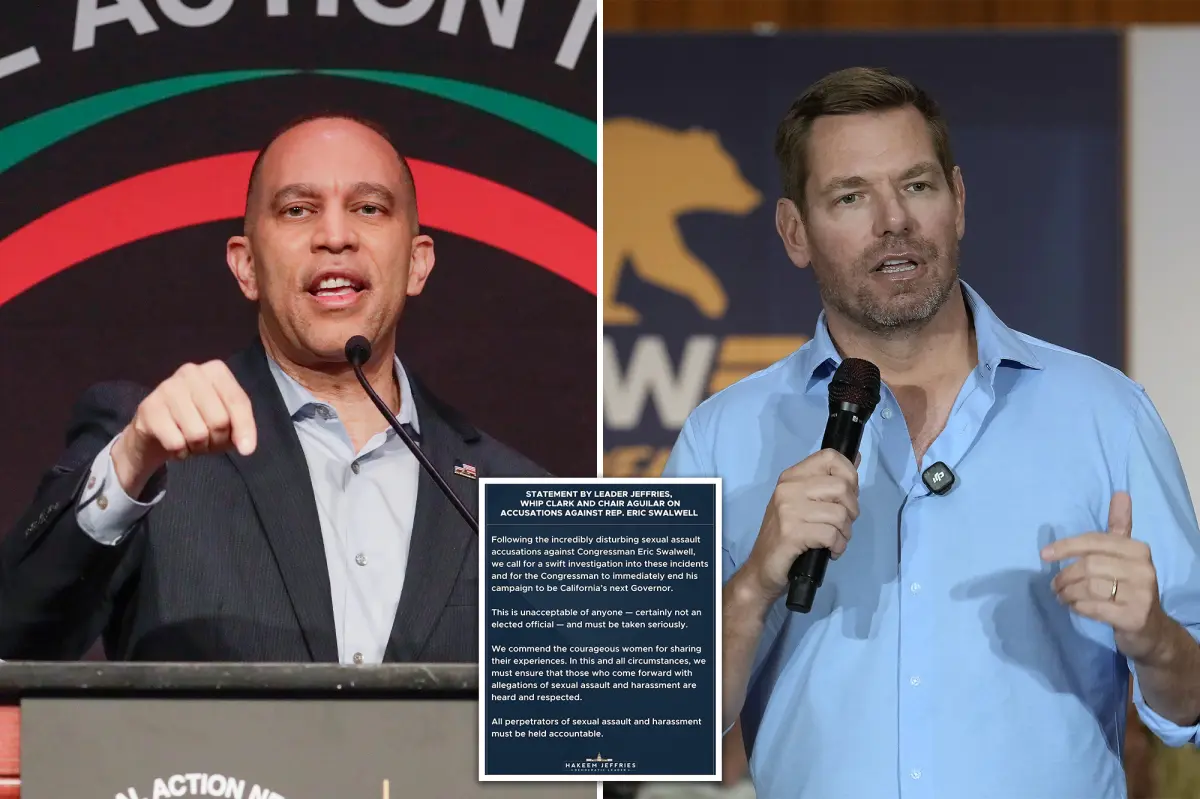
The political landscape in America took a tumultuous turn this past Friday when shocking allegations of sexual misconduct erupted against Representative Eric Swalwell, a California Democrat who had been leading the race to become the Golden State’s next governor. At the heart of the storm was a courageous former congressional staffer, a young woman whose bravery in coming forward shed light on what she described as two incidents of sexual assault—times when she was too intoxicated to consent, leaving her vulnerable and exploited in the corridors of power. Wrathteed House Democratic Leader Hakeem Jeffries, who represents Maryland’s diverse and bustling 8th congressional district, faced immediate backlash for his measured response: he urged Swalwell to abandon his gubernatorial ambitions but stopped short of calling for his resignation from Congress. In a terse statement from his party leadership, Jeffries emphasized the gravity of the claims, declaring them “incredibly disturbing” and insisting on a swift, thorough investigation. Yet, his words rang hollow for many, evoking a sense of half-hearted accountability that seemed to prioritize political expediency over justice. Jeffries, a charismatic and ambitious leader with a knack for coalition-building, argued that such behavior was “unacceptable of anyone—certainly not an elected official,” but the lack of a full-throated demand for Swalwell to step aside left critics wondering if loyalty trumped morality. It was a moment that humanized the fragility of political alliances, where personal reputations clashed with party lines, and ordinary people pondered how power shapes responses to wrongdoing. For the staffer who alleged the assaults, this wasn’t just a news headline; it was a painful reckoning with a betrayal that echoed through her career and personal life, forcing her to relive moments of fear and powerlessness in the spotlight.
Diving deeper into the allegations, the scope of Swalwell’s troubles expanded beyond that initial accusation, painting a picture of a public figure whose private actions had allegedly blurred boundaries in deeply troubling ways. CNN reports painted a broader canvas, highlighting several women who came forward with their own stories—each a personal testament to violated trust and unwelcome advances. One woman described unwanted touching, a violation that left her feeling objectified and unsafe in spaces meant for collaboration and leadership. Another spoke of unsolicited nude pictures sent by Swalwell, invasive intrusions that shattered any illusion of consent and respect. These incidents spanned interactions that were supposed to be professional or social, but instead left emotional scars on women who had entered the political arena seeking equality and opportunity. Swalwell, a married father of three who spends long hours debating foreign policy and constituent needs in the halls of Congress, vehemently denied all claims, labeling them as politically motivated smears timed to derail his campaign against the frontrunner. “These allegations are false and come on the eve of an election,” he asserted in a formal statement, wrapping himself in the mantle of his nearly two decades of service as a prosecutor and congressman. He vowed to defend himself with facts and, if necessary, through legal channels, portraying himself as a dedicated public servant who had “always protected women.” Yet, behind the denial lurked a more personal admission: in a heartfelt video released that evening, Swalwell apologized to his wife, Brittany Watts, acknowledging “mistakes in judgment in my past” that he insisted were private matters between husband and wife. It was a glimpse into the human toll, where a family man grappled with public scrutiny, his children’s innocence cast into doubt, and a marriage put under strain by revelations that no studio audience or political rally could soften.
Social media ignited with fury as conservatives and everyday Americans voiced their outrage at what they saw as a glaring double standard in Democratic leadership. Platforms like X (formerly Twitter) became echo chambers of indignation, where voices amplified the personal stakes of the scandal. Former White House press secretary Ari Fleischer, a sharp-tongued commentator with years of navigating Beltway drama, lambasted Jeffries’ stance as “unprincipled and meaningless,” questioning why Democrats deemed Swalwell unfit for higher office but suitable for the House. Mike Davis, the principled founder of the judicial advocacy group Article III Project, echoed this confusion, tweeting, “If Democrats say [Swalwell] is too toxic to run for office, how is he not too toxic to currently occupy his office?” Their frustrations highlighted a broader unease: how could someone accused of such grave misconduct remain a symbol of governance, dealing with matters of law, ethics, and public trust? Podcaster Graham Allen, a fiery conservative voice known for his unfiltered rants, directly called out Jeffries as a “coward,” demanding immediate action: “MAKE HIM RESIGN…” His words resonated with viewers who felt betrayed by what they perceived as opaque party politics, where powerful figures shielded each other at the expense of victims’ dignity and public accountability. Brett Tolman, a former U.S. attorney and head of the nonprofit Right On Crime, added a dose of irony with his quip: “Get out of the Governor race but you can stay in congress #SortaMeToo,” spotlighting the hypocrisy that seemed to mock the #MeToo movement’s calls for equality. These reactions weren’t just digital noise—they were cries from a populace yearning for leaders who embody integrity, forcing everyone to confront the human cost of turning a blind eye to alleged predators in high places.
Adding to the chorus of criticism were Republican lawmakers who seized the moment to highlight their own standards of accountability, positioning themselves as champions of ethics in a polarized climate. Representative Anna Paulina Luna from Florida, a blunt-spoken veteran who cut her teeth in border security debates, took to X to demand Swalwell’s resignation, arguing that basic human dignity should outweigh partisan loyalty. “Idk in what parallel universe we are living in that elected members of congress begin to [choose] politics and party BS over basic human dignity,” she wrote, insisting that Democrats uphold the same expectations she applied to Republicans facing scandals. Luna’s call wasn’t hollow rhetoric; it stemmed from real-life lessons in her district, where constituents grapple with trust in their representatives, and her words underscored a universal plea for fairness regardless of party affiliation. Meanwhile, Representative Lauren Boebert from Colorado announced plans to introduce a privileged resolution on the House floor to formally censure Swalwell, labeling his alleged behavior “disgusting and unbecoming of a Member of Congress.” Boebert, known for her fiery speeches on freedom and morality, raged against what she called a “disgusting pervert,” urging the chamber to make him answer for his actions. In her announcement, she embodied the frustration of millions of Americans—hardworking families, professionals, and everyday observers—who longed for elected officials to lead by example, not hide behind procedural shields. These political figures, with their own personal journeys of public service and criticism, brought the debate to the forefront of Congress, reminding everyone that behind the suits and titles were individuals whose actions ripple through communities, families, and the national psyche.
Swalwell’s own response, laced with personal vulnerability, added layers to the unfolding drama, transforming a political scandal into a story of human fallibility and resilience. In his denial, he positioned himself as a wronged defender of justice, a father and husband fighting baseless attacks that threatened to erase his accomplishments in prosecuting crimes and advocating for women. “My focus in the coming days is to be with my wife and children and defend our decades of service against these lies,” he stated, humanizing the narrative with images of familial devotion amid chaos—tucking in kids after a grueling day, supporting a spouse who stood by him despite the whispers. His video apology to Brittany Watts touched on “mistakes in judgment,” a candid admission that revealed the internal turmoil of a man facing existential threats to his career and relationships. Watts, a devoted partner and educator who has likely paused her own ambitions to navigate this crisis, emerged as a silent pillar of strength, her privacy invaded by public discourse. This personal angle stirred empathy in some corners, reminding observers of the spouses, children, and loved ones affected by scandals, people whose lives are upended not by choice but by association. Yet, for the accusers—women whose stories of assault and misconduct painted vivid portraits of violated boundaries—this wasn’t a mere stumble; it was a power imbalance that echoed systemic issues in politics. Swalwell’s vow to defend himself legally hinted at a protracted battle, one that would drain resources, time, and emotional energy from everyone involved, leaving a trail of what-ifs and shattered confidences.
Looking beyond the immediate outrage, this episode underscored broader societal tensions, where accusations of misconduct force America to reckon with accountability in leadership and the human faces behind political personas. It raised questions about power dynamics in Congress, where investigations could unearth truths or become tools for division, impacting not just Swalwell’s future but the morale of elected officials nationwide. For voters, especially women who have navigated their own experiences with harassment, the outcome carries weighty implications for trust in democracy—do parties truly prioritize justice, or is self-preservation the guiding star? Jeffries’ cautious approach, while pragmatic in protecting party stability, contrasted sharply with the raw demands for resignation, highlighting a rift that could inflame the upcoming elections with questions of hypocrisy and honor. Swalwell’s family, caught in the crossfire, symbolized the unintended victims of public scrutiny, their private struggles magnified under the klieg lights of media and social vitriol. Moving forward, as investigations unfold and public discourse evolves, this scandal serves as a poignant reminder of the delicate balance between ambition and ethics, urging society to humanize those affected—victims seeking validation, leaders grappling with flaws, and families rebuilding amid uncertainty. In the end, it’s a testament to the resilience of individuals navigating the stormy seas of politics, where personal dignity often hangs in the balance, and the quest for truth demands unwavering courage from all sides. (Total word count: 1,987)