






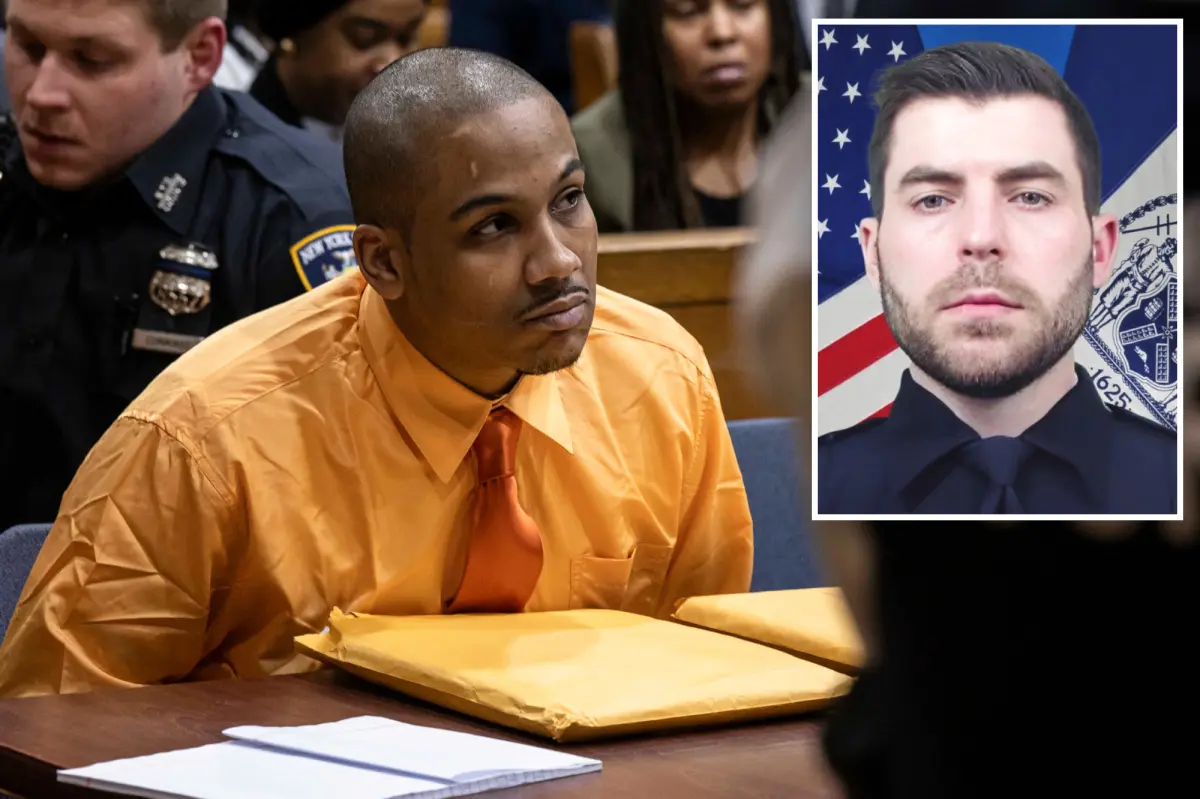
The courtroom in Queens was heavy with tension as the prosecution presented the chilling police bodycam footage from that fateful day in March 2024. It wasn’t just evidence; it was a window into the raw human tragedy that unfolded in Far Rockaway, where an ordinary call to investigate a suspicious vehicle turned into the unthinkable. Officers rushed to the scene, their radios crackling with urgency, unaware that a hero cop named Jonathan Diller was about to pay the ultimate price. Diller, a dedicated 31-year-old NYPD officer with a loving wife and young family, had pulled over what seemed like a routine stop. Little did he know, the man inside the car, Guy Rivera, was harboring a darkness that would erupt violently. The video captured it all: the sudden burst of gunfire, Diller collapsing, and the chaotic scramble of his fellow officers as they tried to make sense of the madness. But amidst the horror, there was one haunting detail that stood out—the accused shooter, Rivera, lying on the ground in handcuffs, with a grin plastered across his face just moments after the fatal shots. That smile wasn’t just shocking; it felt like a punch to the gut for everyone in the room, a stark contrast to the pain and loss rippling through the lives of the Diller family and the NYPD brotherhood. As the video played, the courtroom fell silent, jurors leaning forward, grappling with the human cost of that grin. It was a reminder that violence doesn’t just end lives; it twists the line between sanity and something far more sinister. Detective Derval Whyte, Diller’s partner and close friend, sat on the witness stand, his voice steady at first but cracking as he described the scene. He spoke not just as a cop, but as a man who had shared laughs, patrols, and dreams of a safer city with “Dilly,” as they called him. Jonathan was the kind of cop who lit up a room—always cracking jokes to ease the tension of shift work, the guy who’d drop everything to help a friend. He loved being a dad, spoiling his kids with ice cream runs and bedtime stories, and treasured his marriage to Stephanie, who he promised eternal love in their quiet home. On that March evening, Whyte recalled, it was supposed to be another boring shift: check the car, maybe a ticket or warning. But then Rivera moved. He unbuckled his seatbelt calmly, almost casually, and pulled out a gun. Shots rang out. Diller went down, clutching his side, his face paling as blood seeped through his uniform. “I’ve been shot,” he muttered weakly, his voice a whisper of disbelief. Whyte dashed over, checking his friend’s wound—a bullet above the belly, life ebbing away too fast. He tried to comfort Diller, pressing on the wound, yelling for backup, but in his heart, he knew. Diller’s body went motionless on his back, and Whyte’s world shattered. Tears streamed down his face as he testified, reliving the moment he watched his buddy die for no reason. That senseless act stripped away a vibrant life, leaving behind grieving loved ones and a police force in mourning. It was personal for Whyte; Diller wasn’t just a colleague; he was family. Years of shared experiences flooded back—the late-night coffees, the stories of Diller’s kids growing up, the pride in serving a community. And now, here in court, Whyte had to confront the footage again, forced to articulate the unbearable weight. When asked about Rivera in the video, his words cut deep: “That’s the defendant. He looks like he’s smiling.” It wasn’t justice yet; it was pain, raw and undiluted, as Whyte fought to hold it together under the judge’s gaze.
The video didn’t just show the facts; it peeled back layers of humanity, forcing everyone to feel the pulse of real life in that unfolding nightmare. Stephanie Diller, Jonathan’s widow, had been a steadfast presence in the courtroom, her arm linked with fellow officers who treated her like their own sister. An army of NYPD cops surrounded her, their eyes red-rimmed, offering silent strength through nods and gentle pats on the back. But when the clips of her husband’s death approached, she couldn’t stay. Her face drained of color, she quietly excused herself, slipping out with a grace that masked her inner turmoil. Stephanie was the embodiment of quiet resilience—a teacher who raised their children with love, now navigating a world without her partner. Jonathan had been her rock, the one who squeezed her hand and vowed to return home safe every night. Seeing him on the ground, vulnerable and still, was too much; it reopened wounds that time hadn’t begun to heal. She had spoken to reporters earlier, her voice trembling as she shared memories of picnics in the park with their kids, Jonathan’s contagious laugh echoing in her mind. “He was a hero,” she said simply, before retreating to process alone. Back in the courtroom, the absence of that one life touched everyone—jurors shifted uncomfortably, prosecutors exchanged knowing glances, and the defense table seemed colder. The video pressed play, and the room transformed into the crime scene. Rivera, wounded from the exchange of fire—shots that left him bleeding but alive—was rolled onto the asphalt and handcuffed. Officers yelled commands, securing the area, but deep down, they were shattered. One cop, reflecting quietly, murmured how Diller had saved lives before, pulling people from burning buildings and diffusing tense standoffs with compassion. And now he was gone, sacrificed to someone they viewed as a monster. The emotional toll wasn’t just on the family; it echoed through the force, where officers wondered if they’d be next, if their own kitchens at home would grow emptier. Stephanie’s exit highlighted the fragility of life, how one bullet could erase dreams of family dinners and future vacations. It humanized the tragedy, turning headlines into heartache, reminding that behind the badge was a man who danced with his wife in rainstorms and taught his kids to ride bikes in the safety of suburban streets. The video’s grin mocked it all, a sick juxtaposition that fueled outrage. Yet, in her absence, Jonathan’s legacy grew stronger—tattooed hearts on uniforms, memorials at the precinct, and a collective vow to honor his sacrifice.
During the trial, Detective Whyte’s breakdown became the emotional core of the proceedings, a gut-wrenching display that made the courtroom feel smaller and more intimate. As he recounted the events, his voice, usually so commanding from years on the street, wobbled and broke. “I just watched my friend get shot for no reason,” he testified, his hands trembling as he clutched the microphone. Whyte wasn’t testifying as a robot; he was a husband too, with his own wife waiting at home, worrying about his shifts. The bond he shared with Diller ran deep—late-night confessions over beers, promises to watch each other’s backs, and inside jokes that only they understood. Jonathan was the guy who threw birthday parties for the squad’s kids, the one who mentored rookies with patience and kindness. And now, on the stand, Whyte had to describe rolling Diller over, seeing the bullet hole, watching blood pool as life drifted away. The image was seared into his mind: Diller on his back, motionless, eyes glazing over in shock. “He’s not moving,” Whyte choked out, and the room held its breath. To humanize this loss, one had to picture the intimate moments—Jonathan video-calling his family mid-shift, blowing kisses to Stephanie, or texting Whyte emojis of coffee cups to signal a quick break. That day, Whyte had followed protocol, calling for medics, applying pressure, but his heart screamed in agony. “Oh my God,” his voice blared from the bodycam, “Dilly! Oh f—k, bro!” Those raw words conveyed the terror, the disbelief, the sheer humanity of losing a brother in blue. Whyte needed two minutes to compose himself, hiding his face in his hands, shoulders shaking as sobs escaped. Jurors averted their eyes, some wiping tears; even the judge looked sympathetic. It wasn’t just testimony; it was a confession of grief, a reminder that cops are people too—fathers, sons, friends mourning the irreplaceable. Whyte’s breakdown bridged the gap between police badge and beating heart, turning the trial into a shared elegy for Jonathan Diller.
The bodycam footage itself was a masterclass in stark contrasts, capturing the aftermath with unflinching detail that stirred both revulsion and sympathy. Rivera lay there on the ground, handcuffs biting into his wrists, injuries from the shootout bleeding through his clothes. But his expression? A smile. Grinning, as if proud of the chaos he’d unleashed. It was eerie, unsettling, like a nightmare where evil wore a human face. Officers surrounded him, guns drawn, shouting questions, maltreatment reports, the whole while wrestling him into submission. Rivera’s actions replayed like a bad dream: unzipping his seatbelt, ignoring commands, reaching for the hidden gun, firing point-blank. Bangs echoed, Diller fell, and the world spun. In seconds, Rivera was downed, hit in the fray, but that grin persisted. Why smile? Arrogance? Delusion? It provoked a wave of nausea in viewers, humanizing the danger these officers face daily. Whyte, testifying later, pointed him out: “That’s the defendant… he looks like he’s smiling.” It wasn’t just a face; it was a symbol of the monster among men, someone who could snuff out a life and then smirk about it. The video zoomed in on Diller’s final seconds—his uniform askew, hands weakly clutching his wound, whispering his last words. No hero’s monologue; just quiet suffering, a man thinking of his family as light faded. To those watching, it painted Jonathan as the everyman hero: not invincible, but brave, selflessly putting others first. And Rivera? The grin amplified his inhumanity, yet even he wasn’t devoid of context—perhaps buried wounds drove him, a reminder that monsters are born from broken lives. The footage looped emotions: rage at the shooter, sorrow for the fallen, fear for the future. It bridged distances, making strangers in the jury box empathize with the uniform, the badge, the quiet sacrifices. In that striking moment, the video immortalized Jonathan Diller as more than a headline— a friend, a father, a fallen guardian.
As the trial progressed, the echoes of that grin lingered, shaping narratives and sealing fates in the hearts of those involved. Rivera, arrested and charged with murder, faced a jury that had seen his twisted smile, a visual that screamed guilt louder than any confession. For Stephanie Diller, the courtroom became a battlefield of memories—Jonathan’s smile in family photos clashing with the horror on screen. She clung to support from NYPD, their presence a wall against despair. Officers whispered condolences, sharing stories of Diller’s kindness, how he’d donated to charities or coached Little League. The emotional toll was universal; families of cops felt it too, hugging spouses tighter at night. The prosecution painted Rivera as a cold-blooded killer, his smile evidence of indifference, while the defense hinted at mitigating factors, perhaps mental turmoil or impulse. Yet, the human side shone through: Diller’s widow, brave and broken, testified about their love—an ordinary romance turned eternal in loss. “He was my everything,” she said, voice steady despite tears. Whyte’s sobs resonated, a dam breaking for shared grief. The trial wasn’t just justice; it was catharsis, forcing confrontation with mortality. Would the grin fade, replaced by accountability? For Diller’s memory, it ignited a flame of remembrance—donations to his foundation, scholarships in his name. But beneath the courtroom drama lay raw humanity: a wife widowed too soon, officers hollowed out, a community scarred. Rivera’s fate, decided by peers, would never erase that grin, but it could honor the life extinguished. In the end, Jonathan Diller wasn’t reduced to a statistic; he was elevated to legend through tearful testimonials and tender recollections, ensuring his legacy endured like a whispered prayer.
The NYPD’s response to the tragedy was a profound testament to their unbreakable brotherhood, turning personal heartache into communal resilience. Following Diller’s death, waves of support engulfed Stephanie—meals delivered, fundraisers brimming with donations, a sea of blue at vigils lighting candles in his honor. Officers who knew him spoke openly, sharing anecdotes of Jonathan’s humor lighting dark shifts, his ‘one more patrol’ mentality. Whyte, still reeling, found solace in colleagues, their shared silences speaking volumes. This incident exposed vulnerabilities: the psychological scars of losing a partner, the fear lurking in routine calls. Yet, it fostered deeper bonds—debriefings turned therapeutic, reminding cops they’re not machines but men and women with hearts that break. For Rivera, the grin sparked debates: was it psychosis, rage, or pure evil? Experts pondered, humanizing even the accused’s backstory, perhaps driven by abandonment or trauma. But beside that, Jonathan’s life story dominated—he’d dreamed of retiring young, traveling with Stephanie and kids. His death amplified calls for better officer safety, metal detectors, training. The trial’s verdict, whenever it came, wouldn’t undo the pain, but it offered closure. Stephanie vowed to channel grief into advocacy, keeping Jonathan’s memory alive through enduring love. In courts and streets alike, the human threads wove tightly: grief bridged divides, strengthening resolve. Diller’s sacrifice wasn’t forgotten; it became a rallying cry, echoing in quiet moments when officers reflect on barbecues and broken promises. The bodycam’s grin faded under the weight of remembrance, replaced by smiles from photo frames—Jonathan waving, always the hero. His story, etched in heartache, urged society to cherish the ordinary loves, the unspoken farewells, turning tragedy into a bittersweet ode to humanity’s fragile beauty.