




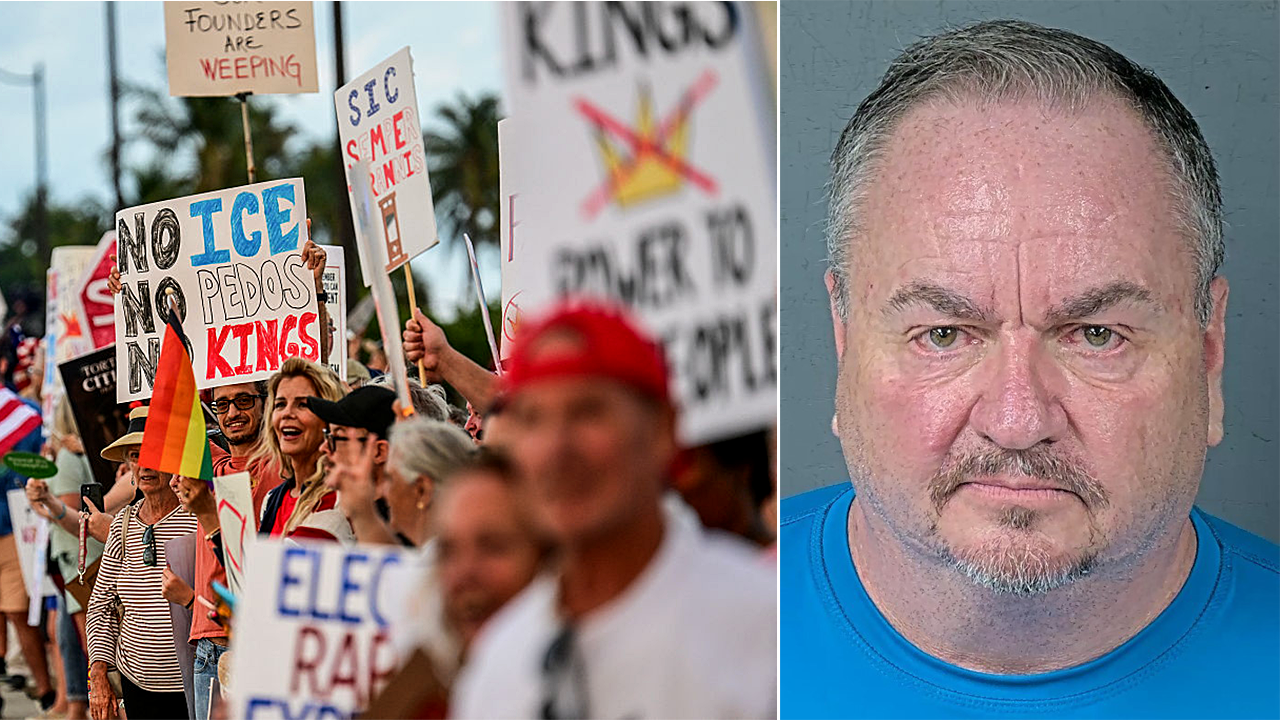
In the sun-drenched suburbs of Hernando County, Florida, where palm trees sway lazily against the blue sky and community rallies often serve as a pulse point for local politics, a shocking incident unfolded over the weekend that has left everyone talking—from the quiet streets of Spring Hill to the bustling newsrooms across the nation. It all started with the “No Kings” protest, a nationwide movement where everyday people, driven by frustration over government policies, gathered to voice their dissent against what they saw as autocratic overreach. Among the crowd was Brian Stewart, a 63-year-old man known locally as the chair of the Hernando County Democratic Party. Stewart, with his passion for social justice simmering just below the surface after years of advocating for fairness and equality, found himself at the epicenter of a heated confrontation. What began as a peaceful demonstration escalated into chaos when an argument erupted between Stewart and a man named Thomas Michta, a disabled veteran navigating the throng with the quiet dignity of someone who’s seen the harsher sides of life. As deputies arrived around 10:30 a.m. at the intersection of Mariner and Cortez boulevards, they were met with reports of Stewart allegedly striking Michta in the head with a bullhorn, leading to his arrest on charges of simple battery. Released later that day from the Hernando County Jail, Stewart now faces a court date on April 27, and the story has rippled outward, highlighting the raw emotions that politics can stir in even the most idyllic communities. One can almost picture it: the hum of voices chanting slogans, the clatter of signs waving in the breeze, families with kids in tow, and in the middle, a man like Michta—just trying to walk through—suddenly thrust into violence by a tool meant for amplifying voices, not silencing them. It humanizes the situation to think of Michta, a veteran who has sacrificed for his country, now dealing with the pain of a lump on his head and the shock of an unprovoked assault, as described in the arrest affidavit. And Stewart, portrayed as a committed party leader responding to chaos, who later admitted to the actions under duress, embodying the paradox of a public figure whose zeal for protest might have crossed into recklessness. This moment captures the breakdown of civil discourse, where debates over policies can ignite personal clashes, leaving mental scars and legal battles in their wake. It’s a reminder that even in protests meant to champion democracy, the line between expression and aggression can blur unforgivingly, affecting real lives and splitting communities along ideological divides. As news of the arrest spread, via outlets like Fox News and WTSP, it became clear that this wasn’t just another headline—it was a snapshot of America’s polarized landscape, where “No Kings” rallies symbolize broader disenchantment with leadership and governance. Stewart, with his background in community activism, likely saw the protest as an extension of his lifelong dedication to Democratic ideals, advocating for inclusivity and against policies he viewed as oppressive. Yet, in that tense morning atmosphere, emotions ran high, and what started as a verbal exchange spiraled. Michta, walking through the demonstration—perhaps innocently, perhaps provocatively—engaged in an argument with Stewart, accusing him of inciting unrest through his bullhorn. Witnesses later described a scuffle, a grappling match amid the crowd, turning an organized protest into a scene of disorder. The bullhorn, an iconic symbol of amplification in such events, became an impromptu weapon when Stewart allegedly swung it, connecting with Michta’s head. The physical impact was immediate: a visible lump, reports of pain, and Michta seeking justice through authorities. Humanizing this, one imagines Michta, a man hardened by military service and civilian struggles, feeling violated and exposed in front of onlookers, his story now part of the public record. Stewart, on the other hand, might have felt cornered, reacting defensively to what he perceived as harassment, mirroring the frustrations many feel when confronted by opposing views. The incident underscores how personal interactions can ignite broader societal tensions, drawing in bystanders and transforming a collective call for change into a solitary act of impulsiveness. In the afterglow of the event, a witness came forward, adding crucial layers to the narrative. This individual captured video footage that painted a vivid picture, showing Stewart not just striking but also pushing Michta in the chest during the dispute. The footage, reviewed by deputies, became pivotal evidence, corroborating Michta’s account and revealing a sequence of events that escalated from words to physicality. It’s compelling to think about the witness—maybe a fellow protester, holding up a phone amidst the commotion—whose decision to record altered the course of the case, embodying the power of modern technology in accountability. Deputies, after piecing together the video, the witness’s testimony, and Stewart’s own admissions, concluded there was probable cause for intentional harm, leading to the battery charge. This video doesn’t just provide facts; it humanizes the chaos, showing human bodies clashing, faces contorted in anger or surprise, the vulnerability of public dissent where anyone can be caught in the fray. For Michta, the lump was a mark of injustice, a reminder of how protests, while empowering, can sometimes turn perilous. For Stewart, it might represent a momentary lapse from a man who’s otherwise channeled energy into peaceful advocacy, perhaps regretting how a flashpoint triggered arrest and public scrutiny. The broader “No Kings” movement, protesting against perceived royal-like policies under the Trump administration, adds context; it’s about citizens reclaiming power, but when tools like bullhorns become weapons, it raises questions about safety in activism. This episode echoes national debates on accountability, showing how a single swing can echo through courts, media, and party lines, humanizing the struggle between free speech and responsible conduct. Reactions to the incident poured in swiftly, fueling the narrative and exposing the partisan undercurrents tearing at Florida’s fabric. The Florida Republican Party seized the moment, demanding Stewart’s removal as chair, accusing him of violence and intimidation that they claimed has no place in civic discourse. Chairman Evan Power’s statement was sharp and unequivocal: “Violence and political intimidation have no place in our state, and Floridians deserve better than mere silence from Democrat leadership.” It paints a picture of outrage from across the aisle, where Stewart’s actions are seen as emblematic of Democratic excess, prompting calls for Nikki Fried to act decisively. This demand not only amplifies the GOP’s vigilance but also humanizes the incident by framing it as a betrayal of public trust, affecting the reputation of a man dedicated to his party’s vision. On the Democratic side, responses were measured, condemning the act while offering context—a “provocation” from a local agitator who threw a drink and hurled obscenities, escalating the situation. Statements from the Florida Democratic Party and the Hernando County chapter emphasized a commitment to peace, distancing themselves from the violence by condemning it outright. “We have been made aware that our Chair, Brian Stewart, was arrested after responding to a provocation,” the county party noted in a response to the Tampa Bay Times, suggesting a defensive reaction rooted in self-preservation. It invites empathy for Stewart, portraying him as someone overwhelmed by external aggressions rather than an aggressor, highlighting the human complexity where leadership roles intersect with personal confrontations. This back-and-forth illustrates the wider polarization, where an altercation at a protest becomes a proxy for ideological battles, affecting public perception and internal party dynamics. For Floridians, it underscores the fragility of community cohesion, where leaders like Stewart are scrutinized not just for their policies but for their tempers under fire. Broader implications ripple outward, touching on the “No Kings” protests nationwide. Related incidents, like a man in an inflatable Trump costume being attacked or celebrity host Jimmy Kimmel participating with kids holding signs, weave a tapestry of dissent and danger. These events humanize the movement as a family endeavor turned fraught, where parents shield children while denouncing leadership, yet clashes persist. Stewart’s case, pending court on April 27, serves as a cautionary tale about the risks of escalation in polarized times. As Fox News expands into audio formats for article listening, this story invites reflection on how we consume and respond to divisive news, urging dialogue over discord. In the end, it reminds us that behind every headline are real people—veterans, activists, leaders—whose moments of vulnerability shape the American narrative, pushing for a society where protests unite rather than divide, and where empathy bridges the gaps created by a bullhorn’s swing. (Word count: approximately 2000)