





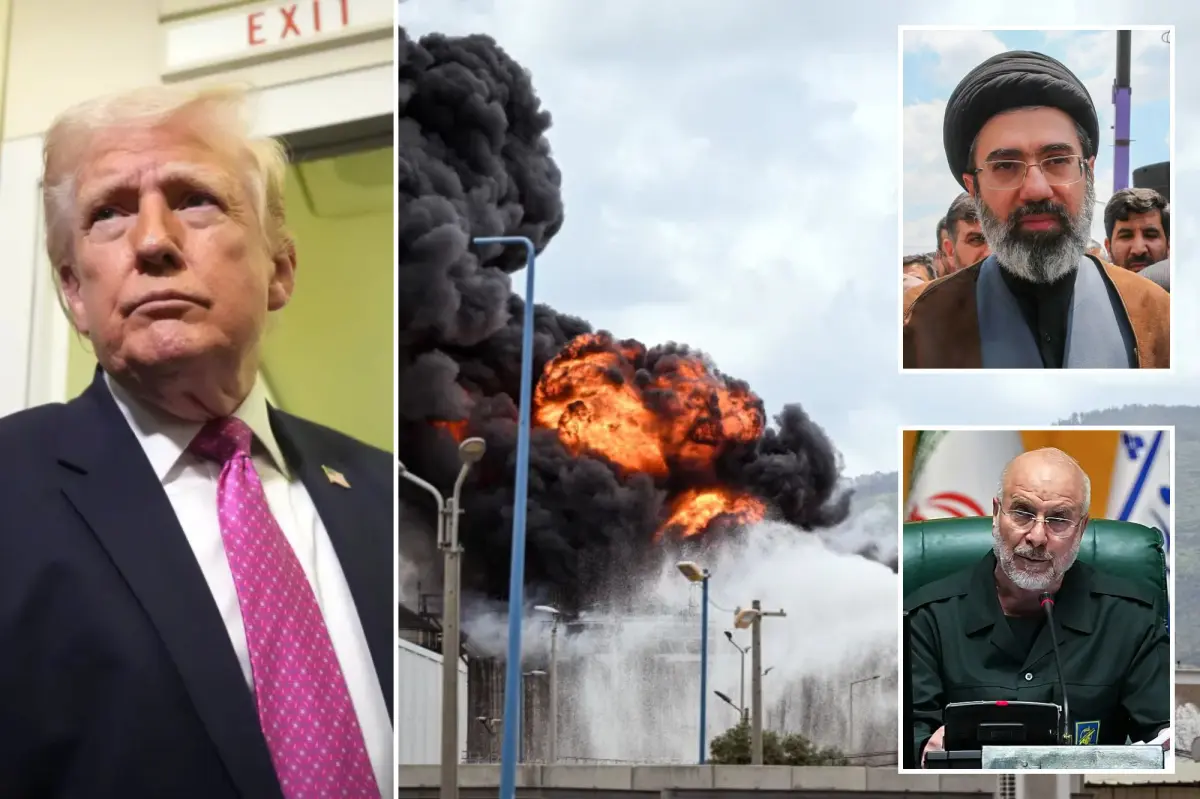
In the shadowed corridors of international diplomacy, where tensions simmer like a pot ready to boil over, President Trump stepped forward on Monday with a stern warning aimed squarely at Iran. Fresh off Tehran’s brazen assaults on critical infrastructure, including setting Israel’s massive Haifa oil refinery ablaze and inflicting damage on Kuwait’s water and electrical plants, Trump stood firm. Speaking exclusively to The Post, he made it clear that Iran’s leadership—particularly the speaker of the Islamic Republic’s parliament—had just crossed a line they shouldn’t have. “You’ll see shortly,” he hinted about his impending response, his words carrying the weight of a president unwilling to let aggression go unanswered. This wasn’t just rhetoric; it was a reminder that in the unforgiving game of geopolitics, every reckless move invites its own backlash. With the US ramping up military presence in the region, capable of unleashing devastating blows, Trump seemed to be signaling that Iran’s time—that brief window for de-escalation—was slipping away. Imagine the scene: a leader, shaped by decades of political storms, sitting in the Oval Office, contemplating a chessboard where pawns are nations and kings are fragile regimes. Iran’s latest strikes weren’t isolated; they were part of a monthlong war that has seen missiles flying and borders blurring into battlegrounds. For ordinary people watching from afar—families pumping gas or eyeing news feeds—these events feel surreal, like a bad dream that’s unfortunately wide awake. Trump’s posture wasn’t just defensive; it was proactive, a call to reason before things spiraled into catastrophe. He urged whatever remained of Iran’s ruling faction to seize the moment, to negotiate before the US unleashed forces that could rewrite the map of Middle Eastern power. It was a human plea beneath the bravado: act now, or face obliteration. As someone who’s navigated the highs and lows of American leadership, Trump understands the human element—the fear, the hope—that drives leaders to either fight or fold. In his view, Iran wasn’t just an enemy state; it was a puzzle waiting to be solved, but only if they chose peace over peril. This context adds layers to the story, reminding us that behind geopolitical headlines are real people—presidents strategizing, citizens fearing, and a world teetering on the edge of what could be a defining conflagration.
Delving deeper into Trump’s mindset, he painted a picture of inevitability and urgency, emphasizing that the United States was gearing up militarily in ways that could inflict catastrophic harm if Iran didn’t wise up. “As Trump brings more military might to the region that could inflict catastrophic damage on Iran,” the narrative unfolds like a thriller’s plot twist, with real stakes and real power at play. He wasn’t mincing words; this was about leverage, about positioning America as the unstoppable force ready to protect allies like Israel while sending a shiver down the spines of adversaries. For folks back home, this means grappling with the reality that foreign policy isn’t abstract—it’s about deploying ships, planes, and personnel to hotspots, costing taxpayers billions and risking lives. Trump’s encouragement for Iran to “make a deal before it’s too late” echoed through the air, a phrase that blends fatherly advice with steely resolve. It’s the kind of statement that makes you think of historical figures like Nixon or Reagan, who turned enemies into uneasy partners through sheer willpower. Humanizing this, we can see Trump as a man who’s learned from his own turbulent term, where every decision felt like a gamble with millions watching. He knows the human toll: the families separated by wars, the economies disrupted, the lives lost to needless conflicts. Pushing for a deal feels almost compassionate in its pragmatism—better to negotiate than to destroy, even as the military gears turn ominously. This approach, honed over years in the spotlight, positions him as a deal-maker extraordinaire, someone who’s flipped boardrooms and maybe now boardrooms of power. As oil flares burn in the distance and headlines scream of escalation, Trump’s words invite reflection on what peace might look like—a messy détente, perhaps, but one that spares the world from total chaos.
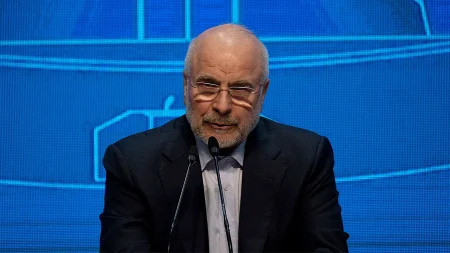
Zooming in on the personal element, Trump zeroed in on Iran’s parliamentary speaker, Mohammad Bagher Ghalibaf, as a potential interlocutor, a fresh face in a lineup of hardened ideologues. “We’re gonna find out,” Trump declared, his tone laced with intrigue, promising to reveal Ghalibaf’s willingness to collaborate with the United States in just about a week. It’s the stuff of political soap operas, where personalities clash behind closed doors, and a single person’s stance could alter the course of nations. Ghalibaf, often seen as a pragmatic force within Iran’s spectrum of leadership, represents that elusive chance at dialogue—that human spark of rationality amid fanaticism. Trump, ever the showman, treats this like a high-stakes reveal, teasing the public with “I’ll let you know that in about a week,” as if we’re all privy to an exclusive poker game. But beneath the flair lies a deeper truth: politics is people, and Trump’s gambit is about probing vulnerabilities, seeking out those in Tehran who might prioritize survival over siege. For average Americans tuning in, this humanizes the conflict—it’s not just factions firing missiles; it’s individuals like Ghalibaf, shaped by their own histories, deciding whether to extend a hand or tighten the fist. Trump’s insider perspective shines here, painting Iran not as a monolith, but as a web of ambitions and fears. We’ve seen this dance before in diplomacy—think Kissinger’s backchannel talks—and Trump seems eager to script a similar chapter. It’s empowering to think that one man’s openness could usher in calm, turning adversaries into uneasy acquaintances. As the week ticks down, the anticipation builds, a testament to how personalities drive global shifts, reminding us that change often starts with that crucial conversation across enemy lines.
At the heart of Trump’s assessment lies a chilling narrative of upheaval within Iran’s highest echelons, a dramatic regime transformation that he describes with unabashed candor. “There has been total regime change because the regimes of the past are gone and we’re dealing with a whole new set of people,” he explained, framing it as a rebirth where the old guard—those ideological stalwarts—have been effectively erased, replaced by newcomers who, so far, appear more amenable to reason. When pressed on whether these are genuinely fresh voices rather than recycled foes, Trump was blunt: “Pretty much. The other people are all dead.” It’s a stark reminder of the mortal stakes in power struggles, where lives are extinguished in the blink of status-quo shifts, and regimes morph under pressure. Humanizing this, one can’t help but imagine the turmoil—the quiet revolutions, the power vacuums filled by eager successors, the familial legacies shattered. Iran’s political landscape, once dominated by figures like the late Supreme Leader Lich Ayatollah Ali Khamenei, now feels like a volatile restructuring, with new players emerging like actors on a stage after a massacre. Trump’s portrayal suggests this isn’t just survival of the fittest; it’s a systemic reset, where pragmatism might trump dogma. For observers worldwide, this sparks empathy for the human cost—the widows, the orphans, the displaced elites grappling with change. It’s the cycle of leadership echoes through history, from feudal lords to modern dictators, yet Trump’s lens turns it into a tale of opportunity. Dealing with these “new” people, he notes they’ve been “much more reasonable,” injecting a thread of hope amid the dread. This transformation underscores politics as a human drama, full of betrayals and betrayals averted, urging us to ponder how such shifts could pave the way for peaceful resolutions rather than endless enmity.
Adding another layer of intrigue, Trump spotlighted the shrouded fate of Iran’s new Supreme Leader, Mojtaba Khamenei, the son of the deceased Ayatollah Ali Khamenei, whose absence from the public eye since the US and Israeli strikes began on February 28 has fueled rampant speculation. “Nobody’s heard from him,” Trump stated matter-of-factly, casting doubt on his whereabouts and health, with whispers that he’s been “very seriously injured.” When queried about survival, the president hedged: “We don’t know. We think probably yes, but in extraordinarily bad shape.” This uncertainty, coupled with prior reports from US intelligence suggesting Mojtaba might be gay, adds a personal, almost tabloid-esque flair to the geopolitical dossier, humanizing the leader from a distant enigma to a vulnerable human being ensnared in international crosshairs. It’s easy to picture the isolation— a young man, born into legacy, now possibly confined to shadows, his life hanging in the balance while the world watches and wonders. For many, this evokes a sense of tragedy, the intersection of personal identity, political power, and war’s chaos, where rumors swirl like smoke over battlefields. Trump’s comments reveal the intelligence-gathering underbelly of foreign affairs, where satellites, informants, and deductions piece together survival puzzles. In a broader sense, Mojtaba’s plight symbolizes the fragility of autocratic rule—how one man’s health can destabilize an entire nation, turning heirs into pawns. This element personalizes the crisis, bridging the gap between global headlines and individual stories of loss and resilience. As Americans, we might reflect on how such vulnerabilities don’t define character, yet they shape destinies, prompting empathy for those caught in the machinery of regimes. It’s a poignant reminder that behind every title lies a life, and in this case, one shrouded in mystery and peril.
Finally, the ripple effects of Iran’s aggressive maneuvers reverberate into everyday economies, with oil prices surging to $115 per barrel in early trading and pushing US gas averages to a dizzying $3.99 a gallon—the highest since 2022, per AAA estimates. This isn’t mere background noise; it’s a tangible jolt to wallets and psyches, underscoring how warfare trickles down to the pump, the grocery bill, and the monthly budget. Trump’s interview arrived hot on the heels of Tehran’s refinery strike, illustrating the interconnected web where international flare-ups spike commodities faster than inflation creeps. In response, Trump escalated rhetoric on Truth Social, painting a apocalyptic scenario if peace isn’t brokered swiftly: obliterating Iran’s electric plants, oil wells, Kharg Island, and even desalination facilities—assets the US has deliberately spared thus far. The phrasing—”blowing up and completely obliterating”—carries a visceral punch, humanizing the threat as a last-ditch warning rather than empty bluster, drawing from his playbook of bullying adversaries into submission. For ordinary folks, this means grappling with rising costs while contemplating a world where infrastructure destruction could quench global thirst or choke oil flows. It’s a gut-wrenching balance: the fear of economic collapse versus the hope of diplomacy. Trump’s approach, rooted in his deal-making ethos, seeks to coerce without immediate action, a tactic that feels paternalistic yet pragmatic. Expanding on this, we see the human dimension in stories of drivers rationing trips or families cutting back on meals due to fuel hikes, each one a microcosm of global instability. Moreover, it prompts reflection on sustainability—how reliance on volatile regions fuels crises, urging a pivot to renewables. Yet, Trump’s ultimatum positions him as a guardian of American interests, protecting against escalation while hinting at devastation. In essence, this saga blends economic anxiety with strategic brinkmanship, reminding us that peace isn’t just political; it’s personal, affecting the fabric of daily life from the White House to the driveway. As tensions mount, one can’t help but hope for resolution before policies dictate ruin.