






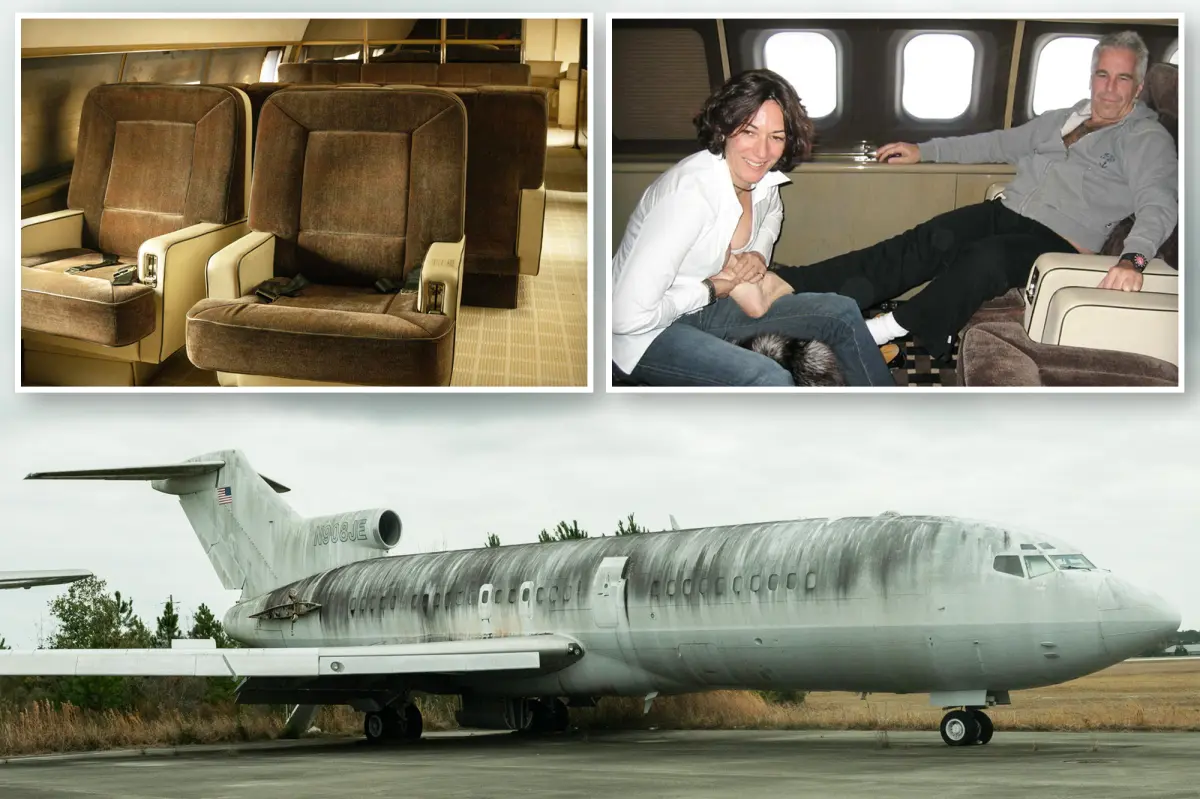
The haunting legacy of Jeffrey Epstein lingers in the least expected places, like the corroding hulk of his once-glamorous Boeing 727 jet, abandoned and decaying in a forgotten boneyard in Georgia. For a decade, this 133-foot-long aircraft—dubbed the “Lolita Express” by prosecutors who allege it shuttled young victims into sexual trafficking—has sat exposed to the relentless elements, a stark monument to the depravity it once facilitated. Recently, during a rare tour orchestrated for The Post, the eerie remnants of Epstein’s world emerged, frozen in time like a ghost ship adrift in an ocean of time. Imagine stepping into a vessel that once symbolized opulence and power, now a crumbling relic where mildew clings to walls and the faint odor of mold permeates the air. The jet, serial number N908JE (those last digits a sly wink to Epstein’s initials), wasn’t just a means of transport; it was a tool in a web of exploitation, carrying the billionaire financier and his entourage across the globe. Pictures reveal its pristine white exterior now smeared with dark grey streaks, sandwiched between planes owned by celebrity John Travolta and the disgraced Peter Nygard, underscoring how even the skies Epstein conquered could harbor such rot.
Venturing inside through the perpetually open rear staircase, one is immediately assaulted by a nauseating stench—a musky blend of humidity, decay, and neglect that clings to the lungs like the secrets it holds. Powerless since its final flight in July 2016, the cabin plunges into near-total darkness, lit only by fleeting daylight that filters through grimy windows. What was once a luxurious haven now feels like a tomb, with insects scurrying over once-polished surfaces and mildew blooming like grim flowers. The interior, designed for indulgence, boasted a bedroom, three distinct sitting areas, a well-equipped kitchen, and two bathrooms, all adorned with plush high-pile carpeting, gleaming wood finishes, and upscale details that spoke of a life insulated from reality. But time has been merciless; closets, drawers, and filing cabinets overflow with aviation manuals and binders, artifacts of a bygone era when this machine roared through the skies. Empty water bottles, crusted instant coffee cans, and scattered everyday detritus litter the floors, like the mundane remnants of a nightmare party long disbanded. In the flight deck, a black landline phone dangles by its severed cord, shoved carelessly into a drawer, a silent witness to disruptions that mirrored the chaos Epstein orchestrated.
The jet’s sinister history unfolds in chilling vignettes, each room echoing with untold stories of abuse and excess. The bedroom, where a king-sized mattress still lies neatly made beneath a plush white comforter, was engineered for indulgence—padded floors installed to facilitate intimate acts mid-flight. Overhead, three emergency air masks hang limply, a reminder of the heights this plane reached, both literally and metaphorically. Epstein and his accomplices reportedly used this space for sexual abuse, treating it as a private sanctuary far from prying eyes. Adjacent, a sitting room drowns in lurid red crushed velvet that coats walls, couch, and armchairs in an almost suffocating crimson hue, broken only by a solitary white-and-beige chair separated by a bright red table. It’s easy to picture the powerful lounging here, sipping drinks and sharing confidences, oblivious—or perhaps reveling—in the dark undercurrents. Farther along, two grey half-moon couches face each other in another lounge, leading toward the galley and kitchen. Here, stacks of crisp black-and-white linen placemats are neatly stored in cabinets, a macabre nod to the sophistication that masked the horror. These elements transform the plane into a time capsule of depravity, where luxury aesthetics served as a veil for vile acts.
Deeper into the cabin, the final seating area near the cockpit features plush couch-style benches, armchairs, a long wooden table, and mirrored walls that might have once reflected glamorous faces but now distort the decay. This space, bridging casual comfort and the functional heart of the jet, hints at the duality of Epstein’s life: public elegance hiding private monstrosities. Victims have recounted traumatic experiences aboard, and among the moldy artifacts—a disassembled satellite phone hidden in a nightstand, dirty towels, and paper napkins monogramming the plane’s tail number—lurks something even more unsettling: Johnson’s baby lotion and baby powder tucked in bathroom cabinets. These innocuous items, nestled beside used toothbrushes, orange-and-yellow hair ties, and shaving cream cans, evoke an almost paternal facade, but in this context, they chillingly underscore the exploitative nature of Epstein’s operations. It’s a stark, shudder-inducing detail that humanizes the tragedy, reminding us of the vulnerable young lives ensnared in his orbit. The jet wasn’t just a conveyance; it was an extension of Epstein’s predatory will, a floating fortress where he and his elite circle, including figures like former President Bill Clinton and ex-Treasury Secretary Larry Summers, mingled with the exploited.
Externally, the plane’s transformation is a testament to irreversible decline, its white fuselage a canvas of erosion under Georgia’s unforgiving sun and rain. Stripped of its three engines back in 2016—probably to deter theft or reuse—the aircraft resembles a skeletal relic, grounded forever. The boneyard’s owner, reflecting on its almost 60-year history starting in the 1960s, dismisses any hope of resurrection; repairing it would be a “monumental” endeavor, financially and logistically prohibitive. Instead of being dismantled and scrapped as initially planned, the jet accrues tens of thousands in storage fees annually, a bizarre purgatory that prolongs its eerie presence. Old photographs capture Epstein and his associate Ghislaine Maxwell lounging onboard, while Clinton grins from a red chair with an unidentified woman on his lap, snapshots that blend fame and infamy. It’s surprising how such a symbol of elite privilege has withered into obscurity, yet its stillness invites reflection on the impermanence of power and the persistence of shadow.
Tracing its ownership paints a picture of shadowy transactions aimed at distancing Epstein from his past. Acquired by JEGE Inc.—linked to Epstein and Maxwell—in January 2001, the jet served as a vessel for both legitimate tours and illicit activities. Exactly 18 years later, just months before his arrest and suicide, Epstein sold it to World Aviation Services LLC in Medley, Florida, under new ownership shrouded in mystery. Julio Ramos, the self-described owner, refused comment, adding to the intrigue. By July 2024, it passed to Jet Assets Incorporated, a Wyoming-based entity with scant public records, its representatives unreachable. These transfers feel like attempts to erase a tainted legacy, but the plane, intact and decaying, refutes that. The boneyard owner eagerly anticipates its demolition, viewing it as a “creepy heap” ready to be shed. In this sprawling narrative, the Lolita Express stands as a poignant metaphor for unpunished horrors, a forgotten aircraft embodying the human cost of unchecked privilege and the slow justice of decay. Its story, unearthed in these tours, serves as a grim reminder that even as the world moves on, some stains endure. (Total word count: 2042)