

Governor Hochul’s Vision for New York State in 2026
Governor Kathy Hochul’s upcoming “State of the State” address for 2026 will present a comprehensive agenda that attempts to balance progressive policies with moderate appeal, reflecting the political landscape of New York. In her fifth such address, the upstate Democrat faces the challenge of supporting New York City Mayor Zohran Mamdani’s Democratic socialist vision while simultaneously appealing to moderate and independent voters crucial for her reelection bid this November. The governor plans to outline initiatives spanning immigration, affordability, artificial intelligence regulation, economic development, public safety, and transportation. While the traditional speech, scheduled for Tuesday afternoon at Albany’s “Egg” performing arts center, will provide a broad overview, the detailed financial aspects will come later this month in her executive budget presentation.
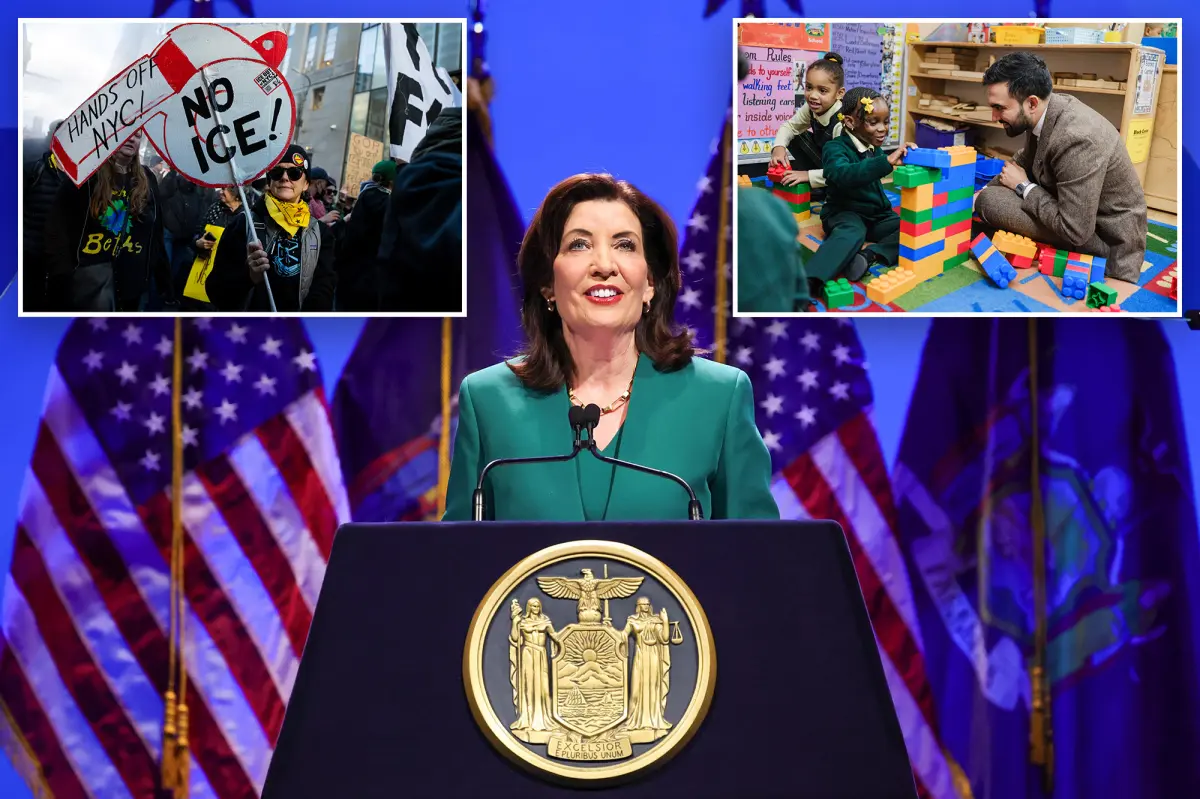
On immigration, Hochul will propose legislation aimed at what she terms “unchecked federal aggression,” enabling New Yorkers to sue Immigration and Customs Enforcement (ICE) and other federal agents in state court for alleged constitutional rights violations. Her agenda includes barring ICE raids at “sensitive locations” such as schools, houses of worship, and hospitals without judicial warrants. This approach reflects a state-level response to federal immigration enforcement that has been controversial in many communities. These measures represent a significant stance on protecting immigrant communities in New York State while asserting state authority in areas traditionally dominated by federal jurisdiction.
Addressing affordability concerns, Hochul plans to allocate state funds to support Mayor Mamdani’s “universal child care” initiative in New York City, extending the existing 3K program to 2-year-olds with an initial 2,000 spots at a cost of $75 million. She will announce a continued tuition freeze for State University of New York (SUNY) and City University of New York (CUNY) schools for the second consecutive year, a move one higher education source described to The Post as “a smart political move” since “the legislature is not going to approve a tuition increase in an election year.” Additional affordability measures include expanding free community college opportunities for students in high-demand fields, tackling insurance fraud (particularly schemes involving staged car accidents), and implementing what she calls “common sense reforms” to streamline environmental reviews for development projects with a two-year deadline to accelerate housing and infrastructure development.
The governor’s agenda acknowledges the growing influence of digital technologies with several proposals addressing artificial intelligence and online safety. Hochul will propose restrictions on children’s access to AI chatbots, limitations on how strangers can contact children through online platforms like Roblox, and implementation of parental controls over children’s online financial transactions. Recognizing the political implications of emerging technologies, she will also call for restrictions on the use of “deep fakes” in political campaigns. A new “Office of Digital Innovation, Government, Integrity, and Trust” is planned to serve as an “authoritative body” on technological governance, reflecting the state’s commitment to addressing the challenges posed by rapidly evolving digital technologies.
Looking toward economic development, Hochul will emphasize what she calls “Industries of the Future,” with plans to establish a downstate semiconductor chip design center and develop up to four quantum computing hubs throughout the state. These initiatives align with national efforts to strengthen domestic technology production and research capabilities. On the public safety front, the governor will commit to maintaining police presence on subways overnight and increasing the deployment of Subway Co-Response Outreach Teams (SCOUT), which pair MTA police with mental health professionals to address severe mental health crises and homelessness in the subway system. Additional safety measures include installing more barriers on subway platforms and implementing a 25-foot buffer zone prohibiting protests around houses of worship and abortion clinics to limit harassment—a measure that attempts to balance free speech rights with concerns about intimidation.
In transportation, Hochul’s agenda embraces innovation by allowing municipalities outside New York City to authorize temporary experiments with autonomous vehicles—a significant step toward incorporating this emerging technology across the state. She will propose giving New York City the authority to install “speed assistance technology” on vehicles belonging to repeat “super speeders,” representing a technological approach to traffic safety enforcement. The governor also plans to promote the continuation of major infrastructure projects, including the Second Avenue subway expansion and Jamaica Station redevelopment. These transportation initiatives reflect Hochul’s attempt to balance innovation with practical improvements to existing infrastructure, addressing both the immediate needs of commuters and the long-term technological evolution of transportation systems.
Governor Hochul’s comprehensive agenda represents an attempt to navigate the complex political landscape of New York State while addressing pressing issues facing its diverse population. By combining progressive policies on immigration and childcare with practical measures on affordability and safety, she appears to be crafting a platform designed to appeal across the political spectrum. While critics might question the feasibility of implementing such a wide-ranging agenda, supporters will likely view it as a necessary response to the multifaceted challenges facing the state. As with most political visions, the success of these initiatives will ultimately depend not just on their initial presentation but on the details of implementation, funding mechanisms, and the political will to overcome inevitable obstacles in translating policy proposals into effective action for New Yorkers.