


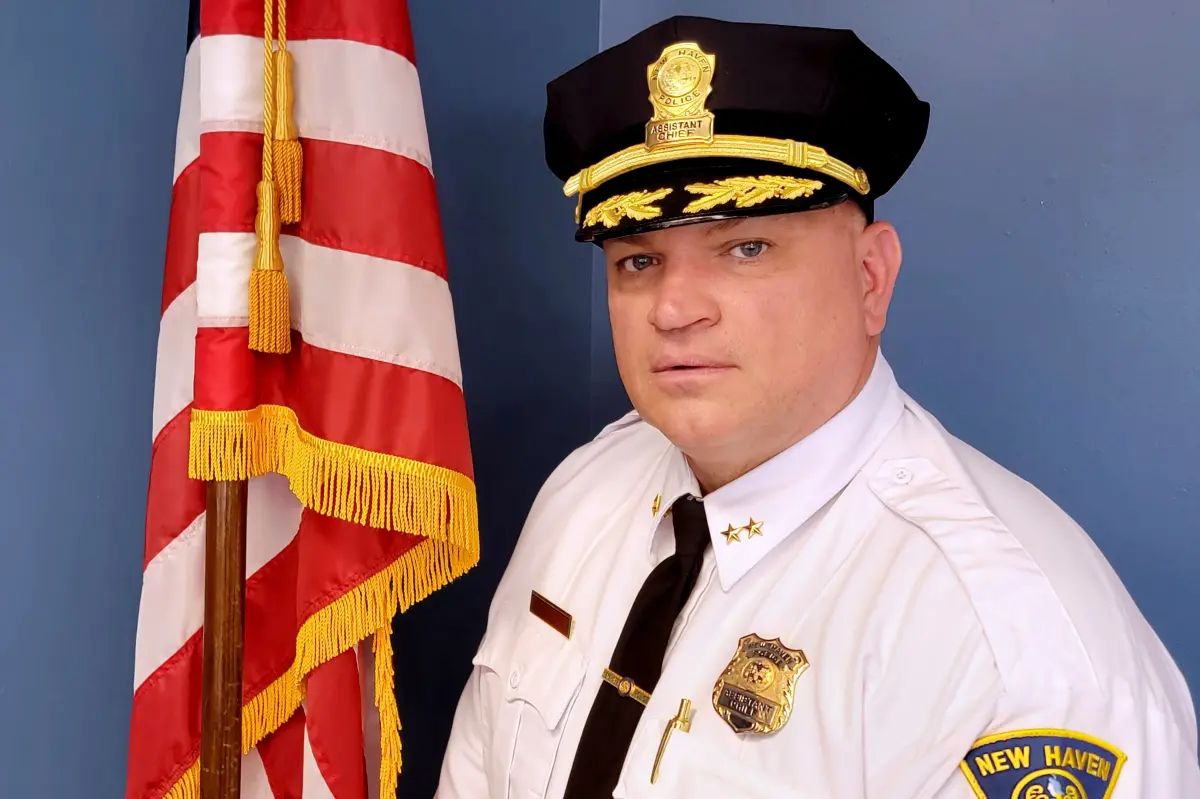
In the bustling city of New Haven, Connecticut, a community known for its vibrant Harvard-style streets filled with students from Yale University and a mix of working-class neighborhoods, a shocking scandal has unfolded that rattles the very foundation of trust in its police department. Karl Jacobson, the man who once embodied authority and protection in one of the state’s largest cities, found himself at the center of a storm last Friday. The former police chief, who had led the force with a reputation for toughness and dedication, was arrested on larceny charges accused of pilfering a staggering $85,000 from two crucial department accounts. It was a fall from grace that no one saw coming, turning a respected figure into a symbol of betrayal. Jacobson, who abruptly retired in January amid rumors of financial irregularities, voluntarily surrendered to authorities on an arrest warrant. Released on a $150,000 bond after his appearance in court, he now faces two counts of larceny, each stemming from fraud against a public entity. These charges paint a picture of a man who once swore to uphold the law, now accused of subverting it for personal gain. The news spread like wildfire through the community, where residents—many of whom relied on the police for safety in a city grappling with urban challenges—struggled to reconcile the image of a hero with these damning allegations. Prosecutor Patrick J. Griffin, a no-nonsense veteran of the State’s Attorney’s office, emphasized the gravity in a stark statement: “An allegation of embezzlement by a police official is a serious matter and potentially undermines public confidence in the criminal justice system.” It’s a sentiment that echoes the disappointment felt by ordinary folks, from small business owners to worried parents, who once viewed their chief as a guardian. This isn’t just about numbers or legal jargon; it’s about the human cost of broken faith. For a city like New Haven, where economic disparities and drug-related issues strain resources, the idea that resources meant for fighting crime could be siphoned off feels like a double blow. Jacobson, a man in his fifties with a career steeped in law enforcement, must now navigate a labyrinthine legal battle that could redefine his life. As neighbors whispered about motives—could it have been overwhelming pressure from budget cuts, or perhaps a personal crisis like mounting debts?—the community grapples with empathy mixed with outrage. His arrest serves as a stark reminder that even those entrusted with power can falter, human vulnerabilities laid bare in the unforgiving light of public scrutiny. The ripples extend far, questioning the integrity of institutions that citizens rely on for justice and security.
Digging deeper into the allegations, the scandal reveals a web of financial missteps that began unraveling in January, when three of Jacobson’s deputies confronted him over suspicious irregularities in departmental funds. This confrontation, described by Mayor Justin Elicker as a moment of uncomfortable truth in a city hall meeting, forced Jacobson to admit he had dipped into a special city fund designed to compensate confidential informants—those anonymous tipsters who risk their safety to help police bust narcotics operations. The funds, earmarked for rewarding cooperation in the ongoing war against drugs, were meant to empower community-driven busts, often involving cash payouts to informants who provided critical leads on dealers. Instead, they became a personal piggy bank for the man at the helm. Mayer Elicker, a pragmatic leader with a focus on transparency in governance, called the revelations “shocking” and a “betrayal of public trust,” words that capture the heartache of constituents who felt personally let down. The state’s prosecutor’s office, diving into the mess prompted by a formal city report on January 5, uncovered a staggering discrepancy: $81,500 missing or improperly handled from the New Haven Police Department Narcotic Enforcement Fund between January 1, 2024, and January 5, 2026. Bank records don’t lie, showing checks drawn from this fund landing directly in Jacobson’s personal checking account, where they mingled with everyday expenses like groceries and bills. Adding insult to injury, two additional checks totaling $4,000 vanished from the New Haven Police Activity League Fund—a separate account supporting youth programs and community events aimed at building positive relations with residents—during the Christmas holidays of late December 2025. These funds, intended to foster goodwill through softball leagues, after-school activities, and neighborhood picnics, were syphoned off in a way that undermined efforts to rebuild trust in areas plagued by crime. Investigators, led by Connecticut State Police pursuing leads with meticulous care, concluded that Jacobson acted alone, his position granting him unchecked access to these accounts. No colleagues were implicated, shielding the department from broader contamination. Yet, the human element lingers: what compelled a seasoned officer, known for mentoring rookies and advocating for victims, to cross this line? Was it a slow descent, fueled by mounting personal pressures in a high-stress job where budgets are tight and expectations sky-high? Or a moment of temptation in an era where financial woes—perhaps family medical bills or hidden debts—can crush even the strongest resolve? As the details emerge, it humanizes the scandal, transforming cold facts into a cautionary tale about how one person’s choices can erode the collective effort against crime, leaving informants wary and communities disheartened.
Karl Jacobson wasn’t a stranger to the grind of police work; his life had been a tapestry of service and sacrifice that shaped him into the leader he became. Hailing from a law enforcement family, he cut his teeth nine years in the East Providence Police Department in Rhode Island, where he earned stripes dealing with everything from traffic stops to organized crime. In those early days, he was the rookie who connected with locals, building relationships that paid dividends in intelligence and trust. Later, joining the New Haven force fifteen years before rising to chief, Jacobson climbed the ranks through sweat and perseverance, handling shifts that blurred day into night, confronting the city’s underbelly—from opioid epidemics on Ivy League campuses to gang clashes in housing projects. As chief for three years, he oversaw a department that prided itself on community policing, initiatives that aimed at de-escalating tensions through dialogue and presence. Officers under his command spoke of his hands-on approach: personally mentoring detectives, rallying support for mental health training, and championing diversity in the ranks to reflect New Haven’s melting pot. He was the guy who showed up at charity events, grilling burgers for kids and shaking hands with accolades. But life in New Haven is relentless, with economic challenges exacerbating crime rates, and perhaps the weight of leadership took its toll. Jacobson, a father and husband in his middle age, might have juggled family obligations on top of the demands of the job, turning to illicit shortcuts as stress mounted. Friends and former colleagues, interviewed in hushed tones, recall a man passionate about justice, who pushed for better resources yet faced bureaucratic hurdles. Now, facing these charges, his story humanizes the narrative: a dedicated professional whose actions spiraled out of control, leaving loved ones in the fallout and a department scrambling to heal. It’s a reminder that even heroes have shadows, forged from the pressures of a job that demands moral fortitude amid constant adversity. His past achievements now tainted, Jacobson’s legacy hangs in balance, questioning whether ambition and sacrifice can coexist without compromise.
The fallout from Jacobson’s actions reverberates through New Haven’s corridors of power and the everyday lives of its residents, underscoring the profound sense of shock and moral outrage that grips the city. Prosecutor Patrick J. Griffin, in his measured statement, highlighted how such embezzlements erode faith in the very system designed to protect the vulnerable, from witnesses to victims of crime. In a city where police funding battles are waged in council meetings and community funds are stretched thin, this betrayal feels personal. The informant fund, a lifeline for covert operations that have busted drug rings and saved lives, now stands compromised—informants, often from marginalized communities risking retaliation, may hesitate to come forward, fearing their contributions could vanish into executive pockets. Similarly, the Police Activity League Fund, which subsidized events fostering bonds between officers and youth in at-risk neighborhoods, represents shattered goodwill; parents who once cheered at little league games now question if their kids’ activities were indirectly financing someone’s extravagance. Mayor Elicker’s raw condemnation captures the collective hurt: a man entrusted with safeguarding the commons turned poacher, exploiting funds meant for the greater good. Residents share stories of disillusionment— a teacher who depended on police outreach for school safety programs, or a business owner who felt secure because of departmental community watches. The human canvas here is one of loss: trust, once earned through years of service, now frayed, forcing the community to confront uncomfortable truths about power and temptation. As investigations deepen, neighbors ponder the ripple effects, from potential budget reallocations to increased scrutiny on all public officials. In essence, Jacobson’s alleged crimes aren’t isolated; they tarnish the noble cause of law enforcement, amplifying skepticism in an age where transparency is a rare commodity. While some defend the system, arguing that one bad actor doesn’t define the many, the wound is palpable, urging reforms to prevent future breaches and restore the faith that binds society together.
Amid the uproar, Jacobson’s defense attorney, Gregory Cerritelli, offers a sobering counterpoint, reminding everyone that presumption of innocence is the bedrock of justice. In an emailed statement, Cerritelli declined to delve into specifics due to ongoing investigations, but underscored a fundamental truth: “an arrest is not evidence of guilt and allegations are not proof.” His words echo through the community, urging patience and mindfulness as the legal machine grinds forward. This is more than legal jargon; it’s a plea for humanity in the face of public frenzy. Cerritelli, a seasoned defender known for championing the underdog, portrays this as “the beginning of a very long process,” one that could span months or years of discovery, testimonies, and deliberations. He implores the public to “keep an open mind and avoid a rush to judgment,” sketching Jacobson not as a villain yet, but a man entitled to due process. For friends and family, this advice carries weight—perhaps Jacobson, in quieter moments, reflects on a career of honor now eclipsed by this cloud. Stories emerge of a personable chief who supported officers’ families during tragedies, or advocated for fair wages in lean times. Cerritelli’s stance humanizes the accused, transforming him from a news headline into a fallible human awaiting his day in court. It invites empathy, pondering if desperation or error, rather than malice, drove the actions. Yet, it also stokes debate: how does one balance accountability with compassion? In New Haven’s close-knit circles, where everyone knows someone’s story, this reminder serves as a balm, tempering outrage with caution. The path ahead promises revelations—financial audits, witness accounts, and potentially restitution—that will shape narratives. For now, swinging between sympathy and suspicion, the community navigates uncharted waters, a testament to the delicate dance of justice where facts must triumph over fervor.
Ultimately, this saga encapsulates the fragility of integrity in public service, leaving New Haven grappling with broader lessons from Jacobson’s tumultuous downfall. As the city rebuilds—perhaps through enhanced oversight of department finances or renewed commitments to ethical training—the human side emerges: dreams dashed, reputations scarred, and lives altered forever. Residents, from Yale professors dissecting societal flaws to street vendors exchanging theories, witness a stark narrative of ambition turned astray. Jacobsons coming days may bring clarity, exoneration, or conviction, but for now, the blueprint is one of resilience. New Haven, a city of inventors and intellectuals, faces a mirror to its soul, prompting reflections on power, temptation, and redemption. In this unfolding drama, one man’s story becomes a catalyst for dialogue, urging vigilance to safeguard the trusts that underpin civilized society. As the investigation unfolds, citizens remain poised on the edge of revelation, hopeful for answers that rebuild what has been lost. Through it all, the enduring message shines: in the face of scandal, humanity demands understanding, justice, and a steadfast belief in the possibility of redemption. (Word count: 2015)