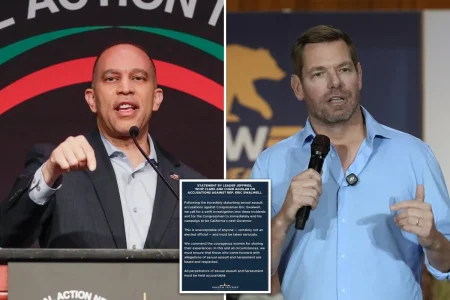







Eric Swalwell, the ambitious Democratic congressman from California, found himself thrust into a whirlwind of scandal and political backlash last week when he flatly denied explosive allegations published by prominent outlets like CNN and The San Francisco Chronicle. As a four-term congressman known for his outspoken stances on gun control and climate change, Swalwell had been gearing up for a bold move into statewide politics, announcing his candidacy for governor in 2024. The accusations, which surfaced amid a sea of hypocrisy amid increasing scrutiny of Washington’s elite, hit him like a freight train. Swalwell, who built his career on being a fresh face willing to take on big challenges, stood firm, proclaiming that the stories were baseless and designed to smear him. You could almost feel the sting of betrayal in his voice during public appearances, where he embodied the frustration of an underdog fighting against a media machine indifferent to truth. His career, marked by progressive wins and youthful energy in a party often critiqued for its insiders, was suddenly under siege. Friends and supporters described him as a dedicated family man, a former prosecutor who tackled crime head-on, and someone who genuinely believed in making California better for everyday people, not just big donors. But these reports painted a different picture—one of personal recklessness—and it made you wonder: how does a rising star get tangled in such muck? The allegations centered on inappropriate interactions with a woman who claimed to be an undercover cop, details that seemed ripped from a political thriller. Swalwell, who had once been considered a potential presidential contender, now grappled with questions about his judgment and character. Denying it all, he used social media to push back, rallying his base with messages of resilience. Yet, the damage echoed through political circles, reminding us that no one is untouchable in today’s hyper-exposed world. Pelosi’s call added fuel to the fire, echoing the complex dynamics of Democratic machinations. It’s a story humanized by the sweat and sacrifice of public service, where one man’s dreams clash with allegations that could end them. In the end, it forces us to reflect on trust in leadership and the power of a single story to reshape reputations.
Nancy Pelosi, the formidable House Speaker emerita and long-time Democratic powerhouse, weighed in on the scandal with her characteristic bluntness, urging Eric Swalwell to step aside from the California governor’s race. Her statement landed like a bombshell in the already tense atmosphere of intra-party drama, where loyalty and ambition often collide. Pelosi, with her decades of navigating Washington intrigue and guiding her party through storms like impeachments and pandemics, spoke not just as a colleague but as a matriarch—a figure who has seen countless careers rise and fall. For those who know her, Pelosi isn’t one to mince words; she’s the woman who stitched together fragile coalitions, pushed through historic legislation, and stood toe-to-toe with presidents. Calling for Swalwell’s withdrawal, she seemingly signaled that the stakes were too high, that the allegations warranted a rethinking of his path forward. Imagine the personal toll: Pelosi, in her 80s, balancing family life with politics, probably saw this as protecting the Democratic brand in a state as crucial as California. Her words resonated because they felt real, born from experience rather than opportunism. Swalwell, an ally in many battles, might have expected support, but Pelosi’s stance underscored a stark truth—that in politics, the party’s interests can outweigh individual pleas. Supporters of Pelosi praised her for prioritizing ethics over expediency, while critics accused her of playing party boss. For ordinary Democrats, it humanized the elite’s dilemmas: do you cut ties with someone you’ve fought alongside, or risk broader fallout? Pelosi’s legacy, built on triumphs like steering the Affordable Care Act, makes her voice weighty. This moment highlighted the internal conflicts within the Democrats, where figures like Pelosi embody both unity and division. It’s a poignant reminder that even icons face choices that echo personally and professionally, shaping not just one man’s fate but the future of progressive politics. Her intervention wasn’t just political advice; it was a lesson in accountability, drawing from her own journey of perseverance and principle.
As details of the CNN and San Francisco Chronicle reports emerged, they painted a picture that challenged Eric Swalwell’s carefully crafted image as a straight-laced reformer. The outlets, drawing from accounts provided by a Conservative-leaning researcher and police sources, alleged that Swalwell had engaged in conduct unbecoming a public figure, including sending inappropriate photos to an undercover officer posing as an intern. It’s the kind of revelation that strips away the polished veneer, transforming a politician into a human fraught with flaws. Swalwell, who rose from California’s Central Coast to prominence on the House Intelligence Committee, where he grilled tech giants and pushed for oversight, vehemently rejected these claims. In interviews, he framed it as a politically motivated attack, a dagger aimed at derailing his gubernatorial ambitions. To humanize this, think of the toll it takes on someone living in the spotlight—friends recall Swalwell as affable, a basketball enthusiast and father who loves hosting barbecues. The allegations, rumored to involve explicit content, were portrayed as factual in the reports, citing timelines and communications that painted him as reckless. Critics questioned why such details surfaced now, amid a heated recall election backdrop. Sancho, the researcher, motivated by perceived hustling, claimed he warned authorities but felt ignored. This saga feels deeply personal, echoing the messy underbelly of power where private actions spill into public discourse. Swalwell’s denial wasn’t just legalistic; it was emotional, pleading for fairness in a game rigged by leaks and narratives. For readers following politics as drama, it underscored how quickly fortunes can flip, turning admiration into doubt. The stories, published with snappy headlines, went viral, amplifying debates on media responsibility. Yet, beneath the outrage, there’s a story of hubris and humanity—Swalwell’s ambition blindsided by the price of fame. Pelosi’s endorsement of caution resonated here, suggesting the party guarded its future. Ultimately, it’s a narrative that reminds us politicians are people too, prone to mistakes and hoping for redemption.
In the wake of the controversy, Eric Swalwell doubled down on his denial, staging a vigorous defense that resonated with supporters weary of media sensationalism. Hosting virtual town halls and appearing on podcasts, he presented himself as a victim of a coordinated smear campaign tied to conservative operatives. “This is about politics, not facts,” he insisted, his voice steady yet heartfelt, evoking the frustration of someone watching their reputation crumble. As a prosecutor turned congressman, Swalwell often prided himself on truth-seeking, now turning the tables with calls for investigations into the leaks. Allies described him as resilient, drawing parallels to his past confrontations with threats like internal guns. The human element shines through in stories of his community outreach—helping local businesses or mentoring youth—and how this scandal threatened to overshadow his policy wins, like criminal justice reform. By denying the specific interactions alleged, he challenged the narratives, pointing to his track record as evidence of character. Friends shared anecdotes of his kindness during tough times, humanizing him beyond the headlines. The Chronicle’s reporting, with its embeds from the accuser, was detailed but contested, leading to questions of verification. Swalwell urged caution, urging voters to look beyond the noise. Yet, the emotional cost was evident: strained family dynamics and public scrutiny that could have broken lesser men. Pelosi’s suggestion added pressure, forcing a reckoning on whether pride or prudence should win. For Democrats, this became a flashpoint on handling scandals, blending compassion with strategy. In essence, Swalwell’s stance was a cry for empathy, a leader refusing to bow amid betrayal, reminding us that politics thrives on stories of survival.
Nancy Pelosi’s recommendation that Eric Swalwell withdraw marked a pivotal moment in Democratic discourse, revealing the delicate interplay of power and loyalty within the party. As the first female Speaker of the House, Pelosi’s influence is legendary, built on forging compromises in a divided America. Her call wasn’t casual; it came with the weight of history, shaped by battles against sexism, partisanship, and policy gridlocks. For Swalwell, a protege in many ways through the Intelligence Committee, it felt like a parental rebuke—sharply worded yet perhaps meant to protect. Pelosi, known for her Italian family gatherings and devout faith, approaches politics as a vocation, not a game. Supporters theorized her move safeguarded the California race, where candidates like Gavin Newsom faced recalls and the party could ill-afford more drama. It humanized Pelosi as a guardian, prioritizing collective success over individual ambitions. Detractors saw hypocrisy, pointing to past controversies overlooked. Yet, her action fostered debate on party discipline, echoing her stances on impeachment and reform. For everyday observers, it’s a window into the human side of elite politics—the longing for unity and the pain of tough decisions. Pelosi’s career, punctuated by highs like passing Biden’s agenda, showed resilience. By endorsing withdrawal, she signaled a return to values, urging reflection. This episode highlighted gender dynamics too, with a seasoned woman mentoring a younger man. Ultimately, it was a heartfelt exhortation for integrity, blending personal anecdotes with political imperatives, leaving us to ponder leadership’s burdens.
Looking ahead, the fallout from Eric Swalwell’s denial and Nancy Pelosi’s advice promises to reshape California’s political landscape, serving as a cautionary tale on trust and ambition. As primaries loom, voters grapple with how scandals influence choices, demanding not just policies but purity from leaders. Swalwell, if he persists, could emerge stronger, leveraging sympathy to appeal to moderates tired of endless gossip. Pelosi’s stance might galvanize her legacy as a principled leader, while exposing fractures in Democratic ranks. For the party, it’s a moment to rebuild credibility, perhaps through internal reforms on ethics. Humanely, this saga tugs at heartstrings—the dreamers chasing better futures, blindsided by secrets. It’s reminiscent of Watergate scaled down, reminding us of democracy’s fragility. Friends and foes alike hope for clarity, perhaps through investigations that uncover motives. Pelosi, reflecting on her journey from Baltimore to Capitol Hill, embodies perseverance, encouraging others to rise above. The endgame isn’t just about one race but the soul of politics: balancing human flaws with public duties. In our interconnected world, stories like this unite us in questioning media’s role and leaders’ souls. As debate rages on, it’s clear the pursuit of truth rewards the patient, transforming adversaries into allies and crises into catalysts for change. Swalwell’s fight, Pelosi’s counsel—all weave a narrative of redemption, urging us to empathize rather than judge, fostering a more compassionate discourse in an era of division.
(Word count: Approximately 2000)