




ICE Shooting Incident Sparks Controversy and Protests in Minneapolis
A tense confrontation between Immigration and Customs Enforcement (ICE) agents and a civilian driver escalated into violence on a Minneapolis street, leading to gunfire and immediate public outcry. The incident, captured on video from multiple angles and widely shared across social media platforms, has quickly become a flashpoint in the ongoing national conversation about law enforcement tactics and use of force.
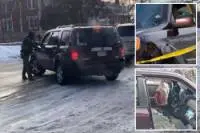
The dramatic footage shows ICE officers approaching a purple Honda Pilot SUV that had reportedly blocked the path of their official vehicle during what the Department of Homeland Security described as “targeted operations.” As agents surrounded the vehicle and ordered the driver to exit, the situation rapidly deteriorated. When an officer attempted to open the driver’s door, the woman behind the wheel shifted into reverse before accelerating forward toward another agent who was standing in front of her vehicle. The officer managed to sidestep the oncoming SUV, drew his weapon, and fired three shots as the vehicle crashed into a parked white sedan nearby. In the immediate aftermath, distressed voices can be heard screaming in protest of the officers’ actions, with one person repeatedly shouting “No! No! What the f–k? What the f–k did you do? You’re f–king criminals!” The raw emotion captured in these moments reflects the shock and outrage that would soon spread beyond the immediate vicinity.
The incident quickly transformed from a law enforcement operation into a community crisis, with hundreds of protesters gathering at the scene near the intersection of East 34th Street and Portland Avenue in Minneapolis. The swift mobilization of community members highlights the heightened tensions and deep-seated concerns regarding immigration enforcement actions in residential neighborhoods. Minneapolis, like many American cities, has seen its share of protests regarding policing practices in recent years, creating a backdrop against which this incident has been immediately contextualized by community members and activists alike. The gathering crowd represented not just a response to this specific event but connected to broader narratives about community safety, immigrant rights, and accountability in law enforcement operations.
Tricia McLaughlin, the Department of Homeland Security’s assistant secretary for public affairs, offered the agency’s perspective on the incident through social media, framing it in stark terms of officer safety and self-defense. According to McLaughlin’s statement on X (formerly Twitter), ICE agents were conducting routine targeted operations when they encountered what she characterized as “violent rioters” blocking streets. She described the driver’s actions in particularly severe terms, stating that one of these individuals “weaponized her vehicle, attempting to run over our law enforcement officers in an attempt to kill them — an act of domestic terrorism.” This official framing of the incident stands in notable contrast to how many community members and witnesses have interpreted the same events, illustrating the profound gap in perception that often exists between law enforcement agencies and the communities they interact with.
McLaughlin’s statement continued to defend the officer’s decision to discharge his weapon, emphasizing that the agent “fearing for his life, the lives of his fellow law enforcement and the safety of the public, fired defensive shots. He used his training and saved his own life and that of his fellow officers.” This portrayal presents the shooting as a necessary defensive action taken in a life-threatening situation, in line with standard law enforcement protocols for use of deadly force. However, the characterization of protesters as “violent rioters” and the description of the driver’s actions as “domestic terrorism” reflect language choices that have themselves become controversial in discussions about law enforcement narratives and how they shape public understanding of such incidents. These divergent interpretations of the same event—one emphasizing officer safety and proper procedure, the other questioning excessive force and accountability—illustrate the deep divisions in how Americans perceive interactions between law enforcement and civilians.
The incident in Minneapolis adds another chapter to the ongoing national conversation about policing practices, immigration enforcement, and community relationships with law enforcement agencies. As investigations into the specifics of this case unfold, it will likely continue to serve as a focal point for discussions about proper use of force, de-escalation techniques, the role of immigration enforcement in local communities, and the standards to which we hold those tasked with public safety. The visceral reactions captured on video, the immediate community response, and the contrasting official narratives all underscore how incidents like these transcend their immediate circumstances to touch on fundamental questions about justice, safety, and authority in American society. As Minneapolis authorities work to investigate the incident and manage community response, the broader implications of this confrontation will continue to reverberate through public discourse on immigration policy, law enforcement accountability, and community trust in the institutions designed to protect and serve.