





Stranded Between Borders: The Plight of Displaced Palestinians in Egypt
Gaza Families Separated by Conflict Face Uncertain Future as Border Remains Closed
In the bustling streets of Cairo, 9-year-old Islam Al Farany carries both visible and invisible burdens. His prosthetic limb and emotional scars tell only part of a story that has unfolded against the backdrop of one of the region’s most intractable conflicts. Islam is among tens of thousands of Palestinians currently stranded in Egypt, unable to return to Gaza despite a recent ceasefire agreement that promised to reopen crucial border crossings.
“Every day I wait to see my brothers and sisters,” Islam says quietly, his eyes reflecting a maturity beyond his years. Two years ago, his life changed dramatically when an Israeli strike hit his relative’s home, causing injuries that eventually led to his evacuation to the United States for medical treatment. Islam and his mother, Tahrir, traveled through Egypt to access specialized care, including being fitted with a prosthetic limb. What was intended as a temporary medical journey has evolved into an extended separation from their family—one that has been complicated by tragedy and geopolitical stalemate.
A Family Divided by War and Closed Borders
The Al Farany family’s story illustrates the human cost of border policies that have left Palestinian families fractured across boundaries. While Islam and his mother were abroad seeking medical treatment, tragedy struck again—Islam’s father was killed in another strike in Gaza. Now, Tahrir’s six other children remain in Gaza, creating a painful separation that has lasted nearly a year.
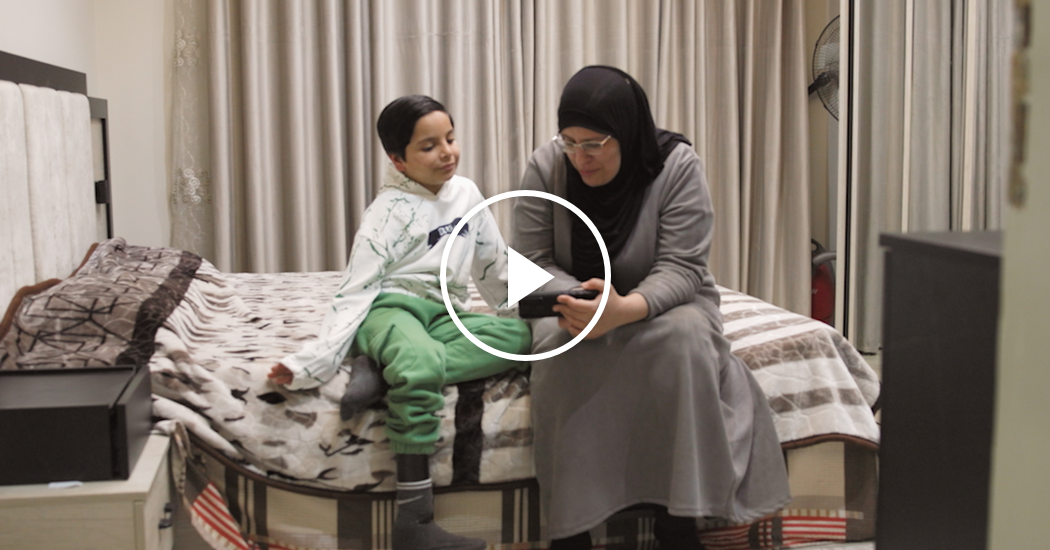
“We speak through video calls when the internet works,” explains Tahrir, describing how her children must visit a local barbershop in Gaza that offers more reliable connectivity. The screen becomes both a lifeline and a painful reminder of their separation. The physical toll of conflict extends beyond Islam—five of his six siblings were also injured in the same strike that necessitated his evacuation. Eight-year-old Ahmed suffered broken hips, while six-year-old Aya lost sight in one eye. Seventeen-year-old Mohamed, the oldest sibling, has assumed increased responsibility for his younger brothers and sisters in their parents’ absence.
“We were supposed to be reunited by now,” Tahrir explains, her voice tinged with frustration. The Al Faranys are caught in a diplomatic impasse that exemplifies the broader humanitarian challenges facing displaced Palestinians. The Rafah border crossing—the only entry point from Egypt into Gaza—has remained mostly closed since Israeli forces seized control of it in May 2024. Although Israel agreed to reopen the crossing as part of the recent truce agreement, officials have since added conditions, stating that Palestinians can return only after Hamas surrenders all remains of captives held in Gaza.
The Complex Reality of Palestinian Displacement in Egypt
For the estimated 30,000 Palestinians currently in Egypt, daily life has become an exercise in uncertainty. Many arrived shortly after the Hamas-led attack on Israel on October 7, 2023, expecting their stay to be temporary. However, as the conflict intensified and border restrictions tightened, what was meant to be a brief refuge has extended indefinitely.
Egyptian authorities have maintained a complex position on Palestinian refugees. While providing initial shelter, Egypt has implemented policies that discourage permanent settlement, citing concerns that accommodating large numbers of Palestinians could lead to their permanent displacement from their homeland—a politically sensitive issue throughout the region. This approach has created a challenging legal limbo for Palestinians in Egypt, whose temporary visas have now expired. Without official legal status, they cannot legally work, purchase property, or enroll their children in Egyptian schools.
“We exist but we don’t exist,” says Haneen Farhat, who fled Gaza over a year ago. Farhat represents the resilience and adaptability that characterizes many displaced Palestinians. Beginning with small food sales from her home kitchen to make ends meet, she has since organized Gazan cooking classes that have gained popularity among both locals and tourists. While this informal business provides some income, it operates in a gray area—technically unauthorized yet tolerated. “I’m building something new while waiting to return to what’s left of my old life,” she explains, capturing the conflicted emotions many refugees experience.
Adaptation and Resilience Amid Ongoing Uncertainty
As weeks of displacement have turned into months and now years for some, Palestinians in Egypt are developing coping mechanisms that balance their desire to return to Gaza with the practical necessities of survival. Community networks have formed, creating informal support systems that help navigate the complexities of life without official status. Social media groups share information about which hospitals might provide care without documentation or which landlords might rent apartments without requiring legal residency.
The humanitarian situation has drawn attention from international organizations, though assistance remains limited compared to the scale of need. Several non-governmental organizations provide medical support, educational programs for children, and legal advice—all crucial services for a population officially invisible to the state system. These efforts, while valuable, cannot fully address the fundamental challenges of statelessness and displacement.
“We’re caught between impossible choices,” explains Dr. Mahmoud Khalil, a Palestinian physician who has been volunteering his services to fellow refugees. “People cannot build lives here legally, yet returning to Gaza means facing danger and destruction. Many homes no longer exist.” This reality has pushed some Palestinians to consider migration to third countries, though such pathways remain limited and often inaccessible without official documentation or financial resources.
The Psychological Toll of Prolonged Separation
Beyond the practical challenges of daily survival, the psychological impact of displacement and family separation has created a less visible but equally serious crisis. Mental health professionals working with the refugee community report high rates of depression, anxiety, and post-traumatic stress disorder, particularly among children who have witnessed violence and experienced sudden upheaval.
For Islam Al Farany, the physical injuries have been accompanied by emotional wounds that his mother says manifest in nightmares and periods of withdrawal. “He asks about his siblings every day, especially his father,” Tahrir explains. “How do you explain to a child that while doctors fixed his body, we cannot fix the broken family?” This question resonates throughout the Palestinian community in Egypt, where many children are processing similar traumas without adequate mental health support.
The uncertainty about when—or if—families will be reunited compounds these psychological challenges. “Living in limbo is its own form of trauma,” notes Dr. Samira Hassan, a psychologist who volunteers with refugee communities. “Without being able to plan for the future or process the past, many Palestinians exist in a perpetual present defined by waiting.” This state of suspension affects everything from educational opportunities for children to adults’ ability to make basic decisions about employment or housing.
International Implications and the Path Forward
The situation of Palestinians in Egypt represents a microcosm of larger geopolitical dynamics shaping the future of Gaza and its people. The closure of the Rafah crossing has become a contentious issue in ceasefire negotiations, with humanitarian organizations consistently calling for its reopening to allow not only family reunifications but also the passage of essential supplies into Gaza.
“Border crossings aren’t just physical structures—they’re lifelines for an entire population,” explains Ibrahim Khader, an analyst with the Palestinian Rights Coalition. “Using them as bargaining chips in negotiations ignores their fundamental humanitarian purpose.” The international community’s response has been mixed, with diplomatic statements often failing to translate into concrete pressure to resolve the border impasse.
For families like the Al Faranys, these high-level diplomatic discussions have direct implications for their daily lives and future prospects. While Islam receives occasional medical follow-up for his prosthetic limb, his siblings in Gaza face ongoing challenges accessing basic healthcare. Their story exemplifies how political decisions about borders create ripple effects through generations, potentially altering life trajectories in ways that will extend far beyond the current conflict.
As Islam practices walking with his prosthetic leg in a small Cairo apartment, his mother’s phone buzzes with another video call—a momentary digital bridge across closed borders. On the screen, his siblings crowd together at the barbershop with its reliable internet connection, eager for a few precious minutes of connection. “Inshallah, we will be together soon,” Tahrir tells them, a prayer that echoes among thousands of separated Palestinian families waiting for borders to open and policies to change. Until then, they remain suspended between places—physically present in Egypt but with hearts firmly anchored to Gaza, caught in a humanitarian limbo that has no clear resolution in sight.