





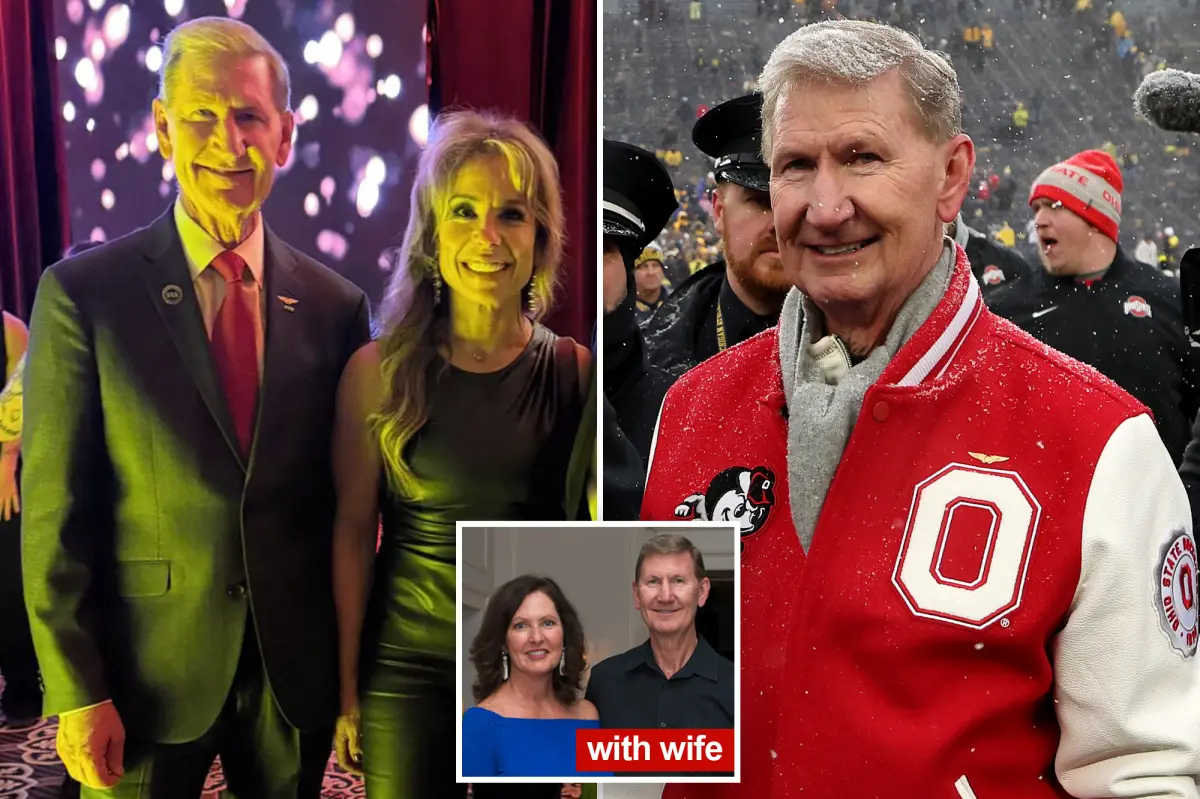
Ted Carter had always been the embodiment of ambition and achievement—a Top Gun pilot with nearly four decades in the Navy, graduating from the US Naval Academy in 1981 and soaring through the ranks to become President of Ohio State University. At 66, married to Lynda for nearly 45 years, he was seen as a pillar of stability, commanding a $1.5 million-a-year salary and wielding immense influence in Ohio’s public landscape. But beneath that polished exterior, whispers of a personal storm began brewing, one that would unravel his legacy in a way few could have predicted. It started with allegations of an “inappropriate relationship” with Krisanthe Vlachos, a Columbus-based podcast host whose show, “The Callout Podcast,” focused on veterans’ stories. Carter, the self-professed “frequent flyer” on her productions, confessed to granting her undue access to Ohio State’s leadership for help with her business ventures. This wasn’t just a momentary lapse; it was a web of engagements that painted a picture of favoritism and closeness far beyond professional bounds. His resignation, announced abruptly on a Monday, sent shockwaves through the university community and beyond. People wondered how a man of such stature could jeopardize it all for what appeared to be a misguided connection. Was it the thrill of the spotlight on a humble podcast? Or something deeper, a craving for validation in a life already replete with accolades? As details emerged, it became clear that Carter’s world had intersected with Vlachos’s in ways that blurred lines—public appearances, event sponsorships, and social media posts that hinted at a bond growing increasingly personal. He hadn’t publicly addressed the specifics of his departure beyond acknowledging the departure with his wife, but the accusations loomed large, prompting reflections on how even the most powerful can falter under the weight of human desires and poor judgment. In Ohio, a state proud of its institutions, this scandal felt like a betrayal, a reminder that no one is immune to the complexities of relationships, especially when power dynamics and personal loyalties collide.
Diving deeper into Carter’s involvement, one could almost imagine him as a regular guest turning up at Vlachos’s unpretentious studio, the thrill of storytelling drawing him back time and again despite the podcast’s modest reach. The “Callout Podcast” was far from a national sensation—episodes garnered just a few hundred views each, a stark contrast to Carter’s high-profile role. Yet, he appeared in nine of her 14 videos so far in 2025, his presence lending an air of credibility to a show that was essentially Vlachos’s passion project. By his own admission during a January 7 episode, he joked about being a “veteran of the veterans” on her platform, the casual banter masking a deeper involvement that went beyond mere promotion. Vlachos, with her warm introductions, often gushed over him, referring to him as a gracious supporter and co-host. In that clip, her compliment flowed effortlessly: “President Carter, you have quite the history and you’ve been so gracious to come and support and co-host more than a couple of podcasts, but your story is always fun and interesting. Would you mind telling it again?” Carter, grinning in response, praised her for assembling an “all-star cast,” raving about fellow guests like JobsOhio CEO JP Nauseef and others with military backgrounds. It was moments like these that humanized him—a man recounting his life story repeatedly, perhaps for the company as much as the audience. The podcast, with its focus on veterans, tapped into Carter’s own heritage as a military man, but beneath the camaraderie lay implications of something more covert. Social media painted a fuller picture: posts showing him traveling to events, not just as a participant but as a co-sponsor, blurring the boundaries between his official duties and personal interests.
One particularly striking vignette was the juxtaposition of their on-screen and off-screen interactions, revealing a warmth that felt almost intimate. During the podcast filming, Carter sat opposite Vlachos, exchanging laughs and professional nods, a standard dynamic for such collaborations. Yet, just days later, a photo surfaced from the Student Veterans of America 2026 national conference in Colorado Springs, showing them side by side, his smile wide and genuine. Vlachos, dressed in striking all-black leather, captioned it affectionately: “my dear friend and mentor.” This wasn’t a fleeting handshake; it was documented proof of a connection that extended beyond microphone wires. In interviews or casual conversations, one might picture Carter as a mentor figure, drawn perhaps by Vlachos’s energy and the shared world of veterans’ advocacy. She, in turn, seemed to revel in his support, promoting their mutual endorsements on her profiles. But reading between the lines, there was an undercurrent of exclusivity—Carter granting “inappropriate access” suggested favors that favored her business. Imagine the scene: a powerful university president pulling strings for a podcast host, attending her events not out of obligation, but perhaps out of genuine affection or a sense of loyalty. It humanized his fall—a story of trust misplaced, of personal bonds overshadowing institutional boundaries. People in positions like his often surround themselves with sycophants, but here, the relationship dynamic felt reciprocal, with Vlachos’s posts highlighting their co-sponsorships and event attendances. Voss, his resignation sparked debates about consent, boundaries, and the human element of temptation, reminding us that even leaders are prone to emotional entanglements that can undo years of hard-earned respect.
Their partnership extended into the realm of real-world events, turning professional ties into tangible collaborations that raised eyebrows. In January 2025, Vlachos’s podcast co-sponsored a poignant performance called “Last Out: Elegy of a Green Beret” at Ohio State, featuring veterans and military families. This wasn’t just charitable; it involved partnerships with heavyweights like JobsOhio, AEP, and the university itself—directly tied to Carter’s sphere. Then, flipping the script, Carter essentially repaid the favor months later by leveraging Ohio State’s sponsorship for Vlachos’s “Gaff-N-Go Rodeo” in Richmond, Virginia. This rodeo-style event aimed to connect military veterans with power linemen, and a video of Carter at the opening ceremony showed him speaking passionately about the “special intersection between Veterans and Power Linemen.” His words, “Walter ‘Ted’ Carter,” carried a sense of endorsement that went beyond logistics. Traveling for these events, one can envision Carter boarding planes, perhaps feeling a spark of excitement in supporting someone he viewed as more than an acquaintance. These weren’t anonymous sponsors; they were hands-on participations, with Carter’s attendance at the rodeo adding to the narrative of a deepening rapport. Vlachos, in her social media chronicles, highlighted these moments, painting a picture of camaraderie. Yet, beneath the surface, the scandal insinuated that this mutual support was tainted by impropriety, possibly influencing decisions at the highest levels. It’s a human tale of reciprocity—two individuals from vastly different worlds finding common ground in purpose, only for it to spiral into controversy, leaving onlookers to ponder if the events were genuine outreach or veiled vehicles for personal indulgences.
Publicly, the fallout underscored the podcast’s humble scale, amplifying the irony of Carter’s gamble. With viewership in the low hundreds per episode, “The Callout” was no viral sensation—it was a labor of love for Vlachos, focusing on veterans’ narratives amid a crowded media landscape. Yet, Carter’s frequent appearances lent it unwarranted prestige, drawing in an audience through his name alone. Imagine the frustration of creators in similar niches, watching a powerhouse like him elevate a modest show, only for it to backfire spectacularly. JobsOhio, a key sponsor tied to both, issued a measured statement on the day of his resignation: “JobsOhio is aware Ted Carter resigned this morning as President of The Ohio State University and that this situation is possibly connected to a relationship between him and the host of a podcast for veterans, which we sponsored.” This acknowledgment linked the dots, suggesting the relationship was more than coincidental. Carter, opting for brevity, confided in his wife as he departed, leaving the specifics shrouded. No responses from Vlachos or him have emerged publicly, leaving room for speculation. In the court of public opinion, this was a cautionary tale about the perils of mingling personal and professional spheres—how a seemingly harmless podcast could catalyze a scandal impacting a major institution. People empathized with the human side: Carter’s long marriage, his military service, versus the lure of a new connection. It humanized the story, turning a high-stakes resignation into a reflection on vulnerability, where even those at the top can chase fleeting engagements with devastating consequences.
Ultimately, this episode in Ted Carter’s life serves as a poignant reminder of the fragility of reputations and the unpredictable nature of human relationships. The allegations painted Vlachos not merely as a host, but as a central figure in his downfall, their “inappropriate” bond exposing cracks in his carefully constructed facade. From cozy photos to mutual endorsements, their story unfolded like a drama, complete with travel, sponsorships, and heartfelt exchanges. Yet, the podcast’s meager success highlighted a stark disparity—was Carter so enamored that he overlooked the professionalism required of his position? His resignation, coupled with somber farewells, left Ohio State reeling, questioning how such a deviation from duty went unnoticed. For veterans and advocates like those on Vlachos’s show, it shifted focus from their stories to the controversy, perhaps stealing attention from meaningful discussions. Carter’s silence and Vlachos’s alike only fueled the intrigue, as friends, colleagues, and strangers pieced together the narrative. In human terms, it’s a story of ambition colliding with intimacy—a navy pilot turned administrator chasing connections that cost him everything. Reflections abound: on mentorship gone awry, on the thrill of collaboration masking hidden agendas, and on the toll such revelations take on families and lifetimes of service. As the dust settles, it invites empathy for all involved, including Lynda Carter, enduring privately, and Vlachos, whose passion project became entangled in notoriety. This isn’t just news; it’s a testament to how personal choices, no matter how well-intentioned, can ripple outward, transforming lives in ways both profound and irreversible.