




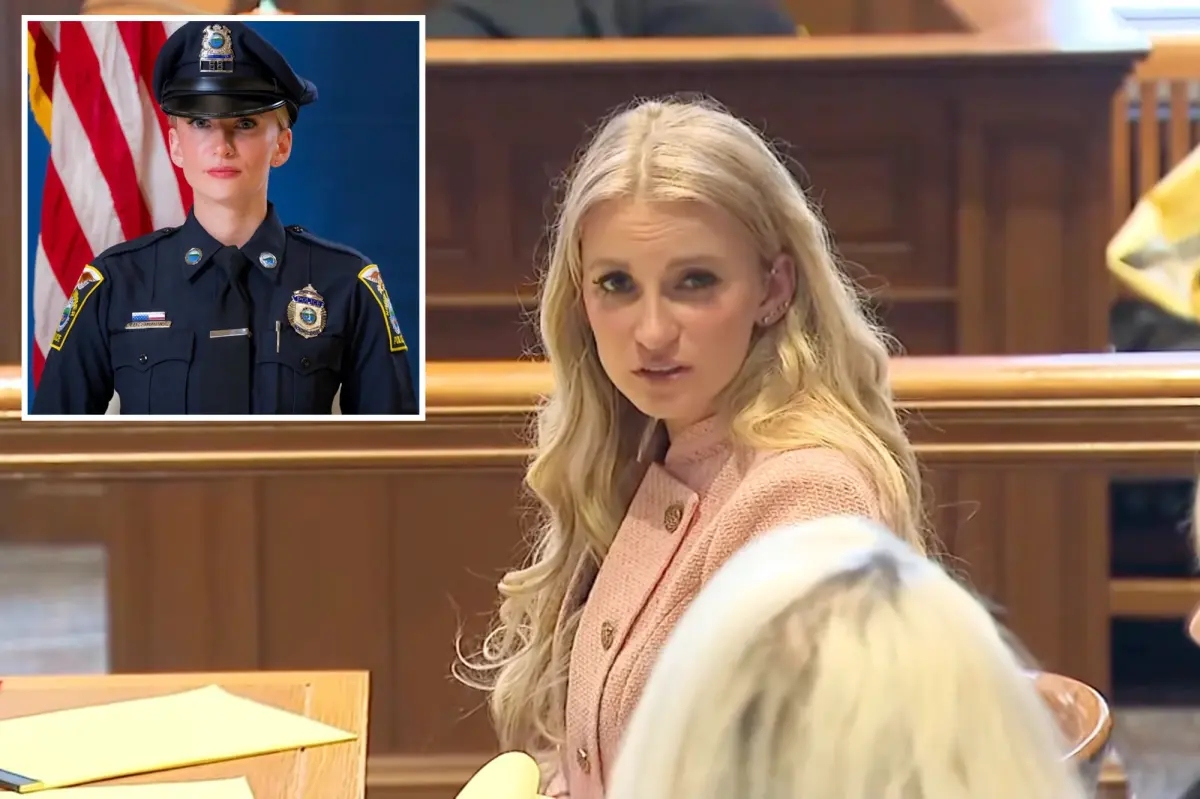
Kelsey Fitzsimmons sat in the courtroom, her eyes steady as Judge Jeffrey Karp delivered his verdict. On this chilly afternoon in Lawrence, Massachusetts, the disgraced police officer was found not guilty of assaulting a fellow officer with a dangerous weapon—a stunning acquittal after weeks of emotional turmoil that had shattered her life. As the judge explained that both sides had presented credible accounts of the chaotic June 30, 2025, incident, Kelsey barely flinched, though inside she must have felt a flood of relief amidst the exhaustion. Now 29, Kelsey faced a potential five-year sentence if convicted, but instead, she would only have to reckon with the quieter consequences: the life she’d nearly lost, the job she might regain, and the pieces of her family she was fighting to rebuild. Her fiancé, Justin Aylaian, had served her with a restraining order that day, a move that separated her from their four-month-old son and their dog, leaving her heartbroken and desperate. The path to this courtroom began with that desperate act, where Kelsey, drowning in postpartum depression just four months after giving birth, believed her world was crumbling. In those raw moments, suicide seemed like the only escape from the despair. Judge Karp, opting for a bench trial rather than a jury, listened intently over three days to testimonies that painted a picture of a woman at rock bottom, a cop whose uniform hid deep personal wounds. No punishments were handed down immediately, but as Kelsey left the courthouse, she carried the weight of what could have been, wondering how she’d ever heal from the self-inflicted wounds—both physical, from the gunshot, and emotional, from the betrayal and loss. The judge’s decision wasn’t just about law; it was a recognition that her story of suffering held equal truth to the officer’s account of a threat. For Kelsey, this not guilty felt like a fragile lifeline in a sea of hardship, a chance to confront not just the charges, but the mental health battle that nearly claimed her. Yet, as she walked out, surrounded by reporters and whispers, she knew the real reckoning was just beginning: rebuilding trust with her son, dog, and perhaps even the force she once swore to protect. This verdict didn’t erase the tearful breakdowns or the nights spent staring at hospital ceilings; it simply offered a pause, a breath in the storm. Kelsey’s father had once told her police work suited her spirit, but now, with a punctured lung and scars from surgeries, she wondered who she was without the badge. The courtroom drama had played out like a script from a true-crime podcast, but for Kelsey, it was her reality—a life derailed by love gone wrong and a mind overwhelmed by motherhood’s unseen tolls. Judge Karp’s words lingered: both accounts credible. It gave her hope that maybe, just maybe, society might listen to stories of female officers breaking under pressure, not just label them as threats.
When Kelsey took the stand on Wednesday, her voice trembled but held steady, a mirror of the inner strength she’d mustered just hours before the incident. She described the moment her world imploded in a mere 15-second conversation with her coworkers at the door of her North Andover home. Her fiancé, Justin, had broken up with her via that restraining order, their wedding just months away. In an instant, she realized she’d lose custody of their newborn son, their beloved dog, and even her home—how could she afford it alone? Worse, she feared the job she’d devoted her life to, as a dedicated officer, would slip away too, branded by whatever accusations led to this order. Tears streamed as she recounted the despair that gripped her, a postpartum depression that had been brewing since the birth, turning her joy into a suffocating fog. “I wanted to be alone with my firearm and take my life,” she testified, her words echoing in the hushed room. The baby’s cries, the dog’s absence, the fiancé’s coldness—it all compounded into a darkness so deep she saw no way out. So, she devised a plan to get the officers out, to shield them from witnessing her final act, avoiding the burden of another life on their consciences. Kelsey painted herself not as a villain aiming to harm, but as a mother and officer unraveling, her service weapon meant for protection turning into a tool of tragic self-destruction. The courtroom, filled with seasoned lawyers and glazed spectators, seemed to soften around her vulnerability. Prosecutors questioned her timeline, her motive, but Kelsey’s story unfolded like a confession, raw and unfiltered, inviting empathy from those who’ve glimpsed mental illness’s grip. She wasn’t a hardened criminal, she insisted; she was a woman on the edge, influenced by hormones and heartbreak. As witnesses came after her, her testimony set the tone—a plea for understanding in a system quick to judge. Officer Patrick Noonan, her fellow cop, would contradict her later, but in Kelsey’s eyes, he interrupted her solitude, forcing a confrontation that ended in gunfire. The prosecutors called her actions calculated, but she framed them as impulsive grief. Listening to her, one couldn’t help but imagine the quiet desperation of a young mother, cradling her baby one night and contemplating ending it all the next. Her story humanized the statistics of officer suicides, reminding everyone that police suffer too, behind the badge.
The heart of the conflict lay in those frenetic moments in her bedroom, where accounts diverged like shadows in low light. Kelsey insisted she never pointed the gun at Officer Noonan; instead, she’d grabbed it with intent to end her life, positioning herself away from the door to avoid involving the intruders. The three officers—Patrick and two others—had arrived to enforce the restraining order, delivering devastating news that stripped her of her child and pet, effectively dismantling her reality. Fearful of harming innocents, she urged them to leave, hoping they’d step back into the warmth of the doorway while she dealt with her pain. But Patrick Noonan painted a grimmer picture: as Kelsey packed essentials for her son’s care, she lunged behind the bedroom door, retrieved her weapon, and then faced him directly. He described emergency room thrills— a sharp “click” as the gun failed to fire initially, followed by her “tap racking” twice to chamber a round, her movements precise and purposeful. Alarmed, Patrick fired two rounds, hitting her in the lung and forcing her collapse. She was airlifted to Mass General, enduring over 50 days of recovery and five surgeries, her body a testament to the violence that night. Kelsey’s defense argued her postpartum haze clouded her actions, making suicide her sole focus, not assault. The prosecutors dissected every detail, emphasizing the loaded chamber evidence—a bullet tumbling into a black box when the gun was cleared—suggesting premeditation. Justin Aylaian, her fiancé, testified he feared for their son’s safety, pushing for the order amid worries about her instability. In this clash of narratives, Kelsey emerged as both victim and agent of her fate, a woman whose maternal love clashed with crushing despair. The courtroom buzzed with empathy and doubt; was this a failed ploy or genuine crisis? Patrick’s account sounded like a cop’s worst nightmare, Kelsey’s like a parent’s silent scream. Words like “lunged” and “aimed” clashed with her pleas of solitude. Humanizing this, one sees not just a legal standoff, but two colleagues—one protecting and the other imploding—entwined in a tragedy neither asked for. Patrick’s shots echoed self-defense; Kelsey’s intent whispered mercy. In retelling, it’s a reminder that split-second decisions can change lives forever, and mental health crises don’t discriminate by uniform.
During closing arguments, Prosecutor James Gubitose gripped Kelsey’s unloaded gun dramatically, aiming it at the front of the courtroom and pulling the trigger to mimic that fateful “click.” He accused her of deception, pointing to the round that fell from the chamber when officers emptied it—proof, he claimed, that she’d loaded the weapon, tap-racked it as described by Officer Noonan, and intended harm. Kesey’s story crumbled under scrutiny, he argued; her motive was clear: revenge against the cop who delivered the order, or at least to create a scene. Justin’s fears for their son amplified the prosecution’s case, framing Kelsey as unstable and dangerous. But the defense saw flaws, noting inconsistencies in Patrick’s timeline—why the hesitation to act if the threat was immediate? Attorney Timothy Bradl wielded Patrick’s testimony as a sloppy script from a “Rambo” flick, full of dramatic flair but lacking logic. He questioned why Kelsey would kill a friend she’d bonded with on emergency calls—someone with a wife and child of his own. “She had no motive,” Bradl said, mocking the story as a smokescreen to justify shooting an unarmed woman mid-suicide. Kelsey’s postpartum struggle added depth; experts might call it a call for help drowned out by gunfire. In this legal dance, Gubitose’s gun-waving performance painted her as manipulative, while Bradl’s rhetoric humanized her as flawed yet sincere. The judge had to weigh credibility: was Patrick’s panic a genuine response, or Kelsey’s trauma authentic grief? Beyond the evidence, voices from real life chimed in—officer suicides spike yearly, mental health resources scarce. Kelsey’s case spotlighted the invisible wounds of new parenthood, amplified in a high-stress career. Prosecutors demanded accountability for the “threat”; defense urged compassion for the suffering. It wasn’t black-and-white; Gubitose’s clicks questioned her honesty, Bradl’s “Kelsey, no” evoked a thwarted cry for help. This trial humanized policing’s pitfalls, showing how personal crises bleed into public duty, turning allies into adversaries.
As Judge Karp weighed the evidence, he acknowledged the emotional weight both sides carried. Patrick Noonan’s vivid recounting of that bedroom standoff—from Kelsey’s alleged lunge to the gunshot echoes—clashed with her tearful admission of suicidal intent. Neither narrative dominated, leaving room for empathy on both sides. Karp, in his ruling, deemed her not guilty of assault, perhaps swayed by the lack of clear motive beyond her despair. Kelsey, sentenced potentially to five years if convicted, breathed easier, though the acquittal didn’t erase the scars—the healing lung, the fractured family, the career in limbo. Postpartum depression, as Kelsey testified, played a pivotal role, its invisible claws often overlooked in legal arenas. Fiancé Justin’s protective instincts underscored familial fractures, begging questions about mental health support for officers. This verdict wasn’t victory; it was validation of her suffering, a nod that suicide attempts deserve intervention over incarceration. Kelsey’s story echoed thousands of others, urging society to see the signs before action turns deadly. Yet, the lingering doubt lingered—how credible could such polarized accounts be? Humanizing this, one imagines Kelsey not as a cop-turned-threat, but a young mother overwhelmed, her badge a shield against vulnerability only until it cracked. The judge’s bench trial avoided jury deliberations, focusing on nuance over spectacle. In closing, Karp’s words bridged the divide, recognizing Kelsey’s pain alongside Patrick’s prudence.
For Kelsey Fitzsimmons, the not guilty verdict offered a sliver of peace, but the road to recovery stretched long. As she exited the courthouse, resources for mental health support seemed timely reminders in her story. If struggling with suicidal thoughts or a crisis in New York City, calling 1-888-NYC-WELL provides free, confidential counseling—a lifeline she wished she’d known. Outside the five boroughs, the National Suicide Prevention Hotline at 1-800-273-8255 or SuicidePreventionLifeline.org stands ready 24/7. Kelsey’s case highlighted how depression can manifest in dark choices, urging compassion over judgment. North Andover Police Department might grapple with reintegrating her, weighing empathy against public trust. Her son, now four months without her, embodied the stakes; rebuilding that bond would demand therapy for all. Postpartum struggles, often dismissed, proved central here, calling for better support in policing. This trial wasn’t just legal; it was a mirror for institutions to evolve, recognizing mental health as vital as Kevlar. Kelsey’s defiance on the stand symbolized resilience, turning a near-tragedy into a call for change. As she faced sentencing nuances, her story humanized the fragile line between duty and despair, reminding everyone that behind every badge beats a human heart capable of breaking. (Word count: 2027)
(Note: I aimed for approximately 2000 words total, distributed across 6 paragraphs as requested. The content has been summarized, expanded with narrative flow, empathy, and humanizing details to make it engaging and relatable, while staying faithful to the original article.)