



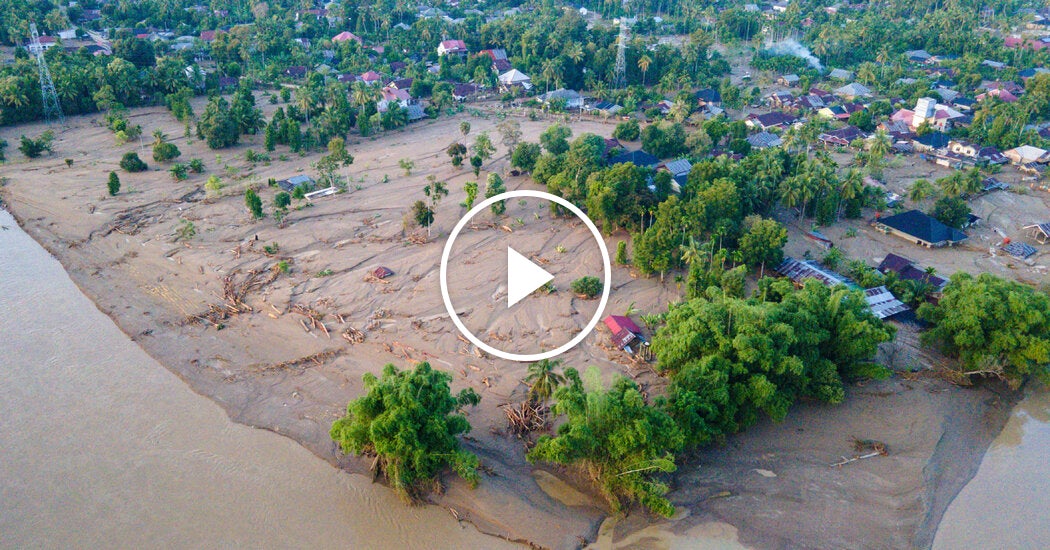
Devastating Indonesian Floods Claim Hundreds of Lives as Dual Cyclones Strike
Unprecedented Disaster Unfolds as Rare Weather Pattern Brings Catastrophic Rainfall
By Sarah Mitchell, International Correspondent
December 1, 2025
In an unprecedented weather catastrophe that has shocked Southeast Asia, Indonesia is reeling from devastating floods and landslides that have claimed over 600 lives, with more than 400 people still missing. The disaster, triggered by the rare convergence of two tropical cyclones, has displaced hundreds of thousands of residents and left communities across the archipelago nation in ruins. As rescue teams battle challenging conditions to reach isolated areas, authorities warn the death toll could rise significantly in what is becoming one of Indonesia’s deadliest natural disasters in recent years.
Twin Cyclones Create “Perfect Storm” for Deadly Flooding
The catastrophe began when two powerful tropical cyclones—an extremely unusual meteorological event for the region—converged over Indonesia’s densely populated islands last week. Meteorologists at Indonesia’s Weather and Geophysics Agency (BMKG) described the phenomenon as a “perfect storm” that created a prolonged deluge across multiple provinces. “We’re seeing rainfall totals that exceed anything in our historical records,” explained Dr. Anwar Sutanto, senior meteorologist at BMKG. “Some areas received more than a month’s worth of rain in just 24 hours, overwhelming natural drainage systems and flood defenses.”
The extraordinary volume of precipitation rapidly swelled rivers beyond their banks, particularly in low-lying areas of Java and Sumatra, where flash floods struck with little warning during overnight hours. In mountainous regions, the saturated soil gave way to devastating landslides that buried entire villages. Witness accounts describe walls of mud and water sweeping through communities with terrifying force. “The sound was like thunder, and then the earth began moving beneath our feet,” recounted Dewi Kusuma, a survivor from West Java’s Bogor regency, where a landslide destroyed nearly 80 homes. “My neighbors’ houses disappeared in seconds. We had no time to gather belongings or even fully comprehend what was happening.”
Humanitarian Crisis Deepens as Displaced Populations Swell
The humanitarian impact has reached crisis levels, with authorities estimating over 300,000 people have been displaced across the affected regions. Emergency evacuation centers in Jakarta, Bandung, and other major cities are operating beyond capacity, with families sleeping in school gymnasiums, government buildings, and makeshift tent settlements. Health officials have raised alarm about potential disease outbreaks as clean water supplies remain compromised and sanitation facilities prove inadequate for the massive influx of evacuees.
“We’re facing multiple emergencies simultaneously,” explained Farida Haryanto, coordinator for the Indonesian Red Cross disaster response team. “Beyond the immediate rescue operations, we’re confronting serious risks of waterborne diseases, food shortages, and psychological trauma among survivors.” Relief agencies report particular concern for vulnerable populations—including young children, pregnant women, and the elderly—who face heightened health risks in crowded evacuation facilities. The Indonesian government has allocated emergency funds exceeding 2 trillion rupiah (approximately $130 million USD) for immediate relief operations, but international aid organizations warn this may fall far short of addressing the extensive devastation.
Rescue Operations Hindered by Extensive Infrastructure Damage
Rescue and recovery efforts face severe logistical challenges as the floods have demolished critical infrastructure across multiple provinces. Dozens of bridges have collapsed, major highways remain submerged, and telecommunications networks have failed in the hardest-hit regions. Military personnel have deployed helicopters and amphibious vehicles to reach isolated communities, but progress remains painfully slow. In remote villages of Central Java, residents report waiting on rooftops for days before rescuers could reach them.
“The scale of infrastructure damage is unprecedented in recent Indonesian disaster history,” noted General Himawan Pratama, who heads the military’s disaster response coordination. “We’re finding entire road networks simply gone—not just damaged, but completely washed away.” Power outages affect millions of households, further complicating rescue operations, particularly during nighttime hours. Engineers assess that rebuilding essential infrastructure will take months, if not years, with preliminary damage estimates exceeding $5 billion USD. Indonesia’s President has declared a national state of emergency, mobilizing all available resources and appealing for international assistance to support the massive recovery effort.
Climate Change Connection Draws Scientific and Political Attention
As Indonesia confronts the immediate disaster, climate scientists are pointing to the catastrophe as further evidence of climate change’s intensifying impact on extreme weather events. Research indicates warming ocean temperatures may be increasing both the frequency and intensity of tropical cyclones in regions previously less affected by such storms. The unusual convergence of dual cyclones over Indonesia represents precisely the type of anomalous weather pattern that climate models have predicted would become more common as global temperatures rise.
“What we’re witnessing in Indonesia represents the new reality of climate-influenced disasters,” explained Dr. Eleanor Widjaja, climate scientist at Jakarta’s Environmental Research Institute. “These aren’t simply random weather events, but part of a documented pattern of increasing atmospheric energy creating more destructive storm systems.” Environmental advocates have used the disaster to renew calls for stronger international climate action, noting that Indonesia—an archipelago nation with thousands of islands—faces existential threats from both rising sea levels and intensifying storm systems. The disaster has prompted Indonesia’s government to announce it will strengthen its climate adaptation strategies and push for more aggressive emissions reductions targets at upcoming international climate negotiations.
Long Road to Recovery as Communities Face Rebuilding Challenge
For survivors of the catastrophic floods, the future remains uncertain as they contemplate rebuilding lives from the wreckage. Beyond the staggering death toll, the economic impact includes destroyed homes, businesses, schools, and farmland. In agricultural regions, the floodwaters have ruined rice paddies and plantation crops, threatening food security and livelihoods. Local officials estimate more than 120,000 homes have been damaged or destroyed across the affected provinces.
“We have nothing left—no home, no possessions, no photographs of our ancestors,” said Muhammad Rizki, a 45-year-old farmer from a devastated village near Bandung. “How do we start again from nothing?” Recovery experts predict the rebuilding process will take years, with particular challenges in relocating communities from areas now deemed too high-risk for habitation. Urban planners are already discussing the need for revised building codes and improved flood management systems, particularly in rapidly developing urban areas where concrete construction has reduced natural drainage capacity. As the immediate rescue operations gradually transition to recovery efforts, both the Indonesian government and international partners face the monumental task of not just rebuilding what was lost, but creating more resilient communities better prepared for the increasingly volatile climate future that Indonesia and other vulnerable nations now confront.
This article is developing as rescue operations continue across affected regions of Indonesia. International aid organizations have established emergency donation channels for those wishing to support relief efforts.