




Art as Resistance: Chinese Artist Gao Zhen Faces Imprisonment for Decades-Old Sculptures
Paper-Cut Love Letters From Behind Bars Tell Story of Family Separation
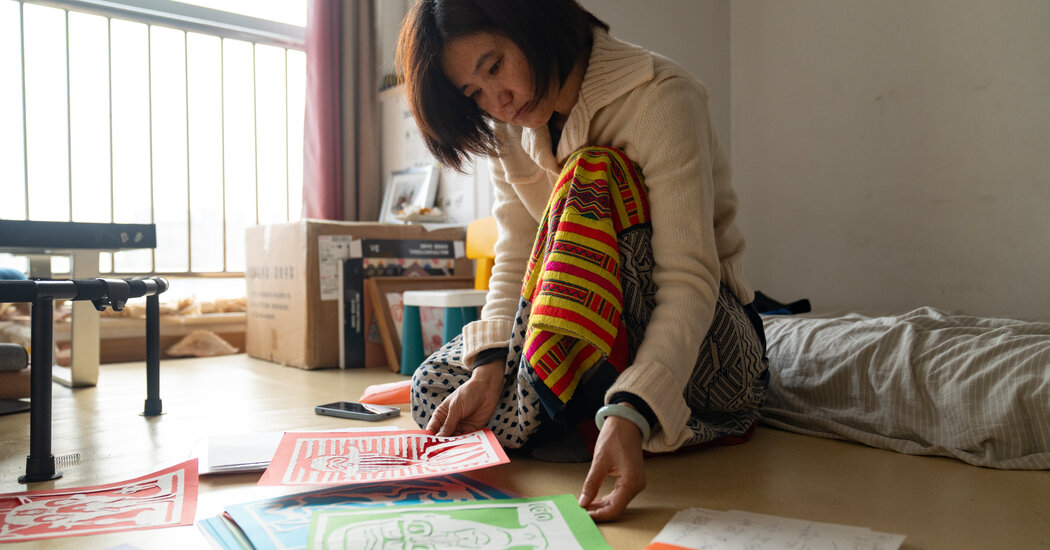
In a sparse apartment on the outskirts of Beijing, Zhao Yaliang carefully unfolds delicate paper-cut images—visual love letters created by her husband, renowned Chinese artist Gao Zhen, from within a detention center where he awaits trial. These hand-torn creations, reminiscent of the traditional Chinese folk art of jianzhi, have become lifelines connecting a family torn apart by China’s increasingly restrictive political climate.
“He’s telling me to take better care of myself and our son,” explains Zhao, 47, pointing to a poignant image of a woman with tear streaks running down her face—a portrait of herself weeping. Another piece bears a poem: “The waning moon shines at midnight, the moment I wake from a dream of longing. The pain of our parting has yet to heal. Tears fall lamenting the late return.”
Gao, 69, faces up to three years in prison on charges of “damaging the reputation” of Chinese heroes and martyrs—specifically, for irreverent sculptures of revolutionary leader Mao Zedong that he created more than 15 years ago. The law he allegedly violated didn’t even exist when the artwork was made, having only been passed in 2018 as part of President Xi Jinping’s broader campaign to control historical narratives and stifle dissent.
The arrest has left Zhao and the couple’s son, a U.S. citizen, stranded in China for over a year after authorities blocked them from leaving the country. The State Department has expressed deep concern about Gao’s detention and the exit ban preventing an American child from departing China, but diplomatic protests have yielded no results for the family caught in this international limbo.
From Cultural Ambassadors to Political Prisoners
Gao Zhen’s arrest represents a stark illustration of China’s shrinking space for artistic expression and political commentary. In the early 2000s, he and his younger brother Gao Qiang—known collectively as the Gao brothers—were celebrated as cultural ambassadors who represented a China willing to confront difficult chapters of its past through art.
The brothers gained international fame for bold exhibitions that addressed taboo topics like the 1966-76 Cultural Revolution—which resulted in their own father’s death—and the 1989 Tiananmen Square crackdown. Their provocative work was considered daring but permissible in the relatively more open China of that era, when the country was eager to showcase its contemporary art scene to the world.
“Mao Zedong has been dead for nearly half a century, yet his ghost still haunts China, harming Chinese people,” said Gao Qiang, who also emigrated to the United States. He believes his brother has been arrested merely for fulfilling his role as an artist—challenging power through creative expression. “This humiliation torments me every day,” he added.
The three sculptures at the center of the case represent some of the brothers’ most controversial work. In “Miss Mao,” the revolutionary leader is depicted with breasts and a Pinocchio nose—a commentary on propaganda and deception. Another piece, “The Execution of Christ,” shows multiple Mao figures with guns preparing to execute Jesus Christ, while “Mao’s Guilt” portrays the former leader kneeling in repentance for the famine and upheaval that occurred under his leadership.
A Family Trapped in Political Crosshairs
What likely triggered Gao’s detention wasn’t his art but his decision to relocate to the United States in 2022, joining his brother and other government critics who had been driven away by Xi Jinping’s crackdown and pandemic-era controls. As a permanent U.S. resident, Gao had traveled between China and America without incident for a decade.
When his mother-in-law fell ill last year, Zhao decided to return to China for a visit. Despite friends’ warnings about potential danger, Gao insisted on joining her and their son. He wanted to revive their work studio and argued he wasn’t significant enough to attract attention from authorities.
This assessment proved tragically incorrect. On the morning of August 26, 2023, more than 30 police officers stormed Gao’s art studio in Sanhe City, Hebei Province. Zhao watched in horror as officers forced her and their son into the kitchen before pinning her husband to a couch and handcuffing him.
“Now with him being taken away, I realize that we were always living on the edge of a cliff,” Zhao reflected.
Victoria Zhang, a friend of the Gao brothers and president of Kunlun Press and the Borderless Culture and Art Center in New York, believes the Chinese authorities want to make an example of Gao to intimidate others who have moved overseas. “Don’t assume that just because you’ve fled abroad, the Chinese Communist Party can’t touch you. The moment you return home they will punish you,” Zhang warned.
Using Family as Leverage in a Political Prosecution
When Zhao later attempted to return to New York with her son, officials at Beijing’s airport stopped her, citing national security concerns. When she tried to seek help at the U.S. Embassy, police intercepted the pair and escorted them back to Sanhe City.
“It’s the strategy they always use—controlling your family to get you to confess quickly,” Zhao explained. Despite this pressure, she says her husband refuses to plead guilty to the charges against him.
She and their son now live in an apartment in Sanhe City, leading what she describes as “an existence in limbo.” The boy, who went by Justin in New York, missed his first semester of first grade before police arranged for him to attend a local school. Mother and son fill their days with school and after-school activities, with weekends often spent at Beijing’s 798 Art District—where the Gao brothers once held exhibitions and where Zhao maintains a small café.
The trauma has taken a toll on their son. For a time, he refused to leave his mother’s side, and he still wakes up with nightmares. Although the boy witnessed his father’s detention, Zhao tells him that “Dad is just away at work”—a story he now repeats to classmates when questioned.
“In reality, he understands. He knows everything. He just wants to comfort me,” Zhao said.
The Silencing of an Artist’s Voice
Initially, the paper-cut portraits and letters provided solace for Zhao, but even this connection has now been severed. After dissident Chinese artist Ai Weiwei published what appeared to be a letter from Gao in August, authorities cut off his access to pen and paper—what Zhao believes is punishment for that public communication.
Gao’s health has deteriorated during detention. He frequently requires a wheelchair and may be suffering from arteriosclerosis, which could lead to stroke or other serious health complications. His mental well-being is equally concerning; he has been denied access to the detention center’s library and is not permitted time outdoors.
Despite not being allowed to visit her husband, Zhao and her son regularly wait outside the detention center when their lawyer meets with him. “I get to feel a little closer to him,” she said.
The case of Gao Zhen stands as a powerful reminder of how art continues to threaten authoritarian regimes even decades after its creation. As China tightens control over historical narratives and punishes those who challenge official versions of the past, the paper-cut images Gao created from his cell represent both a personal tragedy and a broader statement about the enduring power of artistic expression in the face of political repression.
For Zhao Yaliang, these delicate creations remain tangible proof of her husband’s resilience—torn paper transformed into symbols of love and defiance against a system that seeks to silence critical voices, even those that spoke through art created in a seemingly different era of Chinese openness.