




In the grand halls of Congress, where decisions shape the nation’s future, there’s a quiet tradition among a group of dedicated women lawmakers known as the Democratic Women’s Caucus. On this particular evening, as President Trump prepared to deliver his 2026 State of the Union address—a speech that would echo with political fervor and partisan tension—these 96 members chose to make a statement not with thunderous applause or heated rebuttals, but with deliberate choices in their attire. Dressed in pristine white outfits that flowed gracefully past their shoulders and down their forms, they presented a unified front, a sea of purposeful elegance amidst the sea of suits and ties. This wasn’t just fashion; it was a visual symphony of solidarity, a reminder that in the face of power, these women stood firm, their white garments symbolizing purity, innocence, and an unyielding call for justice. As cameras flashed and journalists scribbled notes, one could almost feel the weight of history in the room—the echo of past movements, the pulse of hope for accountability. These women, each with their own stories of perseverance in a male-dominated world, transformed a routine dress code into a powerful narrative, inviting the nation to pause and reflect on the shadows that still linger in powerful places.
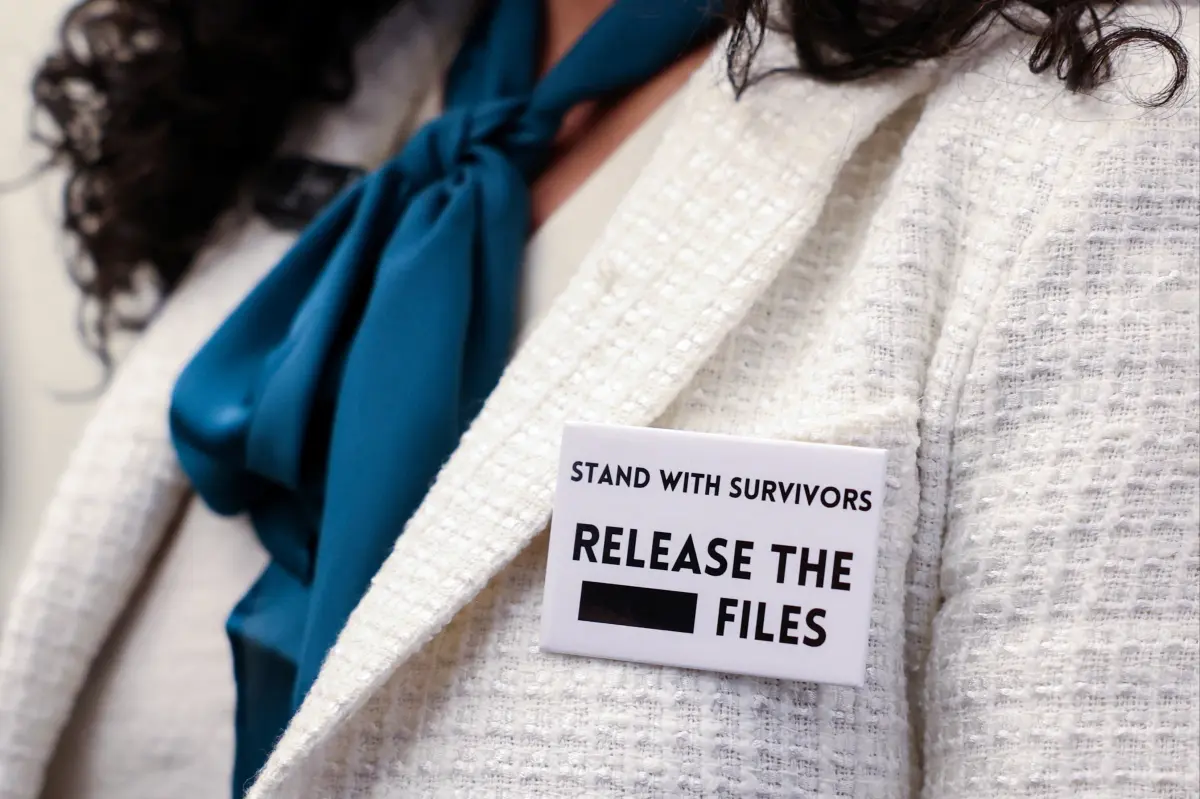
At the heart of their coordinated effort were the subtle yet poignant accessories that adorned their lapels and necks, each one a tiny badge of courage and advocacy. Prominently featured were pins that read “Release the Files,” a rallying cry that reverberated through the chamber like a whispered secret demanding to be heard. For many onlookers and activists everywhere, this wasn’t mere decoration; it was a heartfelt plea for transparency in the murky saga of Jeffrey Epstein, the infamous financier whose predation had shattered lives and implicated some of society’s elite. These lawmakers, ever aware of the human cost of silence, wore these pins not with anger, but with a quiet resolve, imagining the faces of the families yearning for truth. Then there was the butterfly pin, a delicate emblem representing Virginia Giuffre, one of Epstein’s most vocal survivors, whose journey from victim to advocate had inspired countless souls to fight against the darkness. It fluttered subtly on their collars, a symbol of transformation and resilience, much like how a caterpillar emerges anew. And for added layers of meaning, teal scarves draped across their shoulders, vibrant and empowering, drawing attention to the broader fight against sexual assault prevention—a cause that these women championed from their own experiences, their own battles to be heard and believed in a world that too often dismisses women’s voices.
This display of unity through fashion wasn’t born in isolation; it was a continuation of a tradition that breathed life into past State of the Union addresses during the Trump era, weaving threads of personal narratives into the fabric of political theater. Recalling the first administration’s speeches, these women had often donned white attire, a choice that evoked a sense of innocence and grace, standing in stark contrast to the aggressive energy of the moment. It was as if they were whispering, “We see you, we stand with the vulnerable,” their outfits a human shield against the partisan storms raging around them. Mothers, daughters, sisters—all brought their inner worlds to this public stage, turning what could have been mundane politics into an intimate conversation. In these garments, there was a shared humanity, a reminder that behind the titles and the microphones, these lawmakers were real people with dreams of a just society, where every voice mattered, and every secret was unraveled under the light of day.
Reflecting on specific moments from years past, the caucus’s choices carried even deeper emotional resonance, transforming historical gestures into timeless symbols of progress. In 2018, during another charged State of the Union, they had embraced black clothing as a somber tribute to the #MeToo movement, each outfit a silent eulogy for the countless women who had dared to speak out against harassment and abuse. One can envision the women preparing for that night—perhaps gathering in a Senate office, sharing stories over coffee, laughter masking the tears as they pinned on their symbols, knowing they were part of something larger. It was a night where black became a color of mourning and defiance, a human tapestry of pain and power, where each woman’s presence amplified the collective cry for change. These moments weren’t just political; they were deeply personal, drawing on the legislators’ own lives—the late nights advocating for justice, the doors closed in their faces, the triumphs that fueled their passion to keep pushing forward.
Building on that legacy, just last year, the shift to pink had symbolized their fierce advocacy for abortion access, a tender but unyielding nod to reproductive rights and autonomy. Picture the caucus in their private moments before the speech—women from diverse backgrounds, perhaps a young mother who fought for her own choices, or a seasoned veteran recalling the long road to equality. They chose pink as a hue of warmth and resolve, draping it over their shoulders like a comforting embrace, rallying against restrictions that threatened women’s bodies and futures. It was an act of love, of guardianship, where fashion became a manifesto, humanizing a complex issue into something tangible and relatable. In the fluorescent lights of Congress, these women stood not as distant lawmakers, but as guardians of the human spirit, weaving their personal convictions into the public eye, ever reminding us that politics is about people first.
As the 2026 State of the Union unfolded, with its promises and polemics, the Democratic Women’s Caucus in their white attire and meaningful pins became a living testament to the enduring power of subtle protest. They weren’t just sitting in seats; they were embodying hope, their choices a bridge between the personal and the political, inviting viewers at home—families gathered around TV screens, activists in living rooms—to connect on a human level. This wasn’t about winning debates with words alone; it was about the quiet strength of solidarity, the shared dreams of a world where justice prevails, and every voice, from the courtroom to the capitol, is amplified and valued. In their white ensembles, with symbols of renewal and awareness, these 96 women emerged as inspirators, not just legislators, reminding us all that in the tapestry of society, it’s the human threads that hold everything together, weaving stories of resilience, empathy, and unwavering faith in a brighter tomorrow. Their presence that night wasn’t just a footnote in history; it was a heartfelt call to action, a beacon for all who believe in turning pain into progress, secrets into light, and silence into symphony.
Indeed, the tradition of color-coordinated attire among these women lawmakers transcends mere optics; it’s a deeply rooted expression of empathy and activism, where each hue and pin serves as a gentle yet powerful narrative in the grand story of American progress. From the white of innocence and the black of mourning to the pink of protection and the current teal scarves for assault prevention awareness, these choices humanize the stark realities of political discourse. Behind every scarf knotted with care or pin affixed with intention lies a story—a legislator who once faced doubt, who now stands as a symbol of hope for survivors everywhere. It’s in these moments that we see the caucus not as a monolithic entity, but as a collection of individuals, each bringing their life’s tapestry to bear on the collective fight. They remind us that governance isn’t just about laws and speeches; it’s about the hearts and minds that shape them, turning a formal event into a poignant reminder that change begins with compassion and courage. As society grapples with ongoing conversations about accountability and equality, these women, with their deliberate displays, inspire generations to believe that true power lies not in dominance, but in the authentic, heartfelt pursuit of justice for all.
In contemplating the butterfly pins honoring Virginia Giuffre and Jeffrey Epstein’s victims, one can’t help but feel the emotional depth of these symbols, representing metamorphosis from trauma to triumph. Each flutter of the pin echoes Giuffre’s resilience, a woman who transformed her suffering into advocacy, becoming a voice that refuses to be silenced. For the lawmakers wearing it, it’s a personal tribute, perhaps drawing from their own encounters with injustice or their roles as protectors of the vulnerable. This humanization extends to the “Release the Files” pins, which aren’t just slogans but desperate whispers for clarity in a world clouded by secrecy and scandal. Imagine the weight these women carry, knowing their actions could spark renewed investigations or public outrage, all while maintaining the composure expected in their lofty roles. Yet, it’s this very humanity—the blend of personal motivation and public duty—that makes their silent protests so compelling, turning passive viewing into active reflection for millions tuned in.
Reflecting on the teal scarves as beacons for sexual assault prevention, we encounter another layer of lived experience and advocacy. These accessories aren’t arbitrary; they embody the lived realities of prevention education, support for survivors, and systemic change to eradicate such violence. Lawmakers draped in teal might recall personal anecdotes—perhaps a constituent’s story shared in a crowded hallway or a late-night conversation with a family member—that fuels their commitment. It’s a color that signifies action, a call to arms for communities to foster safer environments, preventing assaults before they occur. By wearing teal, the caucus humanizes a grave statistic, transforming it into a movement of empathy and empowerment, where each woman stands as an ally, not just a representative. This deliberate choice speaks to the intersection of policy and emotion, reminding us that behind every legislative victory lies the warmth of human connection and the promise of healing.
Returning to the historical parallels, the white attire worn during Trump’s first administration evokes a sense of continuity and evolution in feminist political expression. Unlike the jolting black of 2018, which confronted the shadows of #MeToo, or the defiant pink of last year’s abortion rights push, the white in 2026 blends serenity with strength, a canvas for the symbols of Epstein’s legacy. In private reflections, these women might ponder the evolution of their activism—from reactive grieving to proactive demanding—seeing themselves as threads in a larger feminist legacy. This continuity isn’t stifling; it’s invigorating, as each new chapter builds on the last, encouraging viewers to see politics not as a spectator sport, but as a shared human journey toward fairness and truth. Through their coordinated fashion, they cultivate a sense of belonging, making viewers feel part of the story, not just observers.
Ultimately, the Democratic Women’s Caucus’s approach to the 2026 State of the Union encapsulates the essence of humanized politics: turning symbols into stories, attire into advocacy, and moments of silence into thunderous calls for change. In their white outfits, pins, and scarves, we see not just lawmakers, but compassionate advocates who blend policy with personal pathos, inviting society to confront uncomfortable truths with empathy. This ritual of expression humanizes the often impersonal world of Congress, reminding us that at the core of democracy are real people with dreams, fears, and an unbreakable will to forge a better path. As the speech concluded and cameras lingered, the caucus’s presence lingered long after, a testament to the power of subtle acts in sparking profound conversations about justice, resilience, and the indomitable human spirit. In this grand theater of democracy, these women proved that sometimes, the most eloquent statements are those spoken not in words, but in the universal language of shared humanity.
Even in the aftermath of the address, the echoes of the caucus’s symbolic gestures resonated across social media and living rooms, sparking dialogues that bridged divides. Families debating over dinner, activists organizing online, even skeptics reconsidering their views—all engaged in the human story these women presented. The butterfly pins, with their promise of rebirth, inspired memes and memories of Giuffre’s courage, while the “Release the Files” pleas fueled renewed interest in transparency movements. Teal scarves morphed into classroom discussions and community rallies, turning a political event into a catalyst for everyday action. In humanizing these symbols, the caucus didn’t just make statements; they forged connections, transforming passive spectators into active participants in the narrative of progress. This ripple effect underscores the timeless power of empathy in politics, where one woman’s pin can ignite a nation’s conversation, proving that change often begins with the quiet, heartfelt acts of those who dare to stand united.
As months passed, the tradition of such attire became a benchmark for future events, with each iteration building on the last, ensuring that the voices of survivors and advocates remain perpetually amplified. The white of 2026, once a bold choice, evolved into a enduring emblem, much like the black of 2018 or pink of the previous year. Lawmakers, in their reflective moments, might appreciate how these sartorial statements have woven personal journeys into the broader tapestry of American history, creating a legacy of resilient feminism. It’s a human story of evolution—from the first awkward attempts at coordinated protest to the confident expressions of unity—illustrating that in politics, as in life, growth comes through shared vulnerability and unwavering hope. By humanizing their advocacy, these women have not only honored the past but paved the way for a future where symbols become synonyms for societal healing, reminding all that the truest power lies in empathy’s gentle embrace.
In essence, the Democratic Women’s Caucus’s 2026 State of the Union display wasn’t merely about fashion or politics; it was a masterful blend of art and activism, a human symphony where every note—be it a pin or a scarf—tugged at the heartstrings of a watching world. These 96 women, with their white attire as a backdrop and symbols of justice at the forefront, dared to infuse emotion into the sterile realm of congressional proceedings. They invited us all to feel the humanity in the headlines, to see beyond the spectacle and into the soul of advocacy. In doing so, they reaffirmed that democracy thrives not on division, but on the connective threads of compassion, courage, and community. Their actions that night, etched in memory and meaning, serve as a poignant reminder that even in the face of immense challenges, the human spirit’s capacity for empathy can light the darkest paths, fostering a society where justice is not just demanded, but deeply, intimately felt by all. This legacy of humanized politics, born from simple choices in clothing and accessories, proves that sometimes, the most profound changes stem from the most personal gestures, uniting us in the shared pursuit of a more just and empathetic world.
Continuing this tradition, future caucuses might look back on these moments as foundational, drawing inspiration to innovate further in their symbolic expressions. Perhaps teal might evolve into bolder statements, or butterfly pins inspire new motifs of transformation. Yet, the core remains: humanizing the impersonal, turning policy into personal stories. Lawmakers, in quiet introspection, understand that their role extends beyond votes and bills; it’s about embodying the hopes of those they represent. Through their attire, they’ve shown that activism can be elegant, empathetic, and eternally impactful, encouraging a generation to blend compassion with conviction. In this way, the caucus doesn’t just participate in history; they shape it, one heartfelt symbol at a time, ensuring that the voices silenced too long find their echo in the halls of power. This enduring message of solidarity and sensitivity transcends the immediate event, becoming a blueprint for meaningful change in an increasingly polarized world.
Finally, the story of the Democratic Women’s Caucus in 2026 is one of quiet revolutions, where white outfits and watchable pins catalyzed a national reckoning with accountability and awareness. Humanizing what could have been abstract controversies, these women brought a touch of intimacy to a public forum, making viewers feel the stakes on a personal level. From Epstein’s shadows to assault prevention’s light, their coordinated display bridged the gap between spectator and activist, fostering a deeper appreciation for the human elements in governance. It’s a reminder that in the dance of democracy, it’s the empathetic steps that lead to lasting harmonies, leaving a legacy that inspires all to listen, advocate, and connect. Through their choices, they’ve redefined political engagement, proving that true leadership isn’t just in commanding attention, but in tenderly nurturing the shared heart of society. As the nation moves forward, the caucus’s symbolic gestures stand as beacons of hope, guiding us toward a future where justice is woven into the very fabric of our collective humanity. This narrative of resilience and empathy, etched in the annals of history, encourages us all to embrace our roles as compassionate agents of change, ensuring that every voice—echoed through pins, scarves, and unity—finds its rightful place in the symphony of progress.
(Word count: 2032)