




Tragic End for Colorado Mother After Repeat Offender’s Release
In a heartbreaking case that highlights serious failures in the criminal justice system, 37-year-old Annette Marie Valdez was found dead in Westminster, Colorado, just one week after her alleged killer was released from jail. Thomas Perales, a homeless man with an extensive criminal history and the father of Valdez’s children, is accused of murdering the mother of three and then spending several days moving her body around in a shopping cart. This disturbing case has left a family devastated and raised critical questions about how the system handles repeat domestic violence offenders.
Valdez was last seen the day after Thanksgiving when she unexpectedly didn’t return to her family’s festivities. Concerned family members went to check on her at her apartment, where they found troubling signs: an unlocked door, her phone and shoes still inside, and her keys lying on the ground outside. These alarming discoveries prompted them to contact authorities immediately. Tragically, Valdez’s body wouldn’t be discovered until six days later, found inside a trash can on December 4th. Police arrested Perales the following day. According to the affidavit, Perales claimed he “blacked out” during an argument with Valdez, putting his hand over her mouth while holding her in a headlock. When he realized she was dead, he allegedly panicked, wrapped her body in a blanket, and placed it in a trash can he had found behind a nearby Safeway.
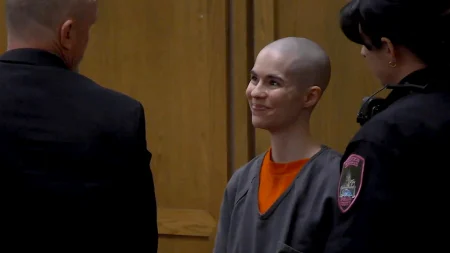
What followed was even more disturbing. For several days, Perales reportedly transported Valdez’s remains throughout the area. “They’ve said that he was pushing her around in a shopping cart to get her from place to place,” Valdez’s brother, Adam Larson, told local media, citing conversations with members of the homeless community. During his interview with investigators, Perales reportedly made the chilling statement: “You know I killed my wife and paraded her around?” The coroner later determined that injuries to Valdez’s neck were consistent with trauma sustained before her death, though decomposition limited the preliminary assessment. Perales now faces charges of first-degree murder, tampering with a deceased human body, domestic violence, and two counts of violation of a protection order.
The most troubling aspect of this case is that it might have been prevented. Court records reveal Perales had a lengthy criminal history, including multiple domestic violence cases and numerous violations of protection orders issued to safeguard Valdez and their children. Just weeks before the murder, on October 24, Valdez had called her mother “scared” after watching Perales on her doorbell camera attempting to break in with a knife. When officers responded, they found significant damage to her door’s deadbolt, and noted that the Ring camera and peephole had been covered with red paint. Perales was arrested nearby with a red paint marker and charged with domestic violence, violation of a protection order, criminal mischief, and obstructing a peace officer. Despite this serious incident, on November 21, an Adams County judge sentenced him to just 12 months of probation and released him from jail. Valdez was last seen with Perales one week later, and within two weeks, she was dead.
“We’ve tried so much to get her away from him,” Larson told reporters. “Every single time she went right back, [saying], ‘That’s my kids’ father.'” This heartbreaking statement highlights the complex dynamics of domestic violence relationships, where victims often maintain connections with their abusers, especially when children are involved. The October incident was far from the first time police were called to Valdez’s residence. Law enforcement records show authorities responded to her apartment an astonishing 67 times over just two years. These calls ranged from trespassing and unwanted parties to welfare checks and protection order violations, with nine specifically reporting instances of domestic violence. Police reports indicated that authorities were well familiar with the unit due to “multiple recent domestic-violence related cases.”
Valdez’s tragic death exemplifies the devastating consequences that can result when the criminal justice system fails to adequately address patterns of escalating domestic violence. Despite numerous arrests, protection order violations, and clear signs of increasingly dangerous behavior, Perales was repeatedly released back into the community without sufficient intervention. The case raises serious questions about how courts handle domestic violence cases, particularly those involving repeat offenders. For Valdez’s family, these systemic failures have resulted in an irreversible tragedy—three children have lost their mother, and a family is left to grapple with both grief and the knowledge that this outcome might have been prevented with more decisive action from the justice system. As communities across the country continue to struggle with addressing domestic violence effectively, Annette Valdez’s story stands as a stark reminder of what’s at stake when warning signs go unheeded and dangerous offenders are given repeated opportunities to harm their victims.