






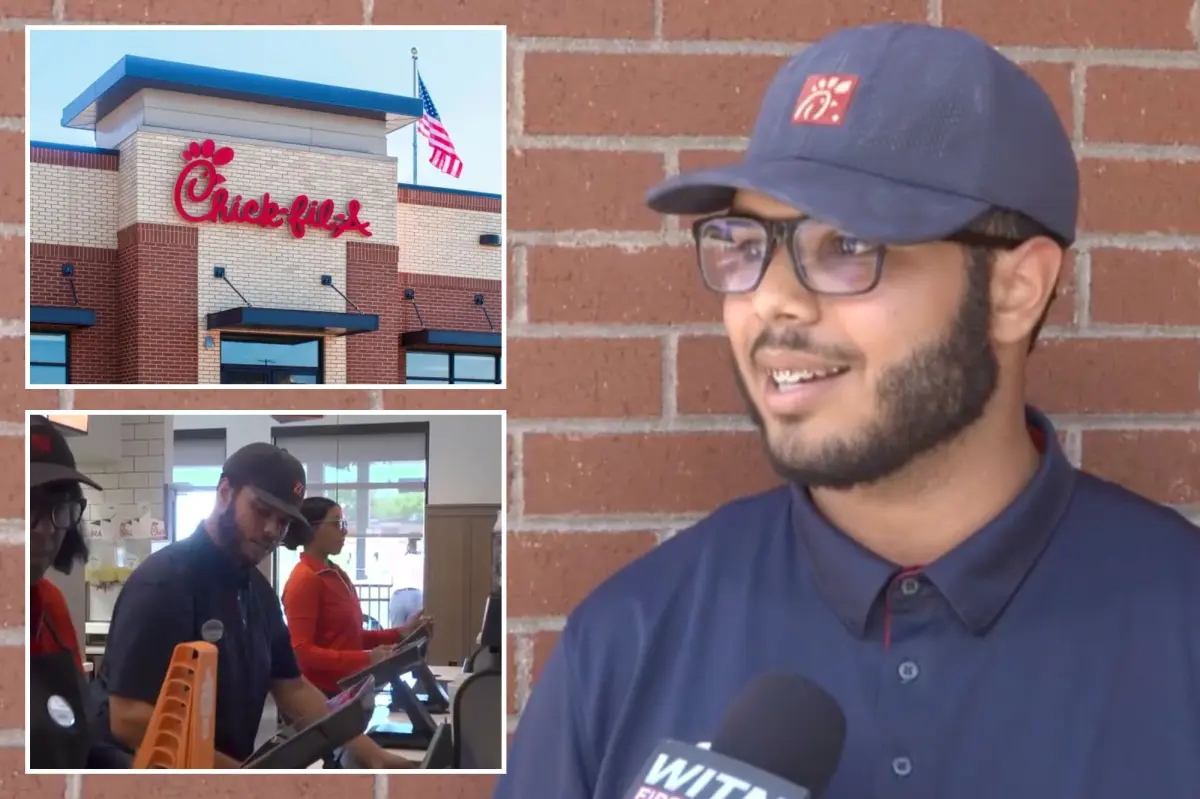
It was a crisp Good Friday morning in Kinston, North Carolina, the kind of day where the sun peeked through the windows of the bustling Chick-fil-A, casting a warm glow on the customers bustling in for their breakfast sandwiches and waffle fries. Jayden Cintron, an 18-year-old employee with a mop of curly hair and a youthful energy that made him popular among the regulars, was starting his shift like any other. He navigated the familiar chaos of the drive-thru and counter, greeting families with a smile that everyone said lit up the room. But during a quick break, he wandered off to the restroom, probably just to splash some water on his face after a particularly busy rush. Little did he know, this ordinary moment was about to turn his life into an unexpected story of honesty and faith. As he stepped inside, something caught his eye—two plain white envelopes tucked near the toilet, almost out of sight but unmistakable. One was labeled “First Citizens Bank” and the other “Truist Bank.” Curiosity piqued, he picked them up, and upon opening them, his eyes widened at the sight of crisp bills totaling a staggering $9,333. It was like something out of a movie—real money, enough to change anyone’s life in a heartbeat. Jayden felt his heart race; his mind raced with thoughts of his rent, his family’s struggles, and those student loans he’d been stressing about. “My first thought was just like … ok, no, this isn’t happening,” he later recalled in an interview with WITN. “Something is wrong.” He double-checked, counted again, and realized it wasn’t a prank or a dream. There was real cash here, unguarded in a public bathroom, and no one around to claim it.
Jayden Cintron stood there for a moment, the bathroom stall suddenly feeling smaller, more confining. At 18, he was no stranger to tough choices—growing up in a modest household, he’d learned early that opportunities often came wrapped in temptation. His parents had instilled strong values in him, reading Bible stories at night and reminding him that true character shines in quiet moments. As he held the envelopes, weighing them in his hands, he thought about his faith. Jesus’ teachings on honesty and integrity flooded his mind, stories from Sunday school about doing the right thing even when no one’s watching. The weight of the money felt heavy, tempting—$9,333 could pay off debts, buy that used car he’d been eyeing, or just give his family a financial break. But deep down, he knew pocketing it wouldn’t sit right. “That’s not what Jesus would’ve done. That’s not what God would’ve wanted,” he reflected, his voice steady when asked later. Instead of slipping the cash into his pocket, he took a deep breath, walked out of the restroom, and headed straight to the restaurant’s human resources department. It wasn’t impulsive; it was deliberate, a quiet act of defiance against the easy wrong road. He handed over the envelopes, explaining what he’d found, feeling a mix of nervousness and peace. In that instant, Jayden wasn’t just an employee; he was a young man choosing path over gain, faith over fear.
The news of Jayden’s discovery spread like wildfire through the restaurant and beyond, turning heads and sparking conversations everywhere. Local law enforcement, including Kinston Police Chief Keith Goyette, was among the first to hear about it. Chief Goyette, a seasoned officer who’d seen his share of petty theft and dishonesty, shook his head in genuine amazement. “A lot of people will … unfortunately, take that money and run with it,” he told reporters, his tone a blend of caution and admiration. “Kudos to that employee at Chick-fil-A. He definitely deserves a reward.” It wasn’t just empty praise; the chief recognized how rare such integrity was in a world where people often justified shortcuts. Then there was John McPhail, the restaurant’s owner, a man who’d built his business on principles that mirrored Jayden’s faith-based approach. McPhail was stunned, then inspired. “True leadership, you know, true integrity is doing the right thing when no one is watching,” he said, his voice reflecting pride in his young team member. “Jayden did that in this case and he should be commended for it.” The employees buzzed about it during shifts—some admitted they might have hesitated, others high-fived Jayden for his courage. Even customers who’d never met him heard the story on local news and stopped in to say thank you, leaving comments online about how his actions restored a bit of faith in humanity. For Jayden, the shock of it all lingered; he hadn’t expected such a fuss. But in those reactions, he saw validation—that in a cynical age, simple honesty could touch people deeply, reminding them of their own moral compasses.
Not long after, the rightful owner of the money showed up to retrieve the envelopes. The person, whose name wasn’t disclosed, was a local banker who’d perhaps been conducting business that day and miscounted funds or simply forgotten them in a moment of haste. Regardless, they were flooded with relief upon getting it back—$9,333 isn’t chump change for anyone. But they didn’t just express gratitude; they insisted on rewarding Jayden for his unparalleled honesty. The owner, feeling indebted, offered a $500 check, a gesture born of deep appreciation. Jayden, however, wasn’t looking for accolades or compensation. Raised to believe that good deeds should come from the heart without strings, he initially refused, his cheeks flushing as he explained, “I didn’t expect anything in return for doing what I believed was right.” It was genuine modesty; he saw it as just the next logical step in living his faith, not a transaction. But the owner persisted, perhaps seeing in Jayden a reflection of values worth nurturing. After several gentle insists—what started as a polite “no thanks” evolved into thoughtful consideration—Jayden finally accepted the reward. It wasn’t about the money; it was about acknowledging the kindness of strangers and the ripple effect his choice had created. For him, the $500 felt symbolic, a reminder that patience and doing right often circle back in unexpected ways.
Stories like Jayden Cintron’s aren’t isolated sparks in a dark world; they’re echoes of humanity’s better angels, popping up in the most mundane places. Take the case from 2022 in Tennessee, where workers at a Home Depot store in Bellevue tracked down a customer who’d lost $700 in cash stuffed into an envelope. Someone had spotted it on the aisle floor, right where the patron had presumably set it down while shopping for Christmas gifts. Operations assistant Alissa Rocchi, who helped orchestrate the reunion, shared that the team went above and beyond—not just holding onto the money, but using every tool to locate the owner. “We wanted to do the right thing,” Rocchi said simply, her words evoking a collective sigh of relief that such gestures still exist. It was heartwarming; the customer, likely a family trying to make holidays special, was overjoyed to get back what was meant for joy and generosity. Or consider that same year in New York City, where a staggering $4,000 in cash was found inside a wallet dropped by a commuter amid the hustle of Times Square. A good Samaritan, anonymous in the chaos, returned it intact. In a city famed for its indifference, this act stood out, proving that even in the concrete jungle, compassion lurks beneath the surface. These incidents, like Jayden’s, remind us that honesty isn’t extinct; it’s just often overlooked. They humanize the world, showing that people from all walks—waiters, store clerks, commuters—can choose grace over greed, faith over temptation.
Reflecting on these tales, it’s clear they weave a tapestry of hope in everyday life, challenging the notion that society is solely driven by self-interest. Jayden’s story, amplified through news outlets and social media, sparked discussions in schools, churches, and online forums. Many pondered what they’d do in his shoes—would the allure of easy money outweigh conscience? For others, it ignited personal reckonings, prompting acts of kindness like paying for someone’s coffee or sending anonymous notes of encouragement. In a broader sense, these narratives highlight the role of faith, community, and integrity in shaping decisions. For young people like Jayden, facing the whirlwind of adulthood, it’s a powerful lesson: true wealth isn’t in bank accounts but in the peace that comes from aligned actions. As society grapples with economic pressures and moral ambiguities, stories like this serve as beacons, urging us to pause, reflect, and maybe even emulate that quiet courage. Jayden Cintron, in his simple act, didn’t just return lost cash; he returned a bit of trust to a world hungry for it. And in doing so, he proved that while temptations abound, the choice to rise above them always matters—leaving us all a little more inspired to do the same.