

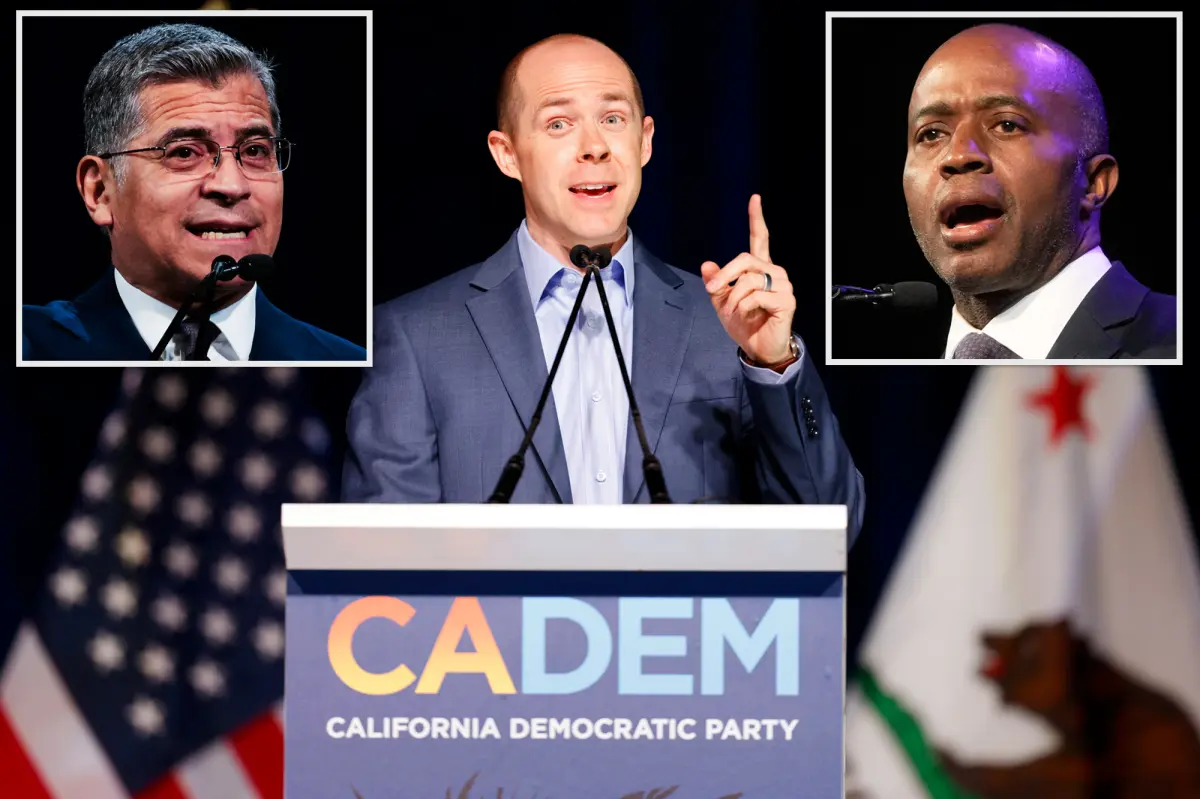
The Tumultuous Landscape of California’s Democratic Governor’s Race
In the bustling, sun-drenched corridors of California’s political scene, a storm was brewing that threatened to shatter the Democratic Party’s long-held grip on the governorship. As the primary season heated up, party insiders like Chairman Rusty Hicks and even former Governor Gavin Newsom found themselves in a quandary, urging lesser-polling candidates to step aside before disaster struck. The fear? A “doomsday scenario” where not one, but two MAGA Republicans could emerge victorious in the March primary, locking Democrats out of the November general election in this deeply blue state. Imagine the heartache of California voters—families relying on progressive policies, educators fighting for public schools, environmentalists protecting the coastline—watching their hopes dashed by internal squabbles. Steve Hilton, the flashy former Fox News host known for his bombastic rants, and Chad Bianco, the tough-as-nails ex-Riverside Sheriff with a law-and-order vibe, were polling strongly, their campaigns fueled by Trump’s populist fire. For Democrats, who prided themselves on unity in the face of national division, this was a wake-up call. The race was crowded, with nine notable Democrats vying for the top spot, each bringing their own baggage, dreams, and constituencies. Suddenly, the party that had powered icons like Newsom was fracturing, with polls showing the field splintered like a dysfunctional family gathering. It’s easy to feel the frustration here: for decades, California has been a beacon of inclusivity, yet now, old rivalries and egos were threatening to pave the way for a red tsunami. Voters across the state—from the vineyards of Napa to the tech hubs of Silicon Valley—watched with bated breath, wondering if their voices would be drowned out by vanity projects. This wasn’t just politics; it was personal, a reminder that in democracy, every candidate carries real hopes and heartbreaks, from single moms juggling jobs to young activists dreaming of a greener future. As the deadline loomed on Friday for filing ballot paperwork, the tension was palpable, with party leaders pleading for candidates to consider the bigger picture. What if the outcome meant rolling back environmental protections or hitting pause on education reforms? The party wasn’t asking for martyrs; they were begging for pragmatism in a state that prided itself on leading the nation. But beneath the panic lay a deeper truth: this race embodied the soul-searching of a party grappling with its own diversity, privilege, and ambition. For ordinary Californians, it sparked conversations at water coolers and dinner tables about loyalty, representation, and the cost of division in an era of uncertainty.
Defiance from the Underdogs: Low-Poll Candidates Hold Their Ground
Amid the drama, a quintet of low-polling Democrats stood their ground like warriors in a losing battle, each refusing to heed the party’s cries to exit stage left. Superintendent Tony Thurmond, polling at a meager 2%, became a voice for the voiceless, firing off a passionate social media video that echoed across Echo Park and beyond. Betty Yee, the former Controller with a steadfast reputation in Sacramento, grinned mischievously as she filed her paperwork, her 5% support seemingly irrelevant to her resolve. Xavier Becerra, the ex-Attorney General with a resume polished by years of public service, circulated a signature-collecting clip declaring his intent to claim the governorship. And Matt Mahan, the energetic San Jose Mayor buoyed by Silicon Valley donors, insisted victory was within reach despite his own 2% polling deficit. Each of these individuals wasn’t just a name on a ballot; they were human beings with stories woven into California’s fabric. Thurmond, for instance, had dedicated his life to education, rising from humble beginnings to champion underserved communities, his frustration palpable as he painted the party as elitist gatekeepers. Yee, a first-generation American with deep roots in the scroll of California’s history, saw her campaign as a chance to amplify overlooked voices, her defiance born from a belief that every dream deserved a shot. Becerra, having fought legal battles for the underprivileged, dreamed of continuing Newsom’s legacy of empathy-driven governance. Mahan, a tech-savvy innovator, envisioned a digital revolution for state bureaucracy, his backers’ millions reflecting a hope for disruption. Even Ian Calderon, polling at just 1%, chimed in with a quizzical “thought we believed in choice,” capturing the democratic ideal’s struggle against pragmatism. These candidates, far from villains, were everyday heroes—parents, mentors, activists—who poured their souls into the fray, undeterred by odds. Imagine the emotional toll: late nights strategizing with volunteers, door-knocking in rainy districts, only to face party scorn. For Californians, this mirrored their own perseverance against life’s uncertainties, whether battling housing crises or job losses. The defiance wasn’t blind; it was a testament to the American spirit, where underdogs refuse to be sidelined. Yet, as polls tightened and reputations hung in the balance, one couldn’t help but feel a pang of sadness for the fractured dream situated.
Accusations of Bias: Thurmond’s Blast and the Race Conversation
Delving deeper into the heart of the matter, Superintendent Tony Thurmond emerged as the pivotal figure, igniting a firestorm with his searing accusations in a viral video that resonated across diverse communities. He didn’t mince words, claiming the California Democratic Party was essentially sidelining candidates of color—folks like himself, Yee, Becerra, and Mahan—while championing white contenders who, in his view, lacked the depth of real-world grit. Thurmond’s 2% polling seemed irrelevant when juxtaposed against the billionaires and Beltway elites dominating headlines, like Tom Steyer, the environmental activist with unlimited funds, or Katie Porter, the sharp-tongued former Rep. known for calling out corporate fat cats. Eric Swalwell, another white hopeful with media savvy, and Rep. Antonio Villaraigosa, the charismatic ex-mayor, all seemed poised for favoritism, Thurmond argued, painting a picture of systemic exclusion that hit home for many. In a state as richly diverse as California—home to Latinos, Asians, Blacks, and countless immigrants—this wasn’t just rhetoric; it was a mirror reflecting deeper wounds of representation. Thurmond, a Black leader who had navigated the education system to uplift disadvantaged kids, spoke from experience, his passion rooted in the injustices he’d witnessed firsthand. He highlighted how he showed up for work daily, unlike some critics of Congress members who “don’t even bother,” and slammed the mistreatment of staff and reporters by certain candidates, humanizing the political fray as a battle for dignity. Yee’s gleeful paperwork-filing photos added a layer of personal triumph, her journey from public accounting to politics a story of quiet determination against odds. Becerra’s energetic video, filled with signatures from everyday folks, underscored the grassroots energy he embodied, drawing from his immigrant heritage and commitment to social justice. Mahan, backed by Valley titans, echoed the innovation ethos, yet questioned why gatekeepers, not voters, called the shots. For Thurmond and his allies, this was about more than polls; it was fighting for equitable narratives in a party they loved. Californians watching felt the sting—parents of color wondering if their kids’ future governors would look like them, allies grappling with unexamined biases. It humanized the divide, turning statistics into stories of resilience and indignation, reminding us that politics isn’t abstract—it’s lived, breathed, and felt by millions.
Hicks’ Plea and the Party’s Desperate Calculus
At the center of the chaos stood Rusty Hicks, the California Democratic Party Chair, a man whose open letter on Tuesday encapsulated the pragmatic anguish tearing at the party’s soul. Like a captain steering a ship through treacherous waters, Hicks pleaded with non-viable candidates to bow out, his words a blend of foresight and fear. He envisioned a nightmare scenario—a rerun of political upsets where the “not impossible” specter of two Republicans, Hilton and Bianco, clinching the top two spots in March haunted his thoughts. Hicks, a seasoned operative with a history of navigating intraparty storms, wasn’t speaking idly; he’d warned about this at the San Francisco convention, amid whispers of Democrat dread that mirrored the national GOP’s momentum. He knew the blame would fall on him, the proverbial fall guy, yet he pressed on, not out of indifference, but a genuine worry for the state’s liberal ethos. Hospitality, universal healthcare, gun control—these weren’t just policies; they were lifelines for Californians affected by wildfires, homelessness, and economic gaps. Hicks humanized the dilemma by admitting his own vulnerability, quipping about incoming scapegoat duty, but his resolve shone through a commitment to collective good over individual glory. Imagine his sleepless nights, poring over polling data, fielding calls from anxious donors and activists, all while championing a vision of unity. Villaraigosa and Becerra’s barbs—insults exchanged like petty jabs in a schoolyard—highlighted the pettiness exacerbating the split. Villaraigosa, with his polished charisma, urged Becerra to exit, while Becerra reciprocated, their mutual disdain a microcosm of broader fractures. For Hicks, these ego-driven clashes threatened more than votes; they risked alienating a base already weary from division. He urged candidates to self-assess, to imagine the ripple effects on community leaders, educators, and families whose hopes hinged on Democratic governance. This plea wasn’t elitist; it was empathetic, born from Hicks’ own journey in politics, where compromise had always trumped chaos. Readers could relate—much like a parent disciplining squabbling kids for the family’s sake—spotting the wisdom in prioritizing the whole over parts. As the deadline neared, Hicks’ letter stood as a beacon, urging reflection on what truly mattered in a state of promise and peril.
The Candidates’ Rebellions and Shifting Dynamics
Zooming into the candidates’ perspectives, the picture grew more nuanced, revealing layers of ambition, loyalty, and heartache that defied simple labels. Thurmond’s defiant stance wasn’t isolated; Yee’s triumphant photo dump and Becerra’s signature drive painted a portrait of individuals clinging to their aspirations despite the fray.态度 Mahan, with his Valley-fueled optimism, declared to Politico that voters, not “political gatekeepers,” held the power, his words echoing the populist call for direct democracy that resonated with tech-savvy millennials and entrepreneurs doubting insider games. Calderon, though lowly polled, invoked Democratic ideals with a touch of idealism, questioning why choices were curtailed in a party of diversity. Villaraigosa, despite his 5% edge, traded zingers with Becerra, each jab revealing personal stakes—Villaraigosa’s storied mayoral career versus Becerra’s storied AG tenure, both men driven by a desire to leave legacies that healed California’s scars. Yet, amidst the bravado, an undercurrent of vulnerability pulsed through. Picture the lonely hotel rooms where these contenders reflected on sacrifices: missed family dinners, drained bank accounts, the wear-and-tear of relentless campaigning. Yee, in her photos, exuded joy, but beneath lay fears of irrelevance, her public service trailblazer path jeopardized. Becerra’s video brimmed with hope, but echoed the immigrant drive to ascend ladders of opportunity, now at risk. For outsiders, this humanized the catalogs—journalists capturing sweat-drenched rallies, volunteers canvassing diverse neighborhoods from Compton to Carmel. The race’s unpredictability fueled excitement, yet also anxiety, as communities pondered what a fractured primary meant for issues like racial justice or infrastructure. Becerra’s out-to-drop-out, then defiant pivot exemplified the fluid emotions, a rollercoaster of hope and resignation. Mahan’s insistence on victory, backed by silicon millions, clashed with Calderon’s democratic plea, showcasing how ambition intersects with ideology. Ultimately, these rebellions weren’t mere stubbornness; they were expressions of deep-seated beliefs in equality and perseverance, traits Californians embodied in their own lives, from activists to everyday dreamers chasing horizons.
Newsom’s Endorsement and Broader Stakes: Echoing Warnings
As the drama crescendoed, former Governor Gavin Newsom injected himself back into the narrative, initially claiming to check out before pivoting to endorse Hicks’ plea, underscoring the gravity of the moment. Standing at a Los Angeles book event, Newsom articulated a poignant message: in a state dubbed the “most un-Trump” in America, the peril of a “Republican Trumper” ruling was no trivial threat—it was a dagger to the heart of progressive values. His reversal spoke volumes about the internal tug-of-war, from detachment to duty, reflecting a leader who had governed through wildfires and pandemics, only to grapple with successor squabbles. Assembly Speaker Robert Rivas added gravitas, urging non-ready candidates to step back respectfully, his words a call to maturity in a game often mired in immaturity. For performers like these, the stakes felt intimately personal: Newsom’s legacy, Rivas’ institutional integrity, tethered to Californians’ futures. The 2000-word odyssey of this political saga humanized the tumult, transforming cold polling into vibrant vignettes of desire, dissent, and determination. In essence, it captured the zeitgeist of a state at crossroads, urging reflection on unity’s triumph over ego in the face of uncertainty.