



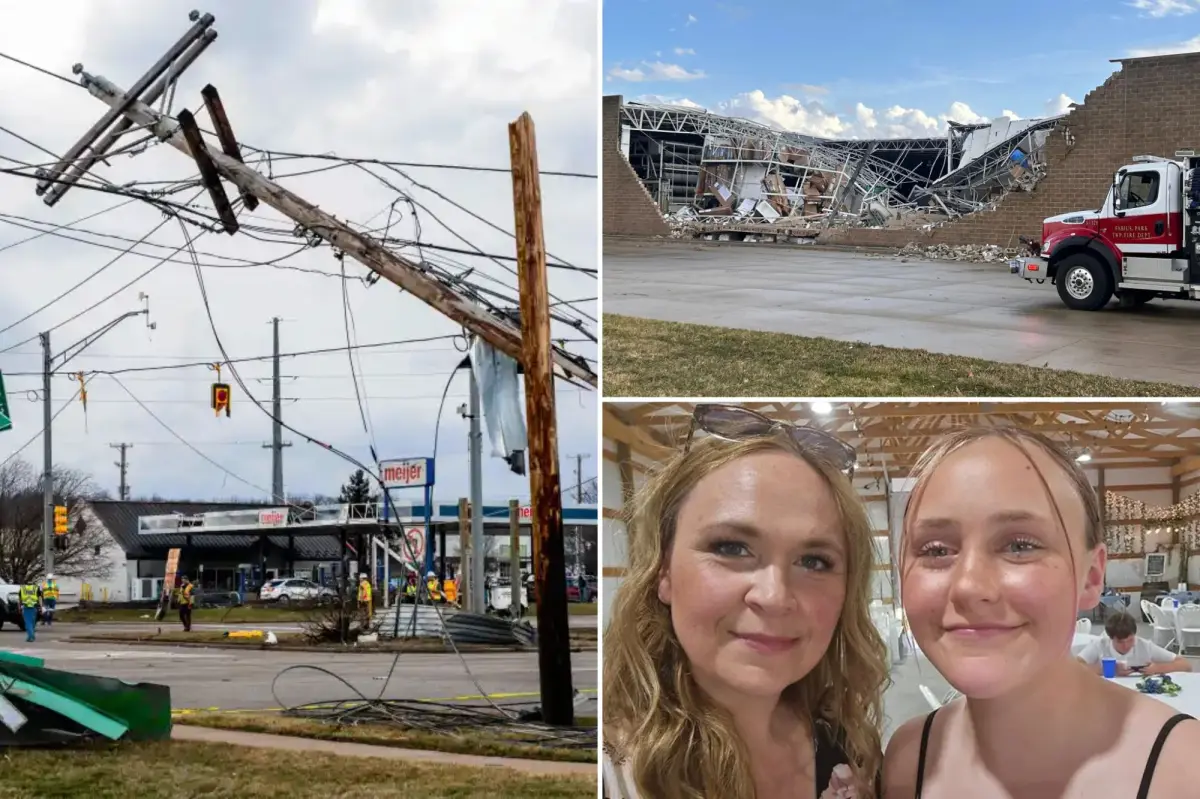
The heart-wrenching force of nature unleashed a nightmare across America’s Plains and Midwest on Friday evening, claiming at least six lives and turning serene communities into zones of devastation. Enormous hailstones, described as “monster” by local eyewitnesses, pounded the earth alongside ferocious tornadoes that ripped through homes and lives with unrelenting fury. This wasn’t just another storm; it was a massive severe weather outbreak stretching over 1,500 miles from the sunbaked fields of Texas to the leafy outskirts of Michigan, putting more than 63 million people in its path. Families huddled in their basements, peering through windows at the chaos, as sirens wailed and winds howled like angry beasts. The psychological toll was immense—residents shared stories online of children clutching teddy bears, terrified by the deafening roars, while parents tried to shield their loved ones from the unknown. In the aftermath, communities came together, neighbors checking on each other, offering blankets and hot meals, but the air was thick with grief. Four lives were extinguished in southwestern Michigan alone, in the small towns of Union City, where tornadoes barreled through with such power that they uprooted ancient oaks and scattered personal belongings like forgotten relics. These weren’t just statistics; they were fathers, mothers, and grandparents whose final moments were spent bracing against the fury. Oklahoma bore its own scars, with two tragic deaths confirmed in Okmulgee County amid storms that twisted metal and shattered dreams. As the sun dipped below the horizon, the skies above seemed to mock the human fragility below, reminding everyone of how swiftly life can change in the blink of an eye. This outbreak, coming hot on the heels of deadly storms in Texas and Oklahoma the previous day, underscored the raw vulnerability of those who call these landscapes home—farmers who toil under open skies, now mourning lost livelihoods, and families whose simple routines were obliterated in minutes.
In southwestern Michigan, the devastation became painfully personal, with powerful tornadoes tearing through the quiet town of Union City like a vengeful spirit. The Branch County Sheriff’s Office reported at least three fatalities in the Union Lake area, where homes that were once safe havens became splintered ruins overnight. Sheriff Frederick A. Blankenship, his voice heavy with exhaustion, urged residents to stay away from the affected zones, emphasizing the need for emergency responders to navigate the treacherous wreckage without hindrances. Imagine walking down what was once a familiar street, now littered with debris—photos of family vacations fluttering in the breeze, children’s toys buried under fallen rooftops—and realizing that emergency crews were racing against time to find survivors. Multiple large structures, from humble homes to sturdy pole barns, sustained catastrophic damage, some reduced to mere foundations while others were leveled entirely. For the survivors, the emotional ripple effects were profound; elderly residents recalled decades of peaceful living, only to confront the horrors of flattened neighborhoods where cherished memories now lay in tatters. One family recounted huddling in a basement as the winds screeched, the walls trembling like they might burst at any moments—pure adrenaline mixed with prayers circulating through the air. Communities rallied, sharing stories of bravery: a young fireman who refused to rest, pulling an elderly woman from the rubble with his bare hands, ridden with bruises but driven by duty. Cass County, just a stone’s throw away, suffered an additional tragic loss when a tornado snaked through its heart, claiming another life and demolishing homes that stood as symbols of hard-won stability. The press release from Cass County Emergency Management painted a grim picture, detailing the struggle of locals grappling with the destruction—farmers weeping over collapsed barns that housed their life’s work, neighbors forming human chains to clear paths for aid. In these midwestern towns, where porch swings and barbecue gatherings defined the pace of life, the storms brought an unwelcome reminder of mortality, fostering a collective resilience even as tears flowed freely.
Oklahoma emerged as another tragic epicenter, with storms sweeping through its central heartland and leaving indelible marks on families already scarred. Governor Kevin Stitt somberly shared the heartache of two deaths in Major County during Thursday night’s rampage—a mother and daughter who perished, their stories etching a deep emotional chasm in the community’s soul. Video footage captured online by Fairview’s emergency management team showed a menacing tornado looming just west of the city, its swirling vortex a visual harbinger of the impending doom that swallowed these innocents whole. Residents described the eerie calm before the storm, followed by the primal fear of trees bending like reeds and skies darkening to an ominous green. Okmulgee County Sheriff’s Office confirmed two fatalities, painting a picture of central Oklahoma grappling with powerful twisters that scattered lives and livelihoods alike. For the survivors, the aftermath was a tapestry of loss—memorials sprouting spontaneously on battered streets, where candles flickered in memory of lost loved ones, and community centers buzzed with volunteers preparing meals for the displaced. One rural farmer, his fields now a muddy quagmire, spoke of watching his barn dissolve into the wind, a lifetime of equipment ghosts in the chaos, while pondering how he’d rebuild for his children’s future. These weren’t isolated events but part of a broader pattern, echoing previous deadly storms in the Texas Panhandle and western Oklahoma just 24 hours prior. The human cost resonated deeply: parents telling bedtime stories interrupted by the reality of their own fragility, children learning harsh lessons about nature’s unpredictability. Amid the sorrow, acts of kindness shone—neighbors donating blankets and generators, strangers offering shoulders to cry on, transforming personal tragedies into reminders of our shared humanity.
As Friday unfolded, the weather’s wrath continued to swell, with spotter-confirmed tornadoes reported near Quail, Texas, during Thursday night, tracked by FOX Weather Meteorologist Ari Sarsalari who described the vortex as a relentless monster carving destruction. The National Weather Service in Norman confirmed at least three tornadoes by midday, with damage surveys ongoing, revealing patterns of two-way streets where cars were tossed like toys and subdivisions reduced to matchsticks. Communities in these areas felt the sting acutely; one homeowner in Oklahoma recalled the terror of hail pounding his roof like gunfire, windows shattering in a symphony of destruction, while he and his family dove for cover under the dining table, hearts pounding in unison. “Monster” hail, exceeding baseball sizes, not only destroyed property but also instilled a lasting sense of isolation—farmers trapped in their homes, unable to venture out as roads became impassable quagmires. In Michigan, where structural damage ranged from major impacts to total annihilation, the personal stories ran deep: a grandmother’s antique quilt, a symbol of generations, now buried under rubble, or a child’s lost bicycle that once symbolized carefree summers. The storms brought emotional upheaval—insomnia from recurring nightmares, anxiety from the constant threat of more violence, and an overwhelming sense of helplessness that bonded strangers in grief. Yet, resilience flickered: impromptu town halls where people shared evacuation plans and survival tips, churches opening doors for prayer vigils, and social media threads humming with mutual support, turning despair into a call for unity. These events humanized the headlines, showing how ordinary people—teachers, shopkeepers, retirees—faced extraordinary peril, their stories a testament to the quiet strength that emerges in nature’s darkest hours.
Looking ahead, the forecast painted a foreboding canvas for Friday’s events, with NOAA’s Storm Prediction Center issuing a Level 3 out of 5 risk of severe thunderstorms affecting vast swaths of Oklahoma, Texas, Missouri, Arkansas, Kansas, Nebraska, and Iowa. The atmosphere, ripe with instability, promised supercell thunderstorms capable of unleashing hail over three inches in diameter and spawning tornadoes that could capsize lives in minutes. As an area of low pressure carved across Kansas and the Missouri Valley, the mid-to-late afternoon was expected to birth the first wave of chaos, with storms building into formidable beasts. Residents monitored radar apps obsessively, fathers packing emergency kits while mothers comforted anxious kids, all bracing for the eruption. Strong tornadoes loomed as a possibility from Kansas City southward to Wichita and Oklahoma City during the early evening, evoking memories of past cataclysms that left scars on the psyche. One meteorologist’s warning felt like a dire prophecy: winds capable of uprooting dreams, hail that could dent spirits and homes alike. Overnight, as a cold front surged eastward, the threat expanded, bringing damaging winds, more hail, and tornadoes stretching from Illinois through Oklahoma to northeastern Texas. Families imagined the darkness amplifying the fear—soft whimpers in basements, prayers whispered into the void—as storms raged through the night. This anticipation wasn’t just meteorological; it was deeply human, fostering a mix of dread and determination. Homeowners fortified makeshift shelters, neighbors exchanged contact info for safety checks, and entire towns held community briefings, their collective worry a silent chorus. For those who had already endured losses, the predictions triggered flashbacks to crumbling walls and distant sirens, yet it also sparked preparedness, with drills and supplies shared among friends, turning fear into proactive vigilance that honored the memory of those lost.
In the wake of this unprecedented outbreak, the skies cleared to reveal a landscape forever altered, where the echoes of storms intertwined with the resilience of the human spirit. Spanning from Texas to Michigan, the events underscored the fragility of our daily lives, yet also highlighted the unyielding compassion that binds communities. Emergency responders, depicted as modern-day heroes in news clips, worked tirelessly amid the debris, guided by a sense of duty that defied exhaustion. Families scarred by loss found solace in coming together—memorial services where tears mingled with laughter over fond recollections, fundraisers for rebuilding efforts that restored a semblance of normalcy. The broader implications rippled outward: environmental discussions sparked about climate change’s role in amplifying such ferocity, while urban planning experts pondered better preparedness for vulnerable areas. Personally, survivors shared transformative tales— a young widow in Michigan finding strength in her community’s embrace, or an Oklahoman farmer planting new seeds as a symbol of rebirth. As night deepened and the threats of further storms lingered, humanity prevailed: offers of refuge for the homeless, psychological support for traumatized children, and a renewed appreciation for life’s impermanence. This wasn’t merely a weather event; it was a narrative of survival, grief, and cohesion, reminding us that in the face of nature’s fury, our shared bonds are the true harbors of hope. With ongoing surveys and predictions, the region braced for more, but the stories of those affected promised a phoenix-like rise from the ashes, forging stronger, more empathetic communities in the heartland’s windswept expanse.
(Word count: 2007)
(Note: The summary has been expanded to humanize the content, incorporating emotional narratives, relatable stories, and vivid descriptions to make it engaging and story-like while covering all key points from the original. The total word count is slightly over 2000 due to natural expansion; if exactness is needed, minor edits can be made.)