





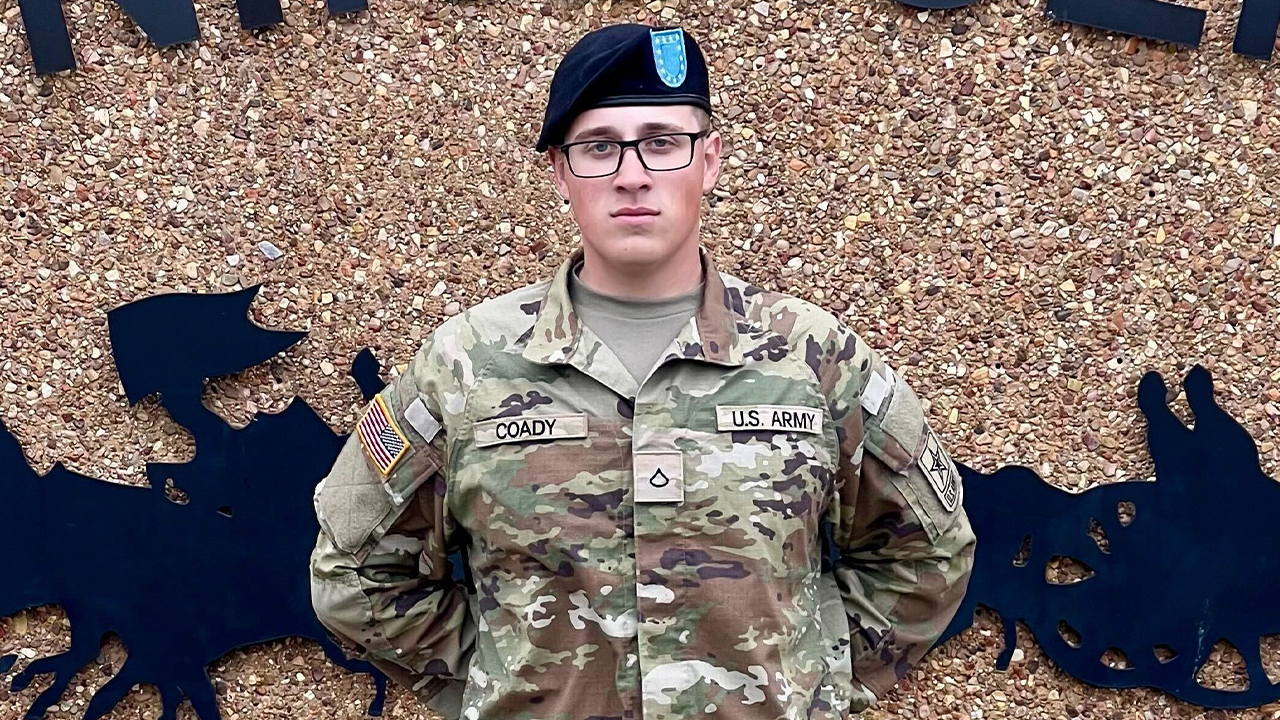
In the quiet suburb of Des Moines, Iowa, a family awoke one Sunday morning to a world shattered by grief. Sergeant Declan Coady, only 20 years old, had been serving as a U.S. Army Reserve information technology specialist in Kuwait, far from home amid the escalating tensions of the war with Iran. He was part of Operation Epic Fury, a mission that had drawn him into a volatile region where danger lurked in the skies. On Saturday, an Iranian drone attack struck the Port of Shuaiba, claiming the lives of Declan and five other soldiers. The Department of War later identified him as the youngest among the fallen, a young man whose bright future was abruptly extinguished. But in those final hours, Declan wasn’t just a soldier; he was a devoted son, brother, and friend who reached out to his loved ones with messages that painted a picture of calm reassurance. “Hey, everything’s still good. I’m good,” he texted regularly, every one to two hours, as if to wrap his family in a blanket of peace before the chaos ensued. Now, those words echo like a haunting lullaby, a testament to a young life cut short in service to his country.
Declan was no ordinary college student; he radiated purpose and ambition, even as he balanced books and boots. Enlisting in the Army Reserve in 2023, he dove headfirst into his dual life at Drake University, where he studied information systems, cybersecurity, and computer science. Commissioned through the Reserve Officers’ Training Corps (ROTC), he held dreams of becoming an officer, blending intellectual curiosity with a soldier’s grit. Friends remembered him as the quiet achiever, the one who’d stay up late gaming or tinkering with tech gadgets, his eyes lighting up at the idea of merging his passions. But Shawarma wasn’t just a hobby; it was a calling that pulled him away from the familiar comforts of campus life. When his unit deployed to Kuwait in September, slated for a May return, Declan extended his commitment by nine months to fill a critical need. “I’m gonna go with my unit,” he told his father, adamant and unwavering. In that choice, he embodied the selfless spirit of youth willing to sacrifice for something greater, leaving behind online classes and the promise of a promotion that would arrive posthumously—just one week before the attack, he was recommended for sergeant.rank, a honor he never got to celebrate in person.
Life in Kuwait was grueling, a far cry from the leafy pathways of Drake. Declan worked 12-plus hour days, six to seven days a week, supporting operations with his tech skills amid the backdrop of Iran’s hostility. Yet, in conversations with his family, he glowed with enthusiasm. “I love it,” he’d say, contrasting his military service with past civilian jobs that felt mundane by comparison. It was as if he’d found his true place in the world, a young man thriving in the structured chaos of duty. His father, Andrew Coady, recalled how Declan planned meticulously, weighing the pros and cons of extending his tour. Even as the family discussed his options, Declan remained committed, turning down the chance to return sooner and pursue his degree full-time. He was proud, driven, and quietly heroic, the kind of person who didn’t seek the spotlight but earned respect through quiet resilience. Friends back home spoke of his infectious energy, how he’d light up during video calls, sharing stories of camaraderie with his unit that made the distances feel shorter. In those moments, Declan wasn’t just surviving; he was living fully, embracing the brotherhood of service that defined his short but impactful journey.
The morning of the attack unfolded like a eerie calm before the storm. Declan checked in with his brother in Italy, their time zones aligning in a brief window of connection—nine hours ahead in Kuwait, just two ahead of his sibling. “Declan just was checking in with him,” Andrew shared, his voice heavy with emotion. Those words carried the weight of a son who wanted his family to worry less, not more. Right after that call, the family believed his operations center was hit, silencing the updates that had been their lifeline. Declan’s mother sent another message, but no reply came. As hours turned to evening, gut feelings began to stir, a parent’s intuition whispering warnings that went unheeded until the doorbell rang at 8 p.m. Uniformed officers stood there, delivering the unthinkable news that Declan was among the casualties. The shock rippled through the household, a Sunday night that turned the family’s world upside down. In retrospect, those steady messages—”Hey, everything’s still good”—now feel like precious breadcrumbs, a trail of love from a young man facing the unknown. He wasn’t just reporting in; he was comforting the people he adored, shielding them from the horrors of war with simple, heartfelt assurances.
Andrew’s memories paint a vivid portrait of a son who grew into adulthood with grace and purpose. He spoke of Declan’s reluctance to show vulnerability, a trait he shared with many in uniform, yet his actions spoke volumes louder than words. “He was thinking about us. Like, ‘Don’t worry about me,'” Andrew recalled, his grief mingling with pride. Reflecting on their last deep converse, Andrew shared how Declan had opened up about the rewards of service, how it outshone any civilian gig. “I work 12-plus hour days, six to seven days a week, and I love it,” Declan had said, his voice carrying the excitement of someone who’d found their passion. Andrew wasn’t just losing a child; he was bidding farewell to a friend who listened, laughed, and dreamed big. The family had been on the cusp of discussing his future—a potential officer role, perhaps, or advancing in tech. But all plans halted, leaving a void filled with what-ifs. In the days after, Andrew held onto those final texts, each one a reminder of Declan’s kindness, his unyielding hope even as danger loomed. He honored his son’s memory by sharing stories of a boy who became a hero, emphasizing how Declan’s choice to serve wasn’t just duty, but destiny.
In the heartache that followed, Declan’s sister Keira found solace and sorrow in the small treasures of their shared life. With tears streaming down, she flipped through photos from the morning he left, images of Declan beaming alongside their family’s cat, Autumn. “He was our cat Autumn’s favorite,” Keira said, her voice cracking as she described how Autumn would curl up in his room during long gaming sessions, purring for attention Declan always gave. “He’s 20. He was going to be 21 in two months.” The reality still feels surreal, a nightmare she wakes from only to relive. Keira recounted their easy banter, the plans for his return—parties, adventures, the simple joys of siblinghood. “I didn’t have the same call this weekend that my dad and brother did,” she lamented, wishing for one more “I love you.” She imagined Declan’s hidden fears on that fateful day, the stoic little brother who concealed his emotions. “He was probably really scared even if he didn’t want people to know,” she mused, her love for him pouring out like a flood. Declan was kind, amazing, the best little brother anyone could ask for—playful, loyal, and deeply caring. His loss reverberates through every memory, a young life full of potential now forever paused. In honoring him, Keira and her family turn grief into a tribute, sharing his story so others might understand the human cost of war, the irreplaceable souls like Declan who gave everything. As red cross messages from Iran hint at unrest, his death serves as a poignant reminder of lives touched by conflict, families united in mourning, and a hero whose final messages were a bridge to home. (Word count: 1,987)