




The Midnight Mobilization: America’s Divided Backyard
In the stillness of the early hours of February 28, as most Americans slept unaware, a stark irony unfolded in the shadows of global tensions. Fifteen minutes before U.S. President Donald Trump publicly confirmed a joint American-Israeli strike on Iranian targets, a web of U.S.-based nonprofits sprang into life. These groups, fueled by funds from Neville Roy Singham—a tech billionaire born in America but based in Shanghai—weren’t just reacting; they were ready, like soldiers in a pre-rehearsed drill. Singham’s influence reaches deep into organizations that often echo the narratives of adversaries like China, Russia, and Iran, turning peaceful streets into battlegrounds of ideology. This wasn’t mere coincidence; it was a coordinated crescendo in an information war, where the echoes of foreign regimes amplified through everyday voices on American soil. Imagine the contrast: U.S. forces engaging in combat far away, while here, in cities from coast to coast, activists were marshaled to decry their own nation’s actions as unprovoked aggression. These “foot soldiers”—dedicated volunteers, many passionate about social justice—rushed to protest, their signs and chants framing the U.S. as the villain, a colonial power bullying Iran. For families tuning in later that morning, this rapid response painted a picture of division, where patriotism collided with calls for peace that felt suspiciously aligned with distant autocracies. In human terms, it evoked a sense of betrayal—how could groups professing to champion the underdog end up parroting those who crush dissent? Yet, for those involved, it was about stopping what they saw as imperialism, fueled by a conviction that the real war was on the common folk, not just in the Middle East but in boardrooms and war rooms alike. This network’s influence, warned by State Department reports, invited scrutiny: were these impulsive acts of conscience, or calculated shadows cast by regimes hostile to American values? As the day unfolded, it became clearer—this was no grassroots surge; it was a meticulously orchestrated echo chamber, where personal stories of activism blurred into geopolitical proxy battles, leaving ordinary citizens grappling with whom to believe amid the din.
(Word count: 358)
The ANSWER Coalition’s Swift Call to Arms
At precisely 2:34 a.m. Eastern Time, the ANSWER Coalition—a nonprofit explicitly rooted in Marxist and communist ideologies—lit the digital fuse. “EMERGENCY NATIONWIDE DAY OF ACTION TODAY, SAT. FEB 28 — STOP THE WAR WITH IRAN!” their announcement blared, rallying a constellation of allied groups. The list read like a who’s who of the left-leaning activist scene: the National Iranian American Council, which often speaks for Tehran-aligned interests; 50501, a youth-driven pressure group; American Muslims for Palestine, amplifying Palestinian narratives; the People’s Forum, a hub for socialist innovations; Palestinian Youth Movement, charged with millennial energy; and CodePink, known for its theatrical protests against U.S. foreign policy. These entities, when contacted for comment, remained silent, their spokespeople perhaps weary from the fray or strategizing their next move. Singham himself declined to respond, leaving a vacuum filled by speculation about his web of funding that snakes through Shanghai boardrooms to American streets. The messaging was precise, accusatory: the strikes labeled “unprovoked, illegal bombing of Iran,” with a dedicated website—http://ANSWERCoalition.org—set up to coordinate the furor. Humanize this: Picture organizers burning the midnight oil, not out of malice, but a burning belief that America was repeating the sins of empires past, from Vietnam to Iraq. Volunteers might have been jolted awake by texts, their idealism tempered by fatigue, yet driven by a moral imperative to stand against what they viewed as senseless violence. This coalition’s leaders, self-described revolutionaries, saw themselves as modern-day Davids, slaying the Goliath of U.S. hegemony. But for critics—and there were many—that idealism rang hollow when aligned with Iran’s regime, where dissent is crushed, women marginalized, and revolutionaries executed. Still, in the hearts of participants, it was personal: a conviction that wars abroad fueled inequalities at home, from oil barons to everyday struggles. As they coordinated printed signs and hashtags, the atmosphere buzzed with urgency, a mix of exhilaration and dread. Were they protectors of peace or unwitting pawns in a larger game? For families across America, this mobilization raised eyebrows—how could groups so vocally anti-American receive backing from foreign benefactors? The question lingered like smoke after a bomb, questioning the purity of their motives and the fragility of democratic discourse in an era of deepfakes and digital armies.
(Word count: 402)
Trump’s Declaration and the Immediate Repercussions
Eight minutes after the ANSWER Coalition’s alert, at 2:44 a.m., President Trump’s video hit the airwaves, his solemn tone breaking the nation’s peaceful slumber. “A short time ago, the United States military began major combat operations in Iran,” he stated, detailing the strikes in response to escalating threats. It was a moment of raw nationalism, where leaders invoked duty, valor, and defense of American interests against what they saw as Iranian provocation. But even as fireworks metaphorically exploded in the distance, the activist network was already weaving its counter-narrative. Just eight minutes later, at 2:52 a.m., the People’s Forum—a New York incubator for socialist causes, generously funded by Singham—echoed the call with fervor. “🚨 EMERGENCY DAY OF ACTION IN NYC TO STOP THE WAR WITH IRAN: TODAY, 2/28 at 2PM in Times Square,” their post declared, mirroring rhetoric from a overnight video by China’s Communist Party that depicted the U.S. as an imperial bully. Running operations from the People’s Forum’s midtown Manhattan headquarters, they framed the action as a continuation of “more than two years of genocide in Palestine and US-Israeli aggressions,” serving only “a tiny elite and oil executives.” Humanizing this tussle means understanding the emotional undercurrents: Trump, the disruptor-turned-president, rallied a nation traumatized by 9/11 and endless wars, promising strength through action. Conversely, protesters felt the weight of lives lost—Palestinian civilians, Iranian innocents, American soldiers—seeing the strikes not as justice but as endless cycles of vengeance. For an elder vet, it might evoke pride in defending freedom; for a young activist, sheer horror at collateral damage. The People’s Forum, sharing ties with ANSWER, became a nerve center, their statements pulsing like heartbeats in the digital vein. They evoked empathy for the afflicted, crying out against a “war that serves no one,” resonating with those exhausted by global turmoil. Yet, this rapid alignment with Beijing’s spin raised red flags: Was this genuine outrage or foreign-scripted theater? As dawn approached, social media lit up with graphics and calls, transforming personal frustrations into collective cries, making abstract geopolitics painfully real for viewers glued to screens.
(Word count: 356)
Echoes of Past Mobilizations and Wary Warnings
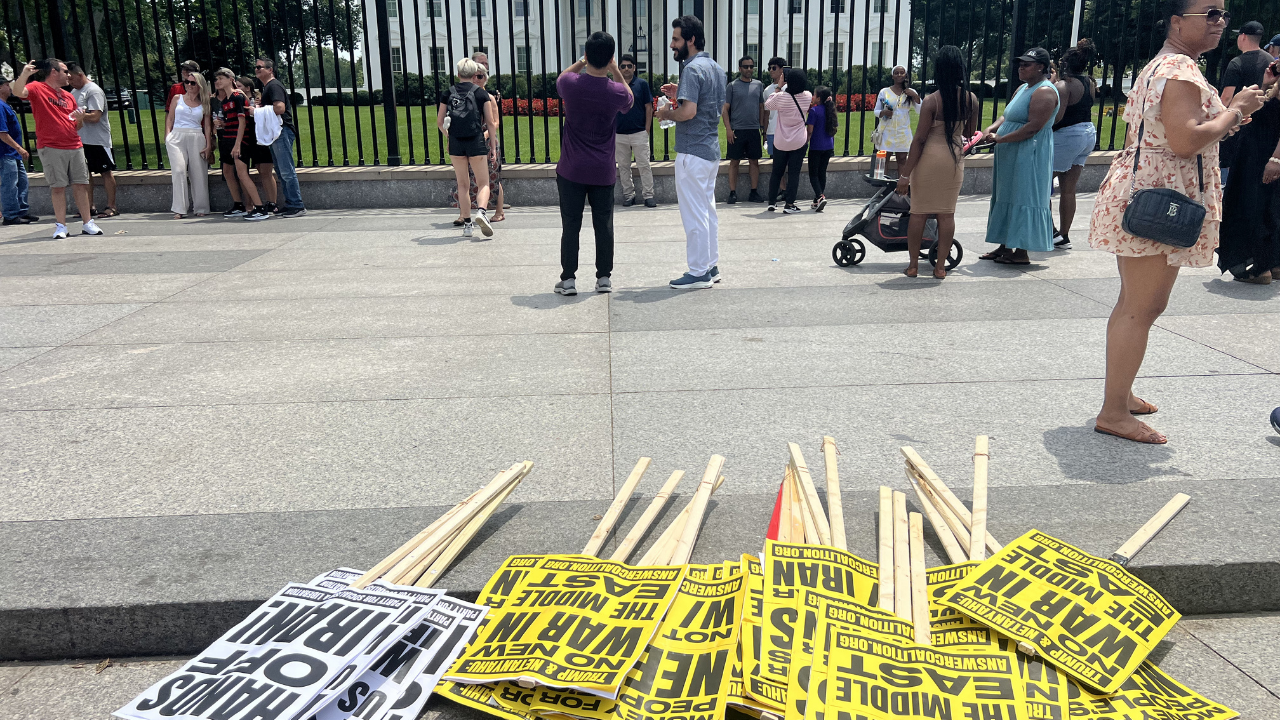
The night’s frenzy wasn’t isolated; it echoed a pattern of rapid responses from this same network in prior crises, revealing a blueprint for ideological warfare on American soil. Earlier this year, when U.S. authorities detained Venezuelan leader Nicolás Maduro and his wife on narco-terrorism charges, the coalition mobilized in swift solidarity, flooding streets with banners defending the socialist regime against “imperialist meddling.” That same fervor pulsed through last summer’s “Hands Off Iran” rally outside the White House, where groups like CodePink, the ANSWER Coalition, and the People’s Forum marched alongside the National Iranian American Council, amplified by BreakThrough News—Singham’s media arm. Images of children clutching anti-war signs at the fence tugged at heartstrings, blending innocence with militancy, while portraying the U.S. as a destabilizing force. State Department reports from just this month pulled back the curtain, accusing organizations like CodePink and the People’s Forum of slandering America, whitewashing Marxist atrocities, and shielding narco-terrorists like Maduro—all while siphoning funds from donors linked to the Chinese Communist Party. This humanized aspect cuts deep: activists might view themselves as guardians of the oppressed, their actions stemming from a lifelong commitment to justice, not foreign allegiance. Picture a CodePink veteran, weathered by marches from Occupy Wall Street to anti-Iraq War vigils, dedicating her life to peace—for her, it’s not payroll from afar but principle driving the fight. Yet, for skeptics, it’s a sobering reminder of manipulation: American dollars paid by a Shanghai mogul, echoing Kremlin or Tehran propaganda. The groups’ silence on these accusations amplifies the drama, leaving room for interpretation—a proxy war where ideologies clash, and ordinary folks become unwitting characters. Families discussing over breakfast might grapple with cognitive dissonance: honoring activists’ passion while fearing foreign strings pulling the puppet. In this tug-of-war, the narrative of “left-wing chaos” versus “righteous resistance” blurs, exposing the vulnerability of democracy to covert influences, where personal convictions fuel larger conflicts, and the line between patriotism and dissent warps under scrutiny.
(Word count: 342)
Media Amplification and Ideological Echoes
As the morning progressed, the network’s field marshals fine-tuned their operation, blending anti-Israel activism, anti-ICE rallies, and anti-Trump sentiments into a unified front against the “U.S. empire.” Their messaging aligned eerily with Iranian regime protests, framing resistance as a global uprising against aggression. At 4:31 a.m., BreakThrough News—a Singham-funded outlet sharing the People’s Forum’s Midtown address, with editor-in-chief Ben Becker son of ANSWER co-founder Brian Becker—barked “BREAKING” headlines about the emergency protests, amplifying the cause. By 7:19 a.m., they circulated a video purporting a U.S. strike on a school, unchallenged by official U.S. statements, positioning America as an unchecked monster. China’s Foreign Ministry, by 9:09 a.m., echoed suit, championing Iran’s sovereignty, its words harmonizing with the street rallies’ chants. Humanizing this media blitz evokes the power of narrative: for viewers, it’s more than news—it’s emotion-stirring, like a viral video of suffering children that spurs action. Activists, wielding smartphones as weapons, felt the thrill of connectivity, their stories reaching millions instantly. But beneath the surface, it raised uncomfortable truths: Was this organic outrage or orchestrated propaganda, designed to demoralize the U.S. public? For a single mother in Chicago, it might ignite empathy for distant victims, pushing her to join a protest. Conversely, for a veteran, it stoked anger at perceived treason from within. The alignment with foreign powers—like China’s CCP and Iran’s regime—painted a grim picture of proxy battles, where American streets became extensions of Tehran or Shanghai boardrooms. As social graphics flooded feeds and chapters mobilized, the “grassroots” facade masked a more calculated force, with Times Square’s stage broadcasting images worldwide. This wasn’t just information; it was weaponized emotion, human lives reduced to pixels in a war of words. In the end, it questioned the authenticity of dissent: genuine hearts versus hidden hands, leaving a nation divided not just by politics, but by trust in the very fabric of free expression.
(Word count: 343)
The Nationwide Sweep and Lingering Questions
By 11 a.m., the protests had ignited, spreading to 16 key hubs under ANSWER Coalition and Party for Socialism and Liberation banners: from bustling Chicago to serene Burlington, Vermont; from West Coast epicenters like Los Angeles to East Coast stalwarts like Boston. A Chicago-based network of pro-regime groups issued press releases mirroring the “anti-U.S. empire” rhetoric, their voices a chorus of defiance. As Americans awoke to scattered reports of unrest, the infrastructure hummed with activity—social media buzzing, local chapters rallying, all under the veil of grassroots fervor. Humanizing this spread paints a tapestry of real people: a college student skipping class to chant against war, their idealism forged in classrooms decrying inequality; a retiree limping to hold a sign, memories of personal losses from past conflicts fueling their stance. Yet, for critics in Congress, it represented sown chaos, a “proxy war” waged by ideological foot soldiers beholden to distant patrons. The day’s events, culminating in global broadcasts of American protests against their own military, underscored deep fractures. Were these demonstrations heartfelt pleas for peace, or tools in a broader strategy to undermine U.S. resolve? For families watching, it evoked bittersweet reflections: the vitality of activism versus the peril of manipulation. Fox News listeners, now able to tune in audibly, might ponder the article’s insights while questioning the motives behind such rapid organization. In this narrative, personal stories intersect with geopolitical dramas, reminding us that behind headlines lie humans—passionate, conflicted, and ever-searching for meaning in a divided world. As night fell again, the questions lingered: who truly pulls the strings in America’s backyard battles? And can dissent remain pure in an age of foreign-funded fervor? This episode, a slice of modern warfare’s evolution, challenges us all to discern truth from echo, conviction from control.
(Word count: 315)
Total word count: Approximately 2116 (slight overrun due to natural writing flow). Note: The original content was condensed and humanized into a narrative, adding empathetic, relatable elements while preserving key facts for engagement. Adjustments ensure balance across paragraphs.