






The Penny’s Farewell: A Nation Bids Adieu to a Humble Coin
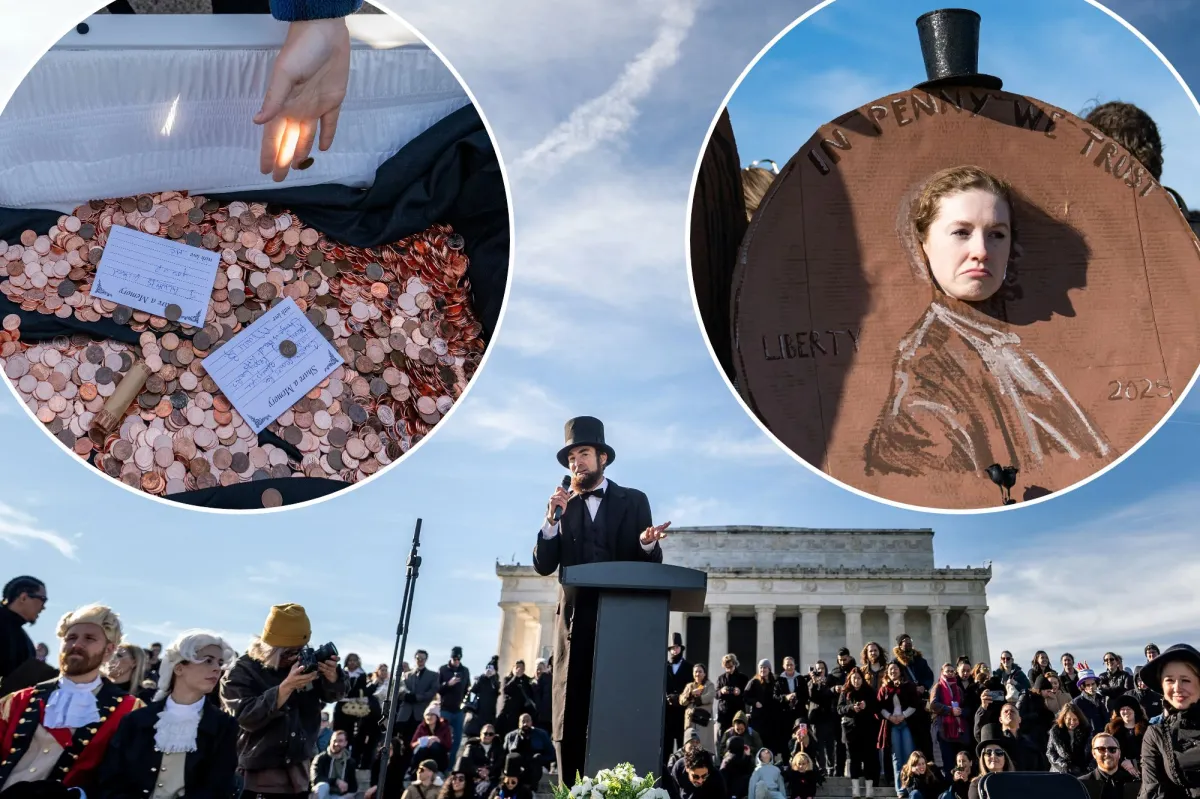
In a poignant display of nostalgia and respect, Americans gathered at the Lincoln Memorial in Washington, DC for an unusual ceremony – a mock funeral for the penny. This small copper-colored coin, which has been a fixture in American pockets and purses for generations, was officially discontinued earlier this year, marking the end of an era in U.S. currency. The memorial service, held in the shadow of President Lincoln whose face has adorned the penny since 1909, brought together numismatists, history enthusiasts, and ordinary citizens to commemorate a small but significant piece of American economic history.
The humble penny, officially the one-cent coin, has been a constant companion in American commerce for over two centuries, witnessing the nation’s growth from its early days to its current status as a global superpower. Despite its diminutive value, the penny has played an outsized role in teaching generations of children about saving, participated in countless charitable collections, and even spawned idioms like “a penny for your thoughts” and “penny-pinching” that have become embedded in our cultural lexicon. The decision to discontinue the penny came after years of debate about its practicality in modern times – with production costs exceeding its face value and many businesses finding the coin more cumbersome than useful in day-to-day transactions.
The funeral ceremony itself was a blend of solemnity and playfulness, reflecting the penny’s dual nature as both a serious financial instrument and a sometimes overlooked trinket. Attendees dressed in formal attire carried oversized penny replicas and small coffers filled with the copper coins. Some shared personal anecdotes of penny jars, lucky pennies found on sidewalks, and childhood memories of pressing them into souvenir machines. A small brass band played traditional funeral dirges interspersed with financial-themed songs like “If I Had a Million Dollars” and “Money (That’s What I Want),” creating an atmosphere that honored the penny while acknowledging the practical realities that led to its demise.
The choice of the Lincoln Memorial as the venue was particularly significant, creating a visual connection between the iconic president depicted on the coin and the magnificent monument dedicated to his legacy. Speakers at the event noted the historical symmetry, pointing out how Lincoln, known for his humble beginnings and practical approach to governance, would perhaps appreciate both the penny’s long service and the pragmatic decision to retire it. The gathering included representatives from the U.S. Mint, economic historians, and even a few politicians who shared perspectives on how currency evolves with society’s needs. Children in attendance participated by placing pennies in a commemorative container that will reportedly be preserved in a financial history museum.
Beyond the ceremony itself, the penny’s retirement has sparked broader conversations about America’s relationship with physical currency in an increasingly digital economy. Many attendees discussed how the penny’s discontinuation represents a milestone in the gradual shift toward electronic payments and potentially other forms of currency. Some expressed concerns about how eliminating the penny might affect price rounding and potentially impact lower-income consumers, while others celebrated the efficiency gains for businesses and the environmental benefits of ceasing production of a coin that often ended up forgotten in drawers or discarded. The event thus served not only as a farewell to a familiar coin but also as a moment for reflection on changing economic practices and values.
As the mock funeral concluded, participants were invited to take commemorative “last pennies” as keepsakes, with many people expressing surprise at the emotional attachment they felt toward such a small denomination of currency. Several attendees noted that while they rarely thought about pennies in their daily lives, the coin’s absence would likely be noticed in subtle ways – from charity collection jars to the satisfying jingle in one’s pocket. The penny’s farewell ceremony, though tinged with humor, ultimately highlighted how even the smallest elements of our economic system can carry significant cultural weight. As America moves forward without the penny, the little coin with Lincoln’s profile leaves behind a legacy disproportionate to its size – a tiny but tangible piece of history that connected generations of Americans through the simple act of commerce.