






The Invisible Front: Inside Ukraine’s Drone Warfare Revolution
A Digital Revolution on the Battlefield
In the partially ruined buildings of Ukraine’s Kherson region, a new kind of warfare unfolds daily—one that plays out on small screens rather than traditional battlefields. This grainy drone footage, captured by Ukrainian operators, reveals the stark reality of modern combat where soldiers rarely see their enemies face-to-face. The operators, born in or near Kherson, now defend their homeland through technology that resembles video games but carries the weight of life-and-death decisions. Their unit consists of a commander, pilot, navigator, and explosives technician—all essential components in this new age of warfare where commercial drones modified for combat have become game-changers in Ukraine’s defensive struggle.
The transformation of war through affordable drone technology represents perhaps the most significant tactical shift in ground combat since the widespread adoption of precision-guided munitions. These Ukrainian drone teams work from makeshift command centers, their eyes fixed on monitors displaying aerial perspectives of enemy positions across the Dnipro River. The soldiers can barely venture outside without being spotted by similar Russian drone operations that mirror their own. The continuous surveillance from above has created a battlefield where movement itself has become dangerous, forcing both sides to adapt to a perpetual state of visibility that previous generations of warriors never experienced.
“Drone operators wage their war from the air, but they rarely see the sky,” explains Sergeant Serhiy, a 46-year-old former infantryman who joined the drone unit after being wounded when his vehicle hit a mine. He and his comrades spend countless hours in dimly lit rooms surrounded by the tools of their trade—wires, antennas, zip ties, duct tape, and soldering irons used to modify commercial drones for military purposes. The Ukrainian military has recognized the strategic importance of this technology by becoming the first major force worldwide to create a separate branch dedicated to unmanned systems, with tens of thousands of soldiers serving in these specialized units even as traditional infantry faces critical personnel shortages.
The Anatomy of a Drone Strike
THE PREP: From Commercial Product to Lethal Weapon
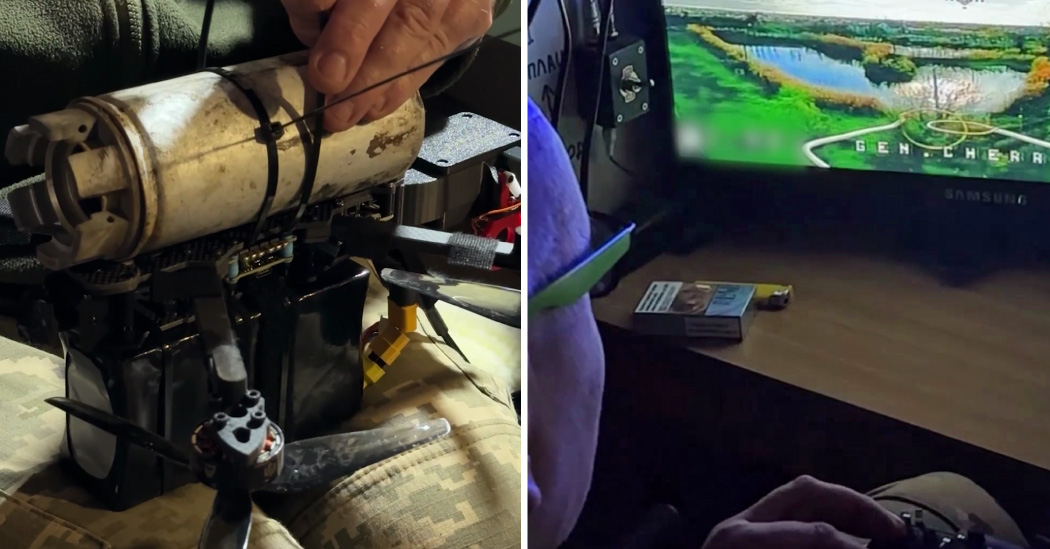
Between missions, the team’s explosives technician works methodically in a separate room, preparing different charges for specific targets. Pellet-packed explosives are designed for use against personnel, while mixtures of TNT and mining explosives are reserved for hardened bunkers. The juxtaposition is striking—consumer electronics being transformed into precision weapons using basic materials in conditions that would seem familiar to any garage tinkerer. A wood stove provides warmth during cold weather, creating an almost domestic scene that belies the deadly serious work taking place.
The reliance on modified commercial drones wasn’t merely a tactical choice but a necessity born of Ukraine’s early-war artillery shell shortages. What began as improvisation has evolved into a sophisticated system that compensates for Ukraine’s relative disadvantage in conventional firepower. While the soldiers prepare their equipment, they simultaneously monitor for enemy drones using interceptors that can detect video signals broadcast by Russian operators across the river. When the detector screen flickers with images of their own position, they know they’re being watched and are potentially in grave danger—a daily psychological burden of knowing that at any moment, they could become targets themselves.
“It’s flying near us,” Sergeant Serhiy warns when the detector picks up a signal from a Russian drone. Moments later, the signal vanishes as Ukrainian electronic jamming systems engage, followed by the distant sound of the disabled drone crashing to earth. This electronic cat-and-mouse game plays out continuously, adding layers of complexity to combat that extend far beyond traditional military engagements. When not actively engaged in missions, the soldiers smoke and chat to pass the time, awaiting orders that could come at any moment.
THE CALL: When Surveillance Becomes Action
The transformation from surveillance to strike happens with remarkable speed. When a Ukrainian reconnaissance drone identifies what appears to be a Russian bunker across the Dnipro River, the command center relays coordinates through secure communications. The navigator receives detailed descriptions of the target while the explosives technician fastens a plastic bottle containing explosives to a drone—the improvised yet effective delivery system for this particular mission. Battery and other components are quickly assembled, and within minutes, the modified commercial drone is ready for deployment.
The mission target lies at a position where Russian and Ukrainian forces are separated by just a few hundred yards, making conventional artillery strikes complicated and dangerous for friendly forces. The drone represents a precise alternative that minimizes risks of friendly fire. As tension builds in the preparation room, Private Oleksandr ties a string between a safety mechanism on the drone and the wooden box from which it will launch. This simple but effective arrangement ensures the explosive remains safe until the drone is airborne—when the craft lifts off, the string will disengage the safety mechanism, arming the device.
The most dangerous moment for the team comes when the drone must be taken outside for launch. Private Oleksandr must briefly leave the safety of their hideout, exposing himself to potential enemy surveillance. His only defense against being spotted is speed—the entire process from receiving the order to launching the drone takes just ten minutes. Sergeant Serhiy and Corporal Oleh, the navigator, take positions before three large computer monitors, preparing for what resembles a video game session but carries real-world consequences that cannot be reset or replayed.
Modern Combat Through a Digital Lens
THE FLIGHT: Navigating a Contested Electronic Battlefield
The flight itself represents a masterclass in modern electronic warfare. Due to GPS jamming employed by Russian forces, the drone team must navigate using visual landmarks like distinctive trees and bends in the river. While the craft used for this mission is called a first-person-view (FPV) drone, operating it successfully requires perfect coordination between two specialists. The pilot controls the craft using a remote console while watching the video feed from the drone’s camera, while the navigator simultaneously monitors footage from both the strike drone and a separate surveillance drone while receiving continuous guidance from the command center.
Some Ukrainian drone pilots prefer virtual reality goggles for a more immersive perspective, but this team opts for desktop monitors, allowing Corporal Oleh to guide Sergeant Serhiy by physically pointing to geographic features on the screens. The target lies several miles away across the wetlands of the Dnipro River, requiring precise navigation through intermittent radio interference that threatens to disconnect the operators from their airborne platform. Despite these challenges, the unit maintains contact, and a few minutes after takeoff, Sergeant Serhiy carefully steers the explosive-laden drone directly into the identified trench.
The strike registers as an immediate success. The surveillance drone captures clear footage of the explosion, confirming the target was hit with precision. The process represents a remarkable evolution in warfare—a relatively inexpensive commercial product, modified with readily available materials, has successfully struck a military target that would previously have required expensive precision missiles or risky close-quarters combat. This democratization of precision strike capability has fundamentally altered the tactical landscape in Ukraine and has significant implications for future conflicts worldwide.
THE AFTERMATH: The Human Element Behind Digital Warfare
There is no celebratory cheering after a successful strike—a marked contrast to the dramatized portrayals of warfare in films and games. The operators exhibit a professional detachment that belies the psychological complexity of their role. Many drone pilots report being disturbed by what they witness through their cameras—the final moments of enemy soldiers running for their lives or desperately seeking cover. They experience combat through a digital interface that simultaneously creates distance from and intimacy with the violence they inflict.
“They attacked my home,” says Sergeant Serhiy simply, when asked how he processes the moral dimensions of his work. For him and many others in Ukraine’s defense forces, the invasion has clarified the ethical calculus—they are protecting their homeland from an aggressor. Yet the psychological burden remains significant, with operators witnessing death and destruction in high-definition detail while physically removed from the immediate battlefield. This creates a unique form of combat stress that military psychologists are only beginning to understand.
Russian and Ukrainian drone teams occasionally engage in a strange form of direct communication, adding text messages to the unencrypted video feeds transmitted by their drones, knowing the opposing side can see them. “It’s the only way we communicate,” explains Sergeant Serhiy, describing this surreal dimension of digital warfare where adversaries taunt each other through superimposed text rather than shouted words across no-man’s-land. For every successful drone strike, there are typically about ten failures—drones lose signal due to electronic jamming or are shot down by alert defenders. During our observation, however, the unit achieved four successful strikes—an unusually effective performance demonstrating their growing mastery of this evolving battlefield technology.
The Future of Conflict: Lessons from Ukraine’s Drone Revolution
The low-cost drone revolution unfolding across Ukraine’s frontlines has profound implications for military operations worldwide. What began as a desperate improvisation has evolved into a sophisticated system that enables a smaller, less-equipped force to challenge a conventionally superior opponent. These commercial drones, modified in field workshops by soldiers who often learned their skills through online tutorials and practical experimentation, have democratized capabilities that were once the exclusive domain of wealthy military powers with advanced defense industries.
Military analysts worldwide are studying this revolution in real-time, understanding that future conflicts will inevitably incorporate these lessons. The psychological dimension is equally significant—combat increasingly resembles remote work, with operators making life-and-death decisions from relative safety while experiencing war through digital interfaces. Yet the human cost remains immense, with thousands of Ukrainian and Russian soldiers killed by these seemingly innocuous commercial products transformed into lethal weapons. The soldiers operating these systems experience a unique form of combat stress—physically removed from danger but intimately connected to destruction they cause through high-definition video feeds.
As we left the Ukrainian drone team’s position, they were already preparing for their next mission—assembling components, charging batteries, and monitoring enemy activities through their electronic sensors. The grainy footage captured by their cameras represents more than just tactical intelligence; it documents a fundamental shift in how wars are fought. The invisible electronic front has become as significant as physical territory, with jamming, counter-jamming, surveillance, and counter-surveillance creating complex layers of conflict that extend far beyond traditional concepts of the battlefield. In this new domain of warfare, Ukraine’s improvised drone forces have demonstrated that innovation and adaptation can sometimes overcome raw military power—a lesson that will shape military thinking for decades to come.