





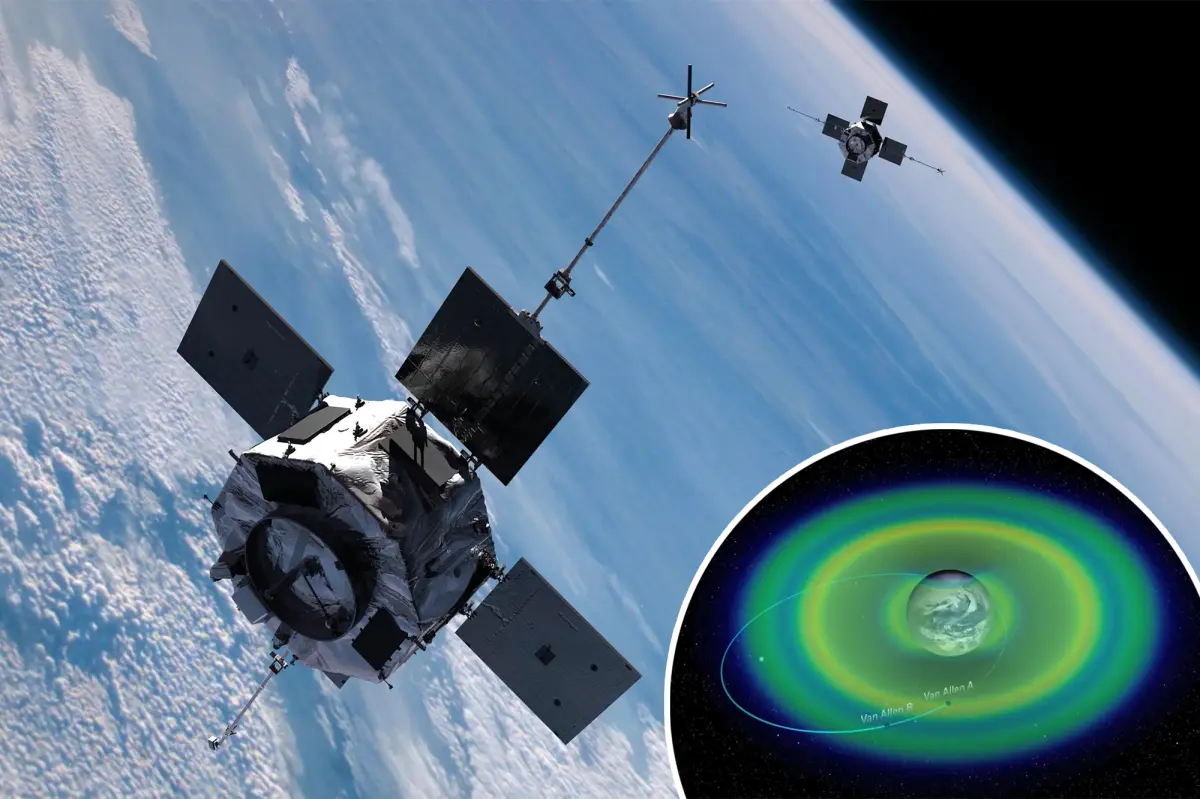
Imagine a cosmic rollercoaster ride where the passenger doesn’t even know they’re on board. That’s kind of what’s happening with the Van Allen Probe A, a hefty 1,323-pound spacecraft named after the legendary scientist who discovered Earth’s radiation belts. This isn’t some Hollywood script, though—it’s a real event unfolding as the probe makes a fiery plunge back to our home planet. After years of orbiting silently in the vast emptiness of space, circling Earth like an invisible guardian, it’s finally time for a homecoming. But this reunion with Earth doesn’t involve warm hugs or family barbecues; instead, it’s a dramatic re-entry through our atmosphere, complete with heat shields, flames, and a fair share of uncertainty. As we gear up for this spectacle, it’s hard not to feel a mix of awe and apprehension, reminiscent of watching fireworks at dusk—beautiful yet unpredictable. The National Aeronautics and Space Administration (NASA) has been monitoring this celestial boomerang with eagle eyes, and their latest update paints a picture that’s equal parts thrilling and nerve-wracking. Scheduled for an approximate touchdown—or splashdown, more accurately—around 7:45 p.m. EDT on March 10, 2026, the probe’s return window spans a full 24 hours, giving us all something to chew our nails over. It’s like waiting for a package from outer space, but instead of a toy or gadget, it’s a massive chunk of technology that could remind us how fragile our cozy existence here is. The folks at NASA aren’t sugarcoating it; they’re calling it a “juggernaut,” a term that evokes images of unstoppable forces tearing through the sky, leaving a trail of glowing embers in their wake. Yet, amid the drama, there’s a comforting reassurance that most of the spacecraft’s bulk will disintegrate as it hurtles through the thick blanket of air surrounding Earth. Think of it as a meteor shower, but with a twist—one that’s man-made and meticulously tracked by scientists who treat it like an old friend returning from a long journey. This whole scenario feels personal, as if the probe is sharing its adventures, and we’re the eager audience gathering to witness its grand finale. The idea of a spacecraft burning up isn’t new—it’s a controlled ballet of physics, where friction from atmospheric re-entry turns metal into molten plasma, evaporating away like mist in the morning sun. But not everything will vanish; NASA predicts that some hardy components, those engineered to withstand extreme conditions, might survive the ordeal and make it to the ground. These fragments could be anything from tough alloy pieces to electronic guts, potentially scattering like confetti across our planet. It’s eerie to ponder, but thankfully, the odds are stacked heavily against anyone getting hit—way, way against it. We’re talking a minuscule risk, about 1 in 4,200, which is the same chance of winning a fun lottery or bumping into a long-lost relative unexpectedly on the street. And here’s the kicker that puts our minds at ease: Earth is a watery world, with oceans covering roughly 70% of its surface. So, if any remnants do defy the odds and slip through, they’re far more likely to crash into a vast, empty sea than land on a crowded beach or someone’s backyard. It’s like the universe is whispering, “Don’t worry, humanity—we’ve got your back, and mostly, it’s going under.” Still, during those tense days leading up to the event, it’s natural to glance at the night sky a little more often, wondering if we’ll catch a glimpse of the probe’s glow as it streaks by. It evokes memories of childhood, staring up at shooting stars and wishing for safe travels. This low risk doesn’t mean we can just sit back and ignore it; NASA’s vigilant watch is a testament to our collective responsibility toward spacefaring neighbors. They’ve been planning for this moment for years, using advanced simulations and telescopes to predict trajectories with as much accuracy as possible. It’s a reminder that while space exploration pushes boundaries, it also requires constant stewardship to ensure our planet’s safety. Families might gather around screens or patios, discussing the wonders of the cosmos over hot cocoa, turning a potentially scary event into an educational opportunity. In essence, this re-entry isn’t just a scientific milestone—it’s a human story of invention, risk, and the fragile dance between Earth and the stars. One wrong calculation, and it could have wreaked havoc, but through meticulous planning and a dash of luck, it’s poised to be a nonevent for most of us. As March 10 approaches, the air will buzz with anticipation, much like the excitement before a major sports game or holiday. People will share memes online, debating whether to don protective helmets on that day or just trust in NASA’s math. It’s a peculiar blend of modern technology and ancient wonder, reminding us that even in the age of smartphones and artificial intelligence, we’re still star-gazers at heart, eager to connect with the mysteries beyond our atmosphere.
Now, let’s zoom out and talk about what this returning spacecraft actually did out there in the great unknown—because understanding its purpose makes this homecoming all the more poignant. Picture yourself as a curious explorer, venturing into uncharted territories armed with gadgets to map the unknown. That’s essentially what the Van Allen Probe A was: a tireless investigator sent to unravel the secrets of Earth’s Van Allen belts, those invisible rings of charged particles swirling around our planet like protective shields. Named after James Van Allen, the father of space physics, these belts are like natural fortresses, trapping high-energy particles from the sun and cosmic rays that could otherwise fry anything unlucky enough to be in their path. From 2012 to 2019, the probe docked there alongside its twin, Van Allen Probe B, playing a cosmic game of particle tag to figure out how these belts gain and lose their cargo. Imagine sorting through a bewildering basement of cosmic junk to understand why some particles stick around while others bolt. This wasn’t idle curiosity; these belts act as Earth’s frontline defense, shielding us from solar storms that could cripple satellites, mess with astronauts, and even knock out power grids here on the ground. Without them, our world of GPS navigation, radio broadcasts, and internet would be in serious jeopardy—so studying them is like inspecting the foundation of a house to prevent future storms. As a result, scientists learned groundbreaking details about how these dynamic regions wax and wane, influencing everything from weather to technological reliability. It’s the kind of knowledge that makes you appreciate the quiet workhorses orbiting above, laboring in silence to keep our daily lives humming. Deployed into the void, the probe orbited through these perilous zones, collecting data that painted a clearer picture of space weather’s ebb and flow. Think of it as a drummer in a band, syncing beats with the sun’s erratic rhythms to create a symphony of protection. The mission wasn’t without its close calls—flying through radiation that’s so intense it’s dubbed “lethal” could fry electronics in seconds. Yet, the probe endured, sending back streams of information that challenged old theories and built new models. This data helps forecast solar flares and geomagnetic storms, allowing humanity to prepare, like a weather report for space. In human terms, it’s akin to having a neighborhood watch that alerts you to incoming trouble, letting families stock up on basics or shield their homes. As the probe hurtles back, we’re reminded that its journey was one of selfless service, gathering intel for the greater good without complaint. And now, as it prepares to burn brightly on re-entry, it’s hard not to feel a sting of nostalgia, like saying goodbye to a faithful companion who’s seen more sunrises than we can count. Families might reflect on how this robot pioneer paved the way for future missions, inspiring kids to dream of space as more than just a distant frontier. It’s a testament to human ingenuity, turning obscure science into tangible benefits that touch lives daily. Without missions like this, we’d be blind to the cosmic threats lurking overhead, relying on guesswork rather than precision. So, as the clock ticks down to 2026, this spacecraft’s legacy lingers, a reminder that exploration isn’t just about conquering space—it’s about safeguarding our shared home.
But wait, here’s where the plot thickens: the Van Allen Probe A wasn’t supposed to linger so long in the spotlight. Originally designed as a two-year gig, much like a temporary job that drags on unexpectedly, the mission stretched into a remarkable seven-year odyssey. This extension wasn’t planned—nobody sets out for a quick errand and ends up on a seven-year vacation—but it happened because the data proved too invaluable to ignore. Picture the excitement among the NASA team, poring over fresh discoveries like kids opening Christmas presents. The probes kept churning out unprecedented insights, revealing intricacies of the Van Allen belts that no one had seen before, proving that sometimes the best plans are exceeded. extending schedules to capture more glory. As the years rolled by, the probe danced through the belts, dodging solar outbursts and gathering insights on how particles interact with Earth’s magnetic field. It was a marathon of discovery, outlasting initial expectations and rewriting textbooks along the way. However, all good things must come to an end, and for the probe, it was when its fuel tank ran dry and its ability to point solar panels toward the sun vanished, leaving it adrift like a ship without sails. This denouement was inevitable yet poignant, a reminder that even machines have limitations. The mission ended not with a bang, but with the spacecraft gracefully relinquishing its orbital perch, falling victim to gravity’s pull after years of defiance. It’s a story that resonates on a human level—think of careers that evolve beyond expectations, friendships that endure longer than anticipated, or projects that bloom into lifeworks. Families watching this unfold might draw parallels to their own lives, where unexpected detours lead to richer experiences. Originally, forecasters anticipated the probe’s re-entry wouldn’t happen until 2034, a decade and a half away, allowing for leisurely planning. But Mother Nature—or in this case, the sun—had other ideas, accelerating the timeline with its unpredictable whims. This early call mirrors real-life surprises, like a vacation cut short by unforeseen events or a reunion rushed by circumstance. As the probe’s fuel dwindled, controllers on Earth monitored helplessly, knowing that deorbiting was the only way to prevent uncontrolled decay. It’s akin to nursing an elderly relative through their final days, cherishing every moment while preparing for farewell. Throughout those seven years, the spacecraft transformed from a tool into a hero, enduring the harsh vacuum where temperatures swing wildly and radiation tests every bolt. Its data streams became lifelines, revealing how the belts respond to solar activity, directly benefiting fields like aviation, power distribution, and even climate modeling. In reflecting on its elongated stay, we see the irony: what began as a short stint became a cornerstone of modern space science. People might share anecdotes online about long-delayed projects in their lives, finding solace in the probe’s resilience. As re-entry nears, it’s not just a mechanical failure we’re witnessing—it’s the culmination of a devoted service, leaving a legacy of knowledge that will enlighten future generations. This extended mission underscores the unpredictability of exploration, teaching us that sometimes the journey matters more than the destination.
Now, let’s delve into the juicy details of why this homecoming is happening sooner than anyone bargained for, adding a layer of intrigue to an already captivating tale. The culprit? A particularly feisty solar cycle that’s been wreaking havoc in ways unseen before. In 2024, scientists confirmed that the sun had peaked at its solar maximum, a phase where our star cranks up its activity like a teenager hitting puberty—erupting with sunspots, flares, and coronal mass ejections that spew solar wind across the void. This cycle has been more active than previous ones, turning expected mild weather into a tempestuous storm. As a result, the atmosphere around Earth swelled with intensified drag, like a balloon filling with too much air, pulling on the spacecraft more forcefully than predicted. It’s reminiscent of how rough winds can knock over garden furniture on a stormy day, except here, it’s atmospheric friction teasing the probe from its orbit years ahead of schedule. Initially, calculations in 2019 pegged re-entry for 2034, giving everyone plenty of breathing room—think of it as planning a retirement party far in advance. But this ramped-up solar energy, with its extra punch, sped things along, reminding us that space isn’t a static exhibit but a dynamic arena where even “constants” can shift. Families might recall vacations disrupted by unexpected weather, empathizing with the probe’s premature exit. The sun’s heightened activity generated stronger solar winds and particle outpourings, boosting atmospheric density and tugging on the Van Allen Probe A like an impatient child pulling a sibling’s sleeve. This isn’t sabotage; it’s pure astrophysics at work, where the sun’s 11-year cycle dictates the pace of events. NASA’s team anticipated some impact but was caught off-guard by the magnitude, leading to revised predictions that brought the date to 2026. It’s a humbling lesson in humility: for all our tech and models, the cosmos still holds surprises. On a personal note, this feels like life throwing curveballs—like a job offer landing during an unplanned move or a health scare urging lifestyle changes. And yet, amid the disruption, there’s value: studying these intense solar periods helps refine future spacecraft designs, making them more resilient. Imagine engineers brainstorming over blueprints, envisioning lightweight materials that resist drag better, or adaptive propulsion for prolonged flights. The probe’s fate underscores the interconnectedness of Earth and her star, where downstream effects ripple outward. As parents explain this to kids, they might use analogies of tides changing with the moon, illustrating unseen forces shaping our world. And in the end, this unexpected nudge toward re-entry isn’t a tragedy—it’s progress, revealing truths about solar-terrestrial interactions that could one day save lives or fortunes in space tourism and beyond. It’s a reminder that even when plans derail, new opportunities emerge, much like rivers carving paths through unforeseen valleys.
Regrets? None for this mission, because even as the Van Allen Probe A prepares for its fiery descent, its legacy burns brighter than ever, proving that some contributions endure long after the hardware fades. The data hauled back from its seven-year slog through the Van Allen belts is a goldmine, still actively mined today for insights into space weather’s wild caprices. Scientists pore over archived files, tracing how radiation belts evolve, which directly informs predictions about solar activity’s impact—think satellite disruptions causing TV blackouts or navigation glitches leaving drivers lost. Astronauts benefit too, gaining clearer warnings about radiation doses that could harm health during deep-space jaunts. Picture a doctor advising a patient on exposure risks based on this probe’s lessons; that’s the real-world power here. Reports from NASA highlight how reviewing this treasure trove sharpens forecasts for geomagnetic storms, potentially averting blackouts that could strand families in the dark or disrupt economies. It’s like having a crystal ball for space, allowing us to button up communications networks, secure power grids, and reroute flights around solar storms. On a human scale, this resonates as protective foresight—akin to weather apps alerting you to pack an umbrella, safeguarding our modern pillars. The probe’s observations of particle dynamics have fueled advancements in modeling, turning vague theories into precise tools. Families might discuss how this data protects their online interactions, from streaming shows to remote work, underscoring gratitude for unsung heroes in the lab. Even post-retirement, the mission influences current satellite designs, incorporating safeguards against belt hazards. It’s a cycle of knowledge, where one probe’s wisdom builds the next, echoing generations learning from elders. Yet, this isn’t all rosy; surviving components add a dash of suspense, sparking debates about contamination risks (though minimal). Overall, the probe stands as a testament to humanity’s quest for understanding, transforming potential peril into prosperity. As re-entry looms, it’s a call to cherish scientific legacies that silently fortify our future.
And what of its twin, that steadfast companion still watching from the heavens? Van Allen Probe B orbits on, expected to dodge re-entry until at least 2030, providing a sequel to this saga with its own unscripted twists. Launched together like siblings in a cosmic Corolla, Probe B mirrors A’s journey through the belts, amassing parallel data that complements and confirms findings. Its continued presence is a silver lining, allowing scientists to cross-reference observations and catch evolutions in real-time. Picture two detectives piecing together a puzzle: where A provides the baseline, B offers updates, revealing how belts shift with solar whims. This tandem service prevents gaps in knowledge, ensuring continuity as space weather evolves unpredictably. Families might parallel this to lifelong partnerships enduring through changes, like friends weathering decades together. Probe B, fueled and functional, shrugs off the same atmospheric drags for now, its solar panels steadfastly bathing in sunlight. But threats linger—radiation could yet claim it, or unforeseen orbital decays could beckon. Still, its extended lease on life means more data for decades, refining models for humanity’s expanding space footprint. Space agencies worldwide leverage its streams for global safety, from military operations to climate research. In humanizing terms, Probe B is the reliable anchor, reminding us that missions transcend individual stories. As 2026 approaches for A, anticipation builds for B’s future reveal, perhaps inspiring new explorations. This legacy isn’t just scientific—it’s inspirational, urging us to invest in ventures that outlive us, much like planting trees for future generations. Ultimately, the Van Allen twins epitomize resilience, their tales bound by discovery’s thread, weaving a narrative of perseverance against the unknown. As we await re-entry’s glow, we honor them, guardians of our fragile balance with the stars.