






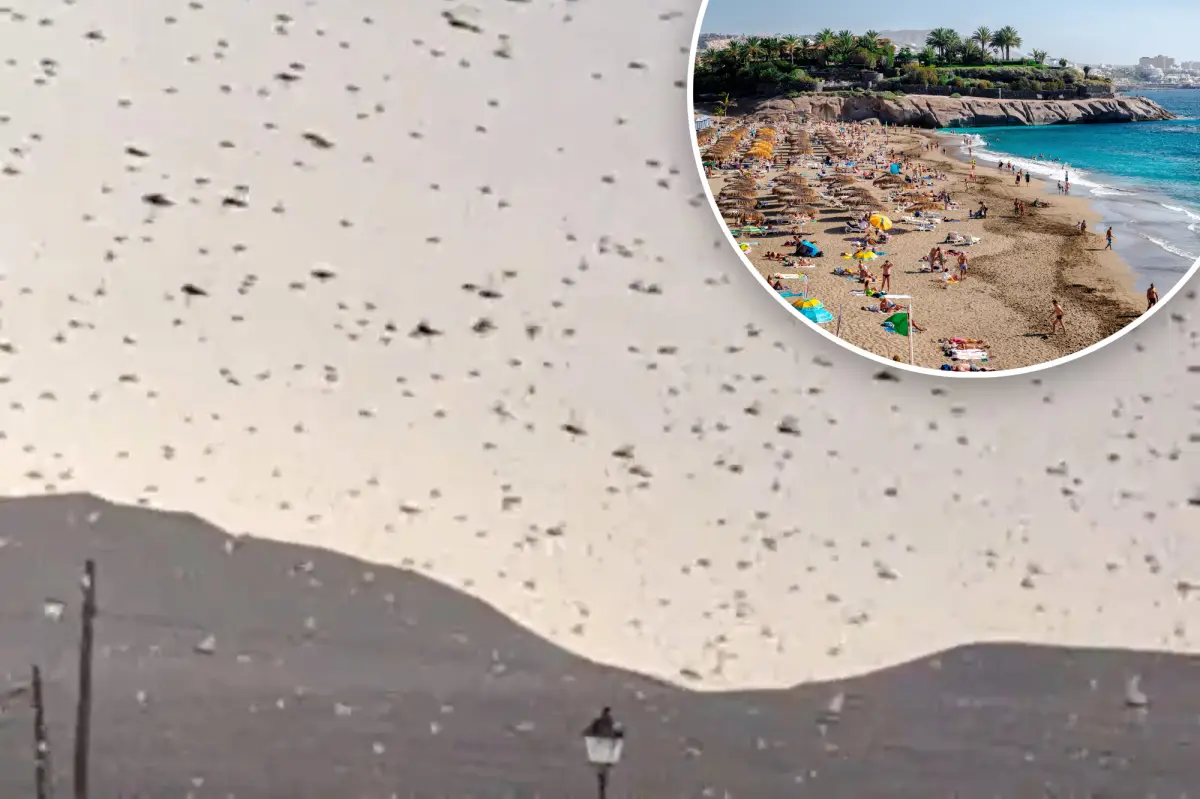
Imagine waking up in the heart of a tropical paradise, with the azure Atlantic Ocean sparkling just miles away, only to discover that the skies are alive with a buzzing, writhing mass of insects, turning day into an eerie twilight. That’s the surreal reality that unfolded recently in the Canary Islands, where a biblical swarm of locusts – yes, straight out of the plagues of the Old Testament – descended upon these idyllic Spanish archipelagos, leaving locals and tourists alike in a state of bewildered awe. We’ve all seen those Hollywood blockbusters where hordes of creepy-crawlies overrun ancient ruins, but this wasn’t fiction; it was happening on vacation spots like Lanzarote and Tenerife, where families plan their escapes to unwind under the sun. Social media exploded with videos of the locusts, some folks comparing it to scenes from “The Mummy” movies, where swarms of scorpions or beetles add that extra layer of nightmare fuel. It’s a reminder that nature’s spectacles can be as thrilling as they are unsettling, transforming a relaxing beach holiday into an unexpected adventure or, for some, a reason to stock up on bug spray. Picture the confusion: early risers stepping outside to water their gardens, only to be greeted by a low hum that builds into a roar, the air thick with wings and legs brushing against skin. This wasn’t just a handful of bugs – it was an epic horde, some estimates putting the swarm at harboring up to 80 million individuals in just 250 acres, enough to evoke that primal fear of being overwhelmed by the untamed world.
The primary battleground of this insect invasion was lanzarote, one of the Canary Islands’ most picturesque jewels, known for its volcanic black sand beaches and European Union designations as a haven for stargazing. Tourists in hotspots like Arrecife, Costa Teguise, Famara, Uga, and Tahíche were the unwitting front-row witnesses to this phenomenon. Families barbecuing by the sea or couples strolling hand-in-hand along the promenade suddenly found themselves dodging aerial assaults, the locusts blotting out the sun like a living cloud. It wasn’t random; these short-horned grasshoppers, the so-called desert locusts, were blowing in from the Sahara Desert in Africa, propelled by mild, humid temperatures and easterly winds. They traveled thousands of miles, perhaps as weary passengers in the same sandstorms that color the Canary skies a hazy ochre, longing for respite just as humans do in these oases. Footage from RTVE Canarias captured the chaos vividly: rabbits out in Famara froze in shock as the locusts poured over them, a scene that played out like a nature documentary gone wild. One local tradesperson recounted how they lost count of the bugs piling up in their shop’s vents, describing the smell as a mix of dry earth and something almost metallic. It’s easy to humanize these creatures when you think of them not as mindless pests but as desperate travelers, driven by survival instincts across vast distances, much like migrants crossing oceans in search of a better life. The Canary Islands’ unique geography – volcanic peaks jutting from the sea, creating microclimates perfect for such unexpected arrivals – made them an accidental waypoint for these winged nomads.
While the spectacle was alarming, the good news for the people of these islands is that locusts pose no direct threat to human health. They don’t bite, sting, or carry diseases in a way that endangers tourists or residents. Instead, the real worry lies beneath the surface, in the lush agricultural heart of the islands. If this swarm balloons into a full-fledged infestation, it could devastate vineyards, tomato fields, and potato crops that sustain the local economy, turning bountiful harvests into barren wastelands. Imagine the farmers who’ve spent generations coaxing life from volcanic soil, watching helplessly as their livelihoods are devoured in hours. A single swarm this size, per the Food and Agriculture Organization of the United Nations, can consume food equivalent to what 35,000 people eat daily – that’s a full day’s rations for a small city, vanishing in an insect frenzy. One vineyard owner in Tenerife shared a personal anecdote: “I’ve seen locust swarms before, but nothing like this. It’s like nature’s vacuum cleaner, stripping away the leaves and fruits before they’re even ripe.” Tourism, the lifeblood of places like Gran Canaria and Fuerteventura, might suffer too, as holidaymakers rethink their plans amid fears of plagues overshadowing paradise. Yet, there’s a silver lining in human resilience; just as we’ve adapted to hurricanes and droughts, the islands’ communities have weathered worse, turning what could be a catastrophe into a story of adaptation. It’s a humbling lesson: in our modern world of climate shifts and global migrations, even pests remind us of our interconnectedness with the wild.
In response to the looming threat, the government of Lanzarote sprang into action, placing its environmental sector on high alert for the crucial 48-hour window that could make or break the situation. Officials weren’t panicking, but they were proactive, monitoring the skies and fields for signs of escalation. Francisco Fabelo, the head of the Environment at the Cabildo, shared reassuring words that echoed through the community: “The next two days are key. If these are exhausted adult locusts, they’ll die out, and it’ll all fizzle.” He spoke with the calm authority of someone who’s seen nature’s ups and downs, drawing on years of experience managing the islands’ delicate ecosystems. His statement about watching for copulations – a polite way of saying reproduction – added a touch of scientific intrigue to the ordeal, making locals chuckle nervously while visualizing tiny locust dates under the palm trees. It humanizes officials like Fabelo as guardians of paradise, balancing optimism with vigilance, much like a parent watching over a sick child. By midday, teams were out surveying the swarms, gathering data that would inform any countermeasures. This wasn’t the Canary Islands hiding away; they were responding with a blend of old wisdom and modern tech, reminding everyone that even in exotic locales, bureaucracy meets biology head-on. One resident, a lifelong islander, recounted how the government’s quick mobilization gave the community a sense of unity, turning a potential disaster into a shared narrative of endurance.
Adding to the chorus of calm was Theo Hernando, secretary general of the Association of Farmers and Ranchers of the Canary Islands (Asaga), who downplayed the drama by framing these wind-borne invasions as “common” nuisances rather than existential threats. “They arrive very weakened, not in shape to settle or reproduce,” he explained, his voice carrying the confidence of generations who’ve faced similar influxes. He spoke of nature’s self-correcting balance, where birds swoop in to feast on the newcomers, turning invaders into easy prey. This reassurance sparked a wave of empathy among islanders, picturing the locusts not just as destroyers but as part of a larger ecological drama – born in the arid sands of Africa, only to become snacks in the Canary food chain. Hernando’s comments resonated personally; many recalled childhood stories of spotting lone locusts washed up on beaches, survivors of epic journeys who couldn’t adapt fast enough. It humanizes the experts too, painting them as storytellers interpreting nature’s script, offering hope that jittery nerves might subside with a bit of time. Communities rallied around this optimism, sharing tips on how to coexist – from hanging nets over gardens to simply enjoying the free bird-watching opportunities. The islands’ spirit emerged stronger, fostering a collective sigh of relief that perhaps this biblical pest was more bark than bite, a fleeting spectacle rather than a siege.
Yet, the Canary Islands haven’t forgotten their history of harsher encounters with these winged pests, lending gravity to the current alerts. Back in October 1958, a far more ferocious desert locust plague swept through, particularly ravaging the southern stretches of Tenerife, where tomato and potato fields were laid waste. Farmers who lived through it still talk of the desolation, with crops reduced to skeletal remnants overnight, sparking fears of famine in an era without today’s modern caches of supplies. The Ministry of Agriculture mobilized like warriors, dispatching planes armed with fumigants to blanket the skies in chemical clouds, while ground crews lit bonfires, banged pots to create deafening noises, and scattered poisoned baits – a symphony of desperation blending tradition with ingenuity. It wasn’t glamorous; one elderly rancher described huddling in smoke-filled fields, eyes stinging as they fought back against the horde, reminiscent of ancient battles where humans pitted sheer will against overwhelming odds. This scourge followed an even earlier devastation just four years prior, wiping out 10,000 hectares of crops and etching locusts as formidable foes in local lore. Such memories infuse today’s response with wisdom, ensuring lessons from the past shape the future. The 2026 swarm, while dramatic, serves as a gentle echo, a wake-up call to remain vigilant without succumbing to panic. It humanizes history too, transforming distant events into relatable stories of survival, where the human spirit – adaptable, inventive, and stubbornly hopeful – always finds a way to thrive against nature’s whims. In the end, the Canary Islands stand as testaments to endurance, blending beauty with resilience in a world where even plagues can become transformative tales. As the winds shift and the locusts wane, residents share a collective gratitude: for the lessons learned, the stories spun, and the reminder that paradise, like life itself, demands appreciation through every unexpected chapter. (Word count: approximately 2015)