




Discovering Hidden Gems: A Wanderer’s Escape to Paris’s 17th and 18th Arrondissements
Imagine stepping off the beaten path in Paris, where the glow of the Eiffel Tower fades into fond memories, and the real heart of the city begins to beat. That’s the allure of the 17th arrondissement, tucked away in the northwest corner like a well-kept secret. Far from the throngs of tourists swarming the Seine, this neighborhood pulses with the quiet charm of local life, reminiscent of Brooklyn’s tree-lined streets but steeped in that quintessential French elegance. It’s a place where young families push strollers past cobblestone alleys and working couples sip espressos at corner cafes, all while the city’s grand monuments lurk just out of sight. I remember the first time I ventured here—my friend and I, wide-eyed from endless Louvre queues, stumbled upon it by accident and felt the weight of jet lag lift like a morning mist. Starting at the foot of the Arc de Triomphe, where Avenue Mac-Mahon offers picture-perfect frames of the iconic arch, you feel that transition from spectacle to serenity. Right there, at 1 Avenue Carnot, sits the Hotel Splendid Etoile—even though it’s currently closed, its presence reminds you of the gateway it represents. But push on, and you’ll enter a world of markets heaving with fresh produce and restaurants that whisper “bonjour” instead of shouting for attention. This is where Parisians live, laugh, and linger, turning daily routines into delightful discoveries that make you question why you’d ever settle for mere tourist traps.
Delving deeper, about a mile and a half from that triumphant arch, you’ll find La Fondation, a sanctuary of luxury that redefined my expectations of urban getaways. This five-star jewel at 40 Rue Legendre isn’t just a hotel; it’s a tête-à-tête with modern opulence hidden in plain sight. The moment I walked through its doors, surrounded by a residential neighborhood that felt worlds away from the chaos of central Paris, I was struck by its industrial chic vibe designed by the genius minds at Roman and Williams. It’s like stepping into a living art piece—retro-modernist details blend seamlessly with breathtaking installations, attracting European elites and New York fashionistas who know how to escape without fanfare. Built on the radical genius of Paris-based firm PCA-STREAM, which transformed a bizarre 1960s structure and elevated car park into this masterpiece, La Fondation offers 58 rooms that are more like personal retreats. Floor-to-ceiling windows flood the spaces with light, and every amenity screams indulgence: from a state-of-the-art gym with yoga, Pilates, and kickboxing classes open to locals, to a subterranean half-Olympic pool stretching 82 feet, complete with a spa, sauna, hammam, and even a rock-climbing wall. Office spaces with an auditorium and a suspended garden on the roof? It’s not just excessive; it’s visionary. And the best part? Rooms start at just $386 a night, making it one of the most unbeatable luxury deals in Paris—a truth I discovered when I booked on a whim and emerged feeling like royalty on a budget.
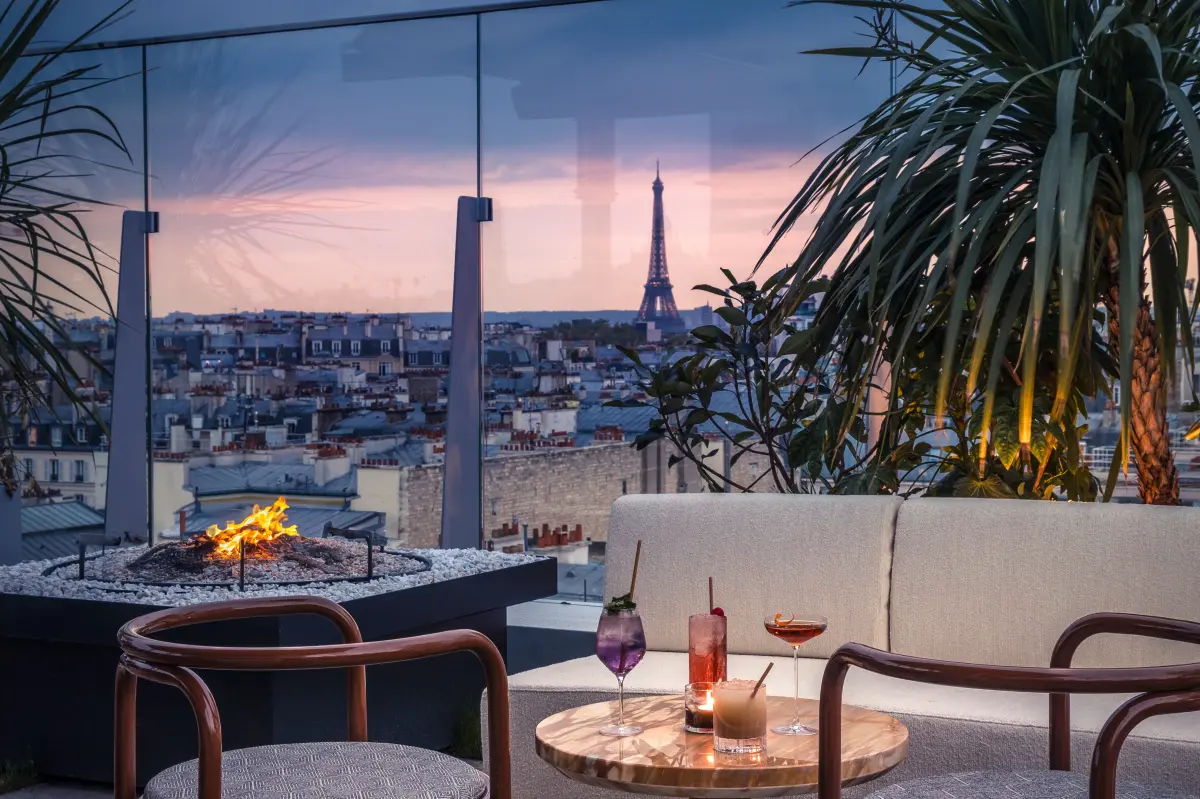
What truly charmed me about La Fondation was its strategic perch, positioning it as the perfect launchpad for exploring beyond the hotel. Nestled between Parc Monceau, that 17th-century gem immortalized in Monet’s paintings with its sun-dappled paths and ornate fountains, and Place de Clichy, where the 8th, 9th, 17th, and 18th arrondissements converge in a buzz of urban energy. It’s the kind of location that turns a trip into a tapestry of experiences—just a 12-minute car ride to the Louvre, or a leisurely stroll to hidden treasures. Mornings began with breakfast at the rooftop bar, where croissants flaked like fine art and smoked salmon met café crème in a symphony that rivaled the views: mansard roofs rolling like waves, parks blooming green, Sacré-Cœur Basilica standing sentinel, and the Eiffel Tower winking in the distance. Nights ended there too, with the bar evolving into a vibrant scene for unwinding. Downstairs, Brasserie La Base and the eighth-floor fine dining spot Les Ailes, both helmed by chef Thomas Rossi, served up French classics that made the routine exquisite. I recall a particular evening when we dined at Les Ailes, the city lights twinkling below like stars, and every bite—whether a rich bouillabaisse or a delicate soufflé—felt like a personal monologue from the chef himself. This hotel doesn’t just house you; it nourishes your soul, weaving luxury into the fabric of true Parisian living.
Venturing out, La Fondation’s neighborhood bursts with everyday magic that pulled me into the rhythm of local life. Just diagonal from the hotel, a tiny grocery store stocks French staples—think baguettes as crisp as a autumn leaf and cheeses that ooze history—making it easy to picnic like a resident. Strolling to Chez Tartar at 31 rue Legendre, I felt like I’d been let in on a secret; this bistro buzzes with locals devouring tartare de boeuf and the ‘la cob d’hiver’ salad, a medley of winter greens with bacon and walnuts that danced on the tongue. From there, the allure deepens with Rue de Lévis’s bustling street market, a kaleidoscope of stalls peddling artisanal wares. Yann Couvreur Legendre, run by a renowned pastry chef, became my sugar-fueled addiction— their mille-feuille layered like a pro’s nostalgia, while an outpost of The French Bastards at Place Saint-Ferdinand delivered parfaits and sandwiches that married fluff to flavor. Marché Poncelet, one of Paris’s most authentic open-air markets near Place des Ternes, redefined freshness for me: mounds of fromage, vibrant flowers, and produce that screamed terroir. And as a pro-tip, detour to the Musée National Jean-Jacques Henner, that overlooked gem showcasing 19th-century Symbolist art in a stately mansion—it’s the kind of find that makes you feel like an insider, not a visitor.
These explorations in the 17th led me seamlessly to the neighboring 18th arrondissement, Montmartre, a hilltop haven immortalized in the cult film “Amélie.” Climbing from one to the other felt like ascending into a dream, where cobblestoned streets and winding alleys evoke the artist’s enclaves of yore. I followed in the footsteps of Audrey Tautou’s character by visiting Café des Deux Moulins at 15 rue Lepic, the real spot where she ping-ponged plates and pondered puzzles—its glass case of tarts and creamy hot chocolates transporting me to the black-and-white whimsy of the screen. To truly immerse, I checked into the Hotel Rochechouart Orso at 55 Boulevard Marguerite de Rochechouart, an eight-story charmer from 1929 with its Art Deco facade sparkling like a relic of the Roaring Twenties. At around $200 a night, it’s an affordable gem at the Butte’s foot, offering Maggie, a brasserie by Chef Ylliam Mhoma that draws crowds for hearty French fare and rooftop views—panoramas of Sacré-Cœur Basilica’s white dome and the distant Eiffel Tower. Then there’s Citrons et Huitres, the seafood wine bar for oysters and vintages, and Mikado Dancing, an underground nightclub like a speakeasy reborn, pulsing with jazz and cocktails.
Montmartre’s magic peaked in its labyrinthine flea markets, treasure troves of vintage designer finds and antiques that had me bartering like a pro. Wandering felt infinitely personal—like rediscovering a childhood playground where every turn hid a story. The Musée de Montmartre, housed in one of the Butte’s oldest homes, breathed life into art history: Renoir’s gardens overlooking the Clos Montmartre Vineyard, where artists like Raoul Dufy and Suzanne Valadon (the first woman admitted to the Société Nationale des Beaux-Arts in 1894) painted away the days. Toasting at Clos Montmartre, Paris’s last working urban vineyard, I raised my glass to Picasso, Modigliani, Van Gogh, and Toulouse-Lautrec—the ghosts of these streets. Sipping wine under the vines, the city’s chaos miles away, I understood why Montmartre endures: it’s not just a district, it’s a feeling, a reminder that sometimes, the road less traveled—those neighborhoods far from flashbulbs—reveals Paris in its purest, most unforgettable form. In this hidden tapestry of the 17th and 18th, I found not a tourist’s checklist, but my own Parisian story, one sip, one view, one market stall at a time.