






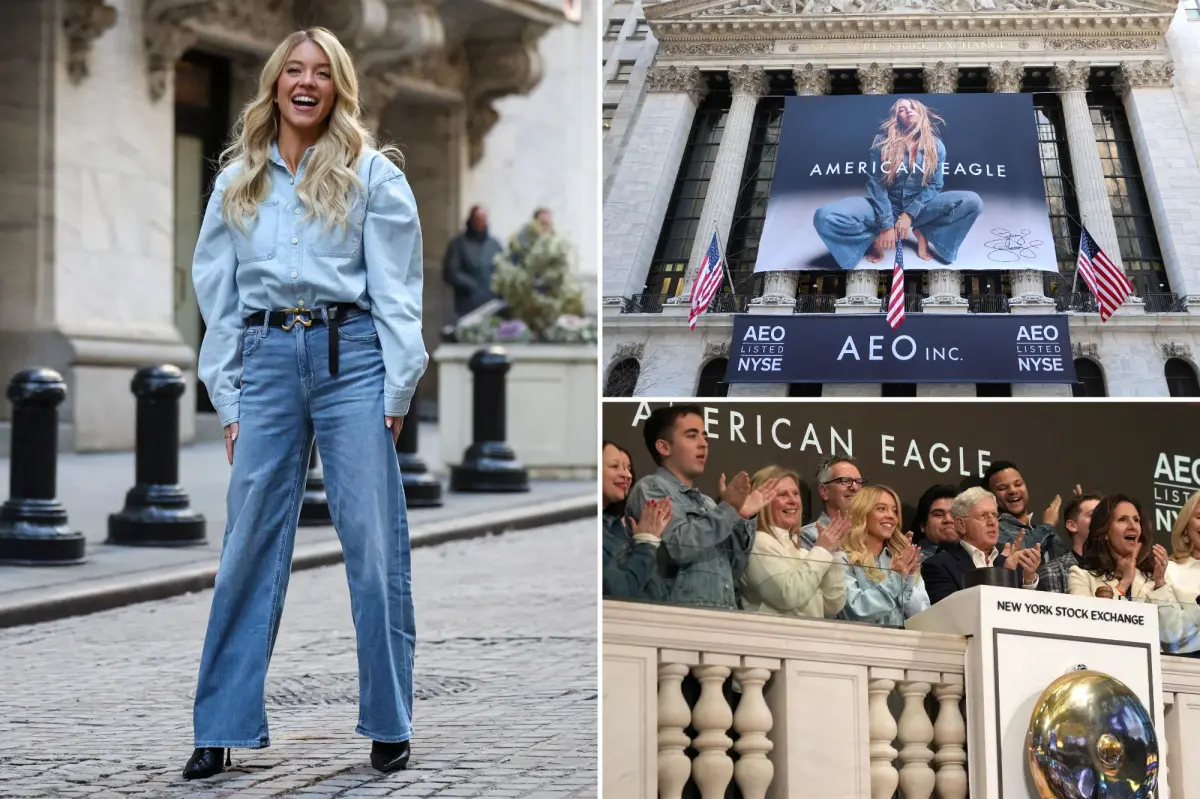
Sydney Sweeney stepped into the bustling heart of Wall Street on a crisp Monday morning, her presence turning heads even among the suits and traders hardened by the chaos of the financial world. Wearing a casual yet polished ensemble, the rising star of Hollywood rang the opening bell at the New York Stock Exchange, marking a symbolic moment for American Eagle Outfitters as she stood alongside the retailer’s Chairman and CEO, Jay Schottenstein. This wasn’t just another celebrity appearance; it was a celebration of a partnership that had ignited not only sales figures but also a whirlwind of online conversations. As she smiled for photos and waved at the crowd, Sweeney embodied a blend of glamour and approachability, reminding everyone that even in the high-stakes arena of stocks and trades, fashion and fame could intersect in the most unexpected ways. She autographed a book on the trading floor, surrounded by American Eagle’s top executives, adding a personal touch to the corporate ritual. It felt like a nod to the American dream— here was an actress from humble beginnings, gracing one of the most iconic symbols of American capitalism, bridging entertainment and retail in ways that felt both bold and genuine. You couldn’t help but admire how Sweeney seemed comfortable in this spotlight, her laughter ringing out over the din of the floor, perhaps hinting at the confidence she’d built through her career. This event was more than a publicity stunt; it was a testament to her growing influence, showing how someone so young could command such attention without ever seeming overwhelmed. As watches beeped and traders shouted orders, Sydney’s bell-ringing echoed through the NYSE, signaling not just the start of trading but perhaps the start of a new era where brands and celebrities collaborated in earnest. It was a moment that captured the zeitgeist, blending high finance with pop culture in a harmony that felt refreshingly modern.
Her outfit that day was a subtle yet clever wink to the brand she represented, effortlessly aligning with American Eagle’s ethos of everyday wear. Sydney donned a pair of jeans paired with a light blue denim jacket, an ensemble that screamed confidence and simplicity—qualities that American Eagle has long championed as a go-to for the average American shopper. In a world where fashion can sometimes feel elitist, Sweeney’s choice felt inclusive, like she was just another person grabbing something comfortable from their closet rather than a superstar flaunting designer labels. It was, as many observers noted, an obvious tribute to the buzzworthy slogan that had taken over social media the summer prior: “Sydney Sweeney Has Great Jeans.” The phrasing, with its playful double entendre, had sparked debates far and wide, but on the NYSE floor, it translated into something more straightforward— a celebration of denim done right. She moved with ease, signing autographs and posing for selfies, her smile wide as she embraced the moment. You could sense the warmth in her interactions, how she made executives and onlookers alike feel at ease, turning a formal event into something more human. That jacket, that pair of jeans—they weren’t just clothes; they were a statement, a way of saying that fashion should be fun and accessible, not intimidating. As she stood there, the camera flashes highlighting her natural beauty, it was easy to see why she’d been chosen for this role. Sellers had seen her as the perfect ambassador, someone whose relatability mirrored the brand’s own spirit, and this bell-ringing was a culmination of that partnership, a physical manifestation of how celebrity endorsements can elevate a company. It added a layer of excitement to the day, reminding everyone that behind the numbers and the trades, there’s room for personality and passion.
The roots of this partnership stretched back to 2025, when American Eagle Outfitters teamed up with Sweeney for an advertising campaign that quickly became a cultural talking point. What started as a standard celebrity collaboration blossomed into something viral, drawing millions of views and shares across platforms like TikTok and Instagram. The ad featured the “Euphoria” star herself, speaking directly to the camera with that signature charm that had won over audiences worldwide. In it, she addressed the skeptics head-on, using her wit to clarify the intent behind the catchy slogan. “Genes are passed down from parents to offspring, often determining traits like hair color, personality, and even eye color,” she explained with a mischievous grin. “My jeans are blue.” It was clever wordplay, a nod to how genetics and fashion could intertwine in advertising, but it didn’t take long for the online world to dissect and debate it. Social media exploded with mixed reactions; some praised its humor, while others questioned whether it veered too close to sensitive topics of heritage and identity. Sweeney, ever the professional, handled it with grace, using the platform to educate and entertain, much like she does in her acting roles. This campaign wasn’t just about selling jeans—it was about storytelling, about how a brand could connect with its demographic on a deeper level. American Eagle had seen an uptick in sales, with the ad campaign credited for boosting denim purchases and redefining how millennials and Gen Z viewed retail. Sweeney’s involvement added authenticity, given her role in critically acclaimed shows, making the partnership feel organic rather than forced. As controversies swirled, it highlighted the power of marketing in today’s hyper-connected age, where a single ad could spark global conversations. It wasn’t merely commerce; it was culture, a reminder of how celebrities like Sweeney shape narratives and influence trends with their every move.
Yet, beneath the surface of the campaign’s success lay a storm of criticism that challenged the boundaries of tasteful marketing. Detractors argued that the slogan’s wordplay dangerously blurred lines between fashion advertising and references to genetic traits, sparking accusations of insensitivity toward complex social issues. Some online commentators suggested it trivialized discussions around inheritance and identity, turning something as profound as genetics into a punchline for selling clothing. This backlash didn’t emerge in a vacuum; in an era where cancel culture and social justice dominate headlines, advertisers walk a fine line, and American Eagle’s attempt at cleverness landed it in hot water. Fans defended Sydney, pointing to her clear intent to highlight the jeans’ color rather than anything genetic, but the damage control required finesse. It was a classic case of internet outrage, where a well-meaning ad got misinterpreted and amplified through memes and threads. Sweeney, known for her poise, addressed it directly in the spot, hoping to defuse the tension with humor and clarity. This controversy not only tested the brand’s resilience but also underscored the risks of viral marketing in sensitive times. What might have been intended as lighthearted fun became a lesson in perception, showing how words can be twisted beyond recognition. American Eagle’s team likely spent sleepless nights monitoring feedback, learning that in the digital age, a slogan could make or break a campaign. It humanized the industry, reminding us that behind glossy ads are real people navigating real-world backlash, striving to innovate while avoiding pitfalls. Sweeney’s experience mirrors that of many celebrities— a mix of triumph and tribulation, where creative freedom clashes with public scrutiny.
Amid the swirling debate, an unexpected voice chimed in to rally support for Sweeney and the ad: none other than President Donald Trump himself. In a characteristic post on Truth Social, Trump praised the actress, writing, “Sydney Sweeney, a registered Republican, has the ‘HOTTEST’ ad out there. It’s for American Eagle, and the jeans are ‘flying off the shelves.’ Go get ‘em Sydney!” His endorsement added fuel to the fire, polarizing opinions further but also injecting a dose of celebrity politics into the fashion fray. Here was a sitting president weighing in on a retail ad, branding Sweeney as a star who embodied patriotic appeal. It felt surreal, like a plot twist in a blockbuster movie, where Trump’s support could sway public sentiment in unpredictable ways. Supporters saw it as validation, a stamp of approval from a high-profile figure that elevated Sweeney’s image as someone unafraid to court controversy. Critics, however, questioned the timing and the motives, wondering if it was a genuine show of fandom or just another political play. Regardless, Sweeney’s Republican leanings added another layer to her persona, painting her as more than a Hollywood actress but a cultural figure bridging divides. Trump’s shoutout likely boosted visibility, drawing even more eyes to the campaign and the bell-ringing event. It humanized politics, showing how leaders can engage with pop culture to connect with the masses. For Sweeney, this defense must have felt empowering, a reminder that her choices resonate on a national stage. The post highlighted the intersection of fame, commerce, and ideology, turning a simple jeans ad into a talking point that transcended its origins.
In response to the uproar, American Eagle Outfitters doubled down on their messaging, issuing a statement that sought to refocus attention on the core of the campaign. “The ad is and always was about the jeans,” the company declared on social media, emphasizing clarity amid the noise. They went on to celebrate empowerment, stating, “Her jeans. Her story. We’ll continue to celebrate how everyone wears their AE jeans with confidence, their way… ‘Great jeans look good on everyone.’” It was a diplomatic pivot, reaffirming inclusivity while distancing from the misinterpreted wordplay. This approach showcased the brand’s commitment to positive marketing, turning criticism into an opportunity for reinforcement. By championing stories and individuality, American Eagle positioned itself as a champion of self-expression, using Sweeney’s star power to amplify that ethos. The response resonated with many, diffusing some tensions and proving that transparency can mend fences in the age of scrutiny. It also highlighted Sweeney’s role as a symbol of confidence, where her involvement spurred conversations about body positivity and personal style. As the dust settled, the partnership emerged stronger, with the actress’s presence at the NYSE symbolizing triumph over adversity. In the end, this tale of fashion, fame, and fallout reminds us of the human side of branding—how one campaign can inspire, unite, and even polarize, all while selling a product. Sweeney’s journey through this odyssey is one of resilience, proving that in a world quick to judge, authenticity can prevail. The bell she rang wasn’t just for stocks; it was a clarion call for boldness in the face of doubt. As American Eagle moves forward, embracing its slogan, we see the enduring appeal of great jeans—and the great stories they can tell.