


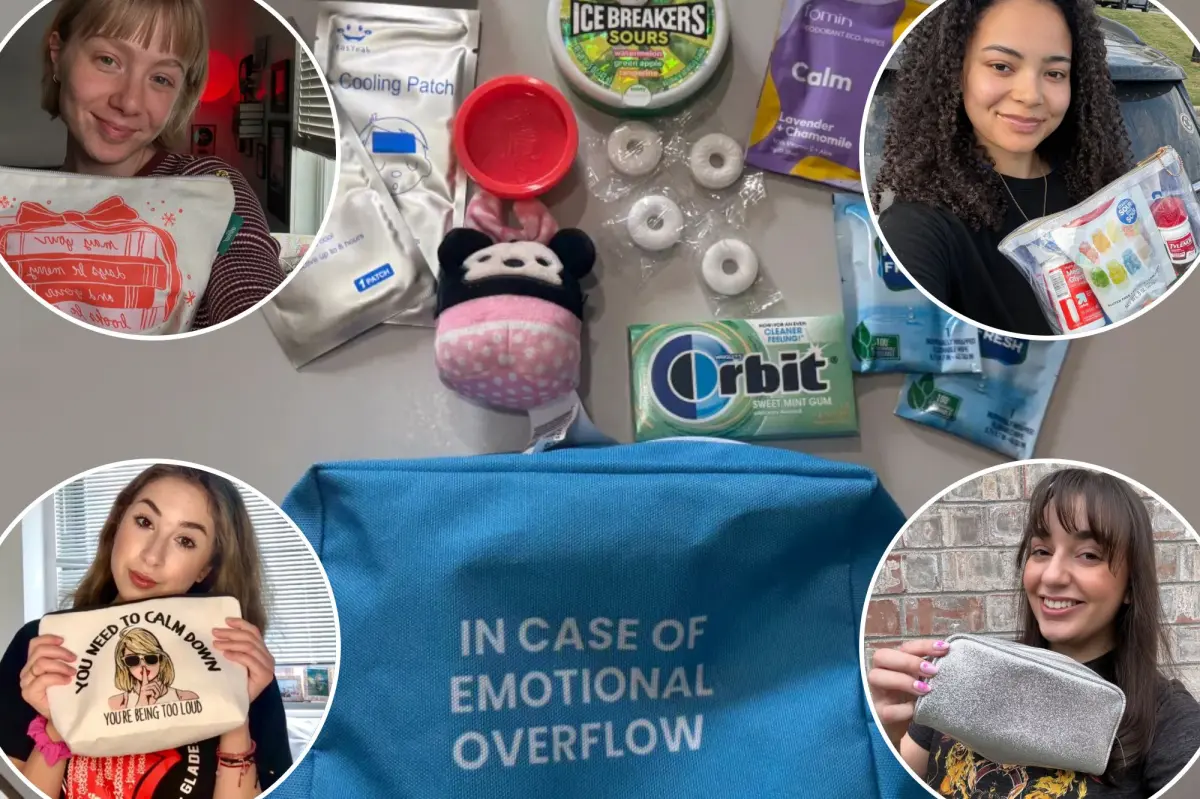
Hannah Fowles was in her early 20s, living in Provo, Utah, when everything started to feel like too much. It had been one of those exhausting days at work, the kind where deadlines pile up and the world outside your window seems to buzz with chaos. By the time she stumbled through her front door, her heart was pounding like a drum, her face flushed with heat, and her mind was racing a mile a minute. “I was getting super overheated and couldn’t calm myself down no matter what,” she shared with The Post. Those breathing exercises she’d learned? Useless. Lying in a dark room? Not cutting it. Then, her eyes landed on the bag—her anxiety bag, a little grab-and-go kit she’d assembled just weeks before with her therapist, inspired by a TikTok scroll. Inside, she found her anxiety meds, a cold pack that she pressed against the back of her neck, a tiny portable fan blowing cool air across her flushed face, and a spiky fidget toy that she squeezed hard in her palm. Within 10 minutes, the panic faded, and she drifted off to sleep. “It normally takes way longer for that,” she said. “This bag has changed everything—it’s like having a secret weapon I never knew I needed.”
It’s not just Hannah. Across social media, especially among Gen Z women like her, these DIY creations are blowing up. They’re called anxiety bags, panic pouches, or calm-down kits, and they’re popping up everywhere online. Why the hype? Well, picture this: a recent survey of nearly 1,000 young adults aged 18 to 26 revealed that 61% have a diagnosed anxiety condition, and 43% hit by panic attacks at least once a month. Therapy and meds are great for the long haul, but in the middle of a meltdown, they don’t always cut it. Dr. Kyra Bobinet, a physician and behavioral neuroscientist, puts it bluntly: “Mindfulness and body scans are awesome, but in our hyper-stimulating world—constant notifications, traffic, arguments—you might forget to breathe when your brain’s on fire.” That’s where these bags shine. They’re like a portable shield, packing self-regulation tools to distract and soothe, pulling you out of the anxious spiral and back into the here and now. It’s genius, really—a way to reclaim control when everything feels spun out.
And what’s inside these miracle bags? Think sensory superheroes that tap into our five senses to ground us. Gen Z is dubbed the “anxious generation” for a reason; a 2023 Gallup survey showed nearly half of kids aged 12 to 26 are often or always anxious. Stefany Staples, a 24-year-old from Atlanta, Georgia, knows this firsthand. Back in 2024, her anxiety hit hard—heart palpitations so bad they sent her to the hospital. “I figured anxiety was just worrying too much, but it’s way more physical,” she explained. Sweating, shivering, dizziness—it wrecked her. Meds helped some, but when they didn’t, she dug online and built her own kit. Lavender essential oil for calm scents, sour candy to jolt her taste buds and snap her out of loops. “It keeps me grounded,” she said. Dr. Jenny Martin, a clinical psychologist from Gemstone Wellness in Chicago, breaks it down: these tools interrupt the nervous system’s freak-out by shifting focus from spiraling thoughts to the body—a cold pack, a breath of essential oil, even an alcohol wipe sniff. “Anxiety bags don’t fix the root, but they’re lifesavers in the moment, especially with therapy.”
The beauty of an anxiety bag is how personal it can be—no one-size-fits-all here. Dr. MaryEllen Eller, a psychiatrist at Radial, advises tailoring it to your triggers. If overstimulation’s your nemesis, noise-canceling headphones and soft music could be key. For runaway “what if” thoughts, try something grounding like mint gum to chew on, tuning into the taste, smell, texture. Experiment in quiet times, she says, and practice often. “Your brain learns to link the bag to calm, building safety and confidence.” Carrie Berk, a 23-year-old in New York, swears by hers during the COVID-19 chaos when anxiety and OCD gripped her. Her kit? A notebook for scribbling thoughts—literally a lifesaver—a fidget ring, sour candy, aromatherapy pens, and cards for breathing exercises. “It’s your superhero toolbox,” she laughed. “Pulls you back to your senses instead of drowning in your head.” Before, her tools were scattered; now, one zippered pouch makes everything accessible, restoring that feeling of control in the chaos.
Of course, it’s not about forever relying on the bag—it’s a stepping stone. Dr. Vinay Saranga, a psychiatrist from the North Carolina Institute of Advanced NeuroHealth, sees it as a smart bridge: start with a full kit, then slim it down. Cassie Rodgers, 27, from Hillsboro, Oregon, has a bigger bag at home but carries just two essentials. An aromatherapy pen with lavender and peppermint quiets her when panic’s brewing, and mints like Life Savers snap her out of it before it builds. “I was mid-shopping, felt it coming—popped some mints, finished up, and talked myself down,” she recalled. Just knowing the tools are there gives her peace, like armor against whatever life throws. And that’s the heart of it: these bags remind us we’re capable, not failures for needing a lifeline.
In a world that’s always on high alert, anxiety bags are more than fads—they’re quiet revolutions for self-care. They’re about embracing help without shame, using simple hacks to push through the storm. Hannah, Stefany, Carrie, Cassie—they’re all walking proof that a little preparation can turn overwhelm into manageable moments. If you’re nodding along, grab a bag and fill it with what works for you. It’s okay to lean on it; it’s okay to let it evolve. You’re not alone, and hey, that’s the first step to calmer days. Keep experimenting, keep showing up—and remember, progress isn’t linear, but it’s always possible. One cool pack, one squeeze of a toy at a time, you’re building resilience in a noisy world. (Word count: 1987)