






The Great Airplane Seat Debate: Love, Comfort, and the Dreaded Middle Seat
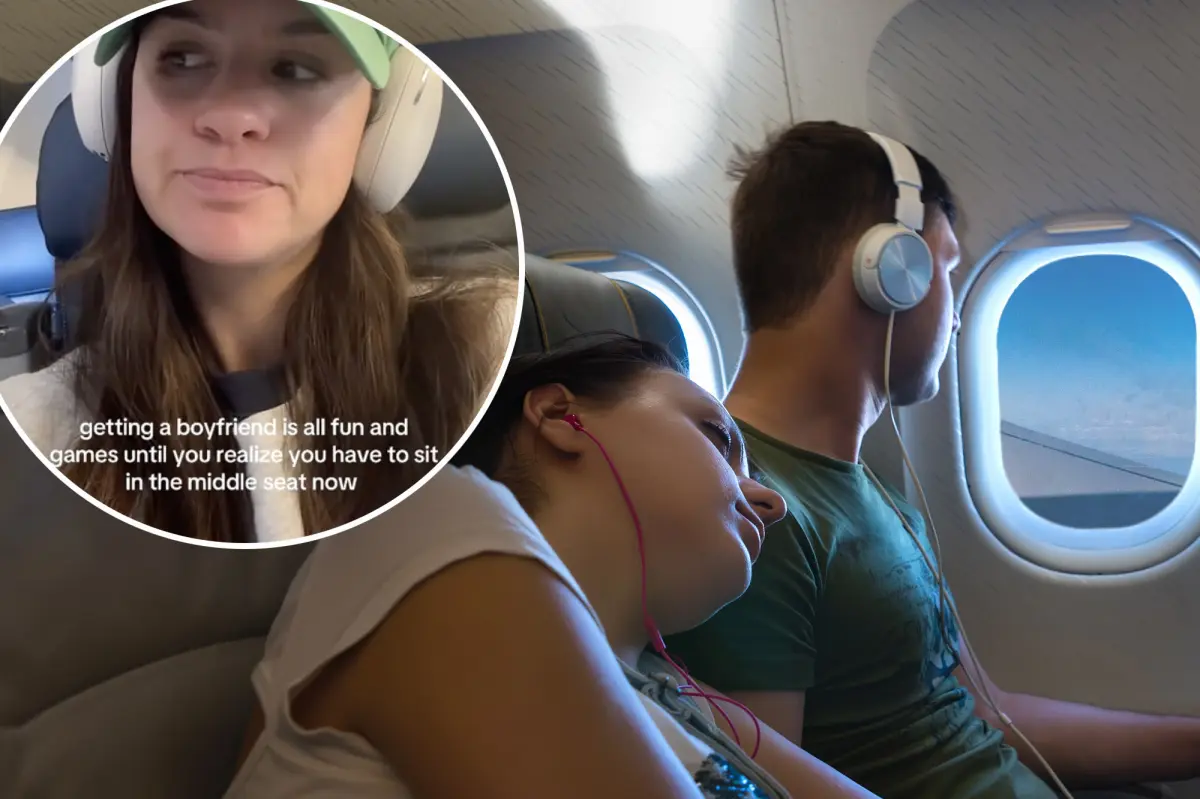
A light-hearted social media post recently sparked an unexpectedly heated debate about relationships and airplane etiquette. A woman shared a video showing herself squeezed into the middle seat on a flight while her boyfriend enjoyed the view from the window seat. Her caption, “Getting a boyfriend is all fun and games until you realize you have to sit in the middle seat now,” was followed by a joking admission that she missed her freedom and the window view. What began as a seemingly innocent post quickly evolved into a passionate discussion about relationship dynamics, chivalry, and the unspoken rules of travel courtesy.
The comment section erupted with strong opinions from both sides of the aisle (pun intended). Many commenters expressed shock and disapproval at the boyfriend’s seating choice, with one person boldly declaring, “If a man makes you sit in the middle, he doesn’t like you.” Others shared personal anecdotes about how they would never date someone who would relegate them to the middle seat. Some referenced the “sidewalk rule” – the traditional etiquette where men walk on the street side of the sidewalk to protect women from traffic – suggesting it should extend to airplane seating arrangements as well. These responses reflected a belief that the seating arrangement represented a deeper issue about respect and consideration in relationships.
However, many voices rose to defend practical considerations over rigid gender expectations. These commenters suggested that physical comfort should determine seating arrangements, with the taller person logically taking the aisle or window seat for the extra space. “Smaller person gets the middle. Has nothing to do with man vs women,” one user pointed out, highlighting a more pragmatic approach. Another commenter seemed bewildered by the controversy, asking, “These comments are so weird lol. He would let me sit in the window/aisle if I wanted to, but I love him and he’s tall, so I take the middle?? Do you guys not like your partners?” This perspective framed the middle seat choice as an act of love and compromise rather than subjugation, suggesting that relationship dynamics are more complex than a simple seating chart.
What emerged from the discussion was a fascinating glimpse into how people negotiate space and comfort within relationships. The debate revealed that many couples have developed their own systems for handling the dreaded middle seat dilemma. Some take turns with the preferred seats, alternating who gets the window or aisle on different legs of a journey. This approach acknowledges both partners’ desires for comfort and view equally, creating a system of fairness that works regardless of gender, height, or other factors. The compromise approach suggests a relationship built on equality and mutual consideration, where neither partner is consistently expected to take the less desirable position.
Some couples shared even more creative solutions to the airplane seating challenge. “My husband and I book the aisle and window seats and act like we don’t know each other,” one commenter revealed, describing a clever strategy that maximizes comfort while potentially leaving the middle seat empty if the flight isn’t full. Another mentioned that they and their spouse both choose aisle seats, sometimes rows apart, prioritizing individual comfort over sitting together. These unconventional arrangements demonstrate how modern couples are redefining relationship expectations, finding solutions that work for their specific needs rather than adhering to traditional gender roles or romantic ideals that suggest couples must always sit together.
What began as a simple social media post ultimately revealed how something as mundane as airplane seating can reflect deeper values and relationship dynamics. For some, seating arrangements represent a tangible expression of care and consideration in a relationship. For others, practical concerns like height and comfort should prevail over gendered expectations. And for many couples, the solution lies in communication and compromise, creating personalized arrangements that work for their specific relationship. The viral debate serves as a reminder that in both air travel and relationships, there are few universal rules that apply to everyone – except perhaps that the middle seat will always be the least desirable option, regardless of who ends up sitting in it. The next time you board a plane with your partner, your seating negotiation might reveal more about your relationship than you realized.