





Alex Honnold Completes Historic Free Solo Climb of Taipei 101
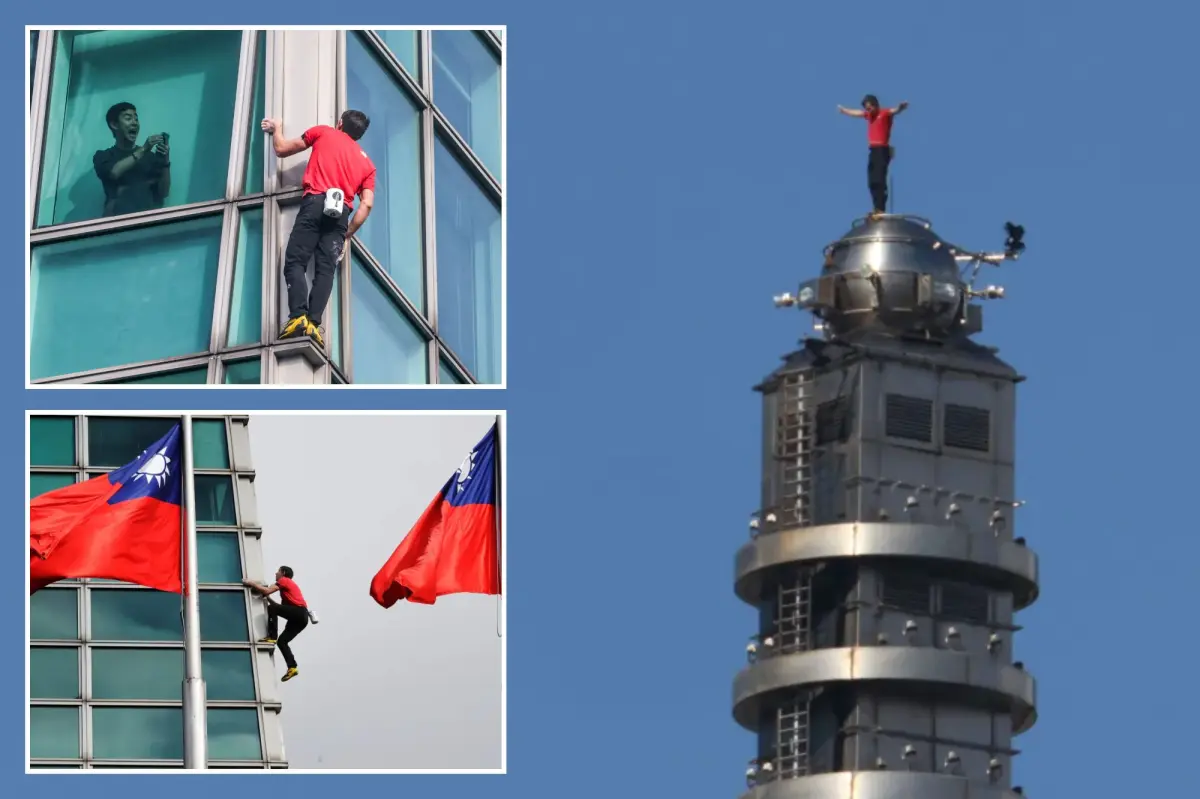
In a breathtaking display of human courage and physical mastery, renowned American rock climber Alex Honnold made history on Sunday by ascending the iconic Taipei 101 skyscraper completely unassisted—without ropes, harnesses, or any protective equipment. The daring 1,667-foot climb, broadcast live on Netflix with a cautious 10-second delay, captivated viewers worldwide as Honnold methodically made his way up one of the world’s most recognizable buildings. For approximately 90 minutes, he navigated the vertical face using only his hands and feet, demonstrating the extraordinary skill that has made him a legend in the climbing world. As he reached the building’s spire, Honnold—dressed simply in a red short-sleeve shirt—raised his arms triumphantly overhead, acknowledging the cheers from the crowd gathered on the streets of Taiwan’s capital below.
Honnold, who rose to international fame following his groundbreaking ropeless ascent of El Capitan in Yosemite National Park (featured in the Oscar-winning documentary “Free Solo”), approached the Taipei 101 challenge with the same calculated precision that has defined his career. Using small L-shaped outcroppings as footholds along one corner of the building, he demonstrated remarkable finger strength and balance throughout the climb. What made the ascent particularly challenging were the large ornamental structures protruding from the tower, requiring Honnold to periodically maneuver around them using only his bare hands. These moments—when he had to pull himself up and around these architectural features with nothing but air beneath him—were perhaps the most heart-stopping for spectators, highlighting both the physical demands and the mental fortitude required for such an undertaking.
The most technically difficult portion of the climb came in the middle section of the building—the distinctive “bamboo boxes” that give Taipei 101 its signature appearance. This 64-floor segment was divided into eight sections, each presenting its own unique challenge with eight floors of steep, overhanging climbing followed by balconies. These balconies provided Honnold with brief opportunities to rest his burning forearms and recalibrate before continuing upward. His methodical approach to these challenging segments revealed the extensive planning and preparation that went into the climb. While the event had originally been scheduled for Saturday, rainy conditions forced a 24-hour delay, highlighting the additional layer of environmental unpredictability that accompanies urban climbing. Even for someone of Honnold’s caliber, the interaction between weather, architecture, and human capacity required careful consideration.
While Honnold’s achievement marks a significant moment in climbing history, it’s worth noting he isn’t the first to scale this particular skyscraper—though he is the first to do so without safety equipment. French climber Alain Robert, sometimes called the “French Spiderman,” previously climbed Taipei 101 on Christmas Day in 2004 as part of the grand opening celebrations when it was briefly the world’s tallest building. However, Robert used protective equipment during his ascent, making Honnold’s free solo climb a pioneering achievement that pushes the boundaries of what’s considered possible in urban climbing. The contrast between these two ascents highlights the extraordinary evolution of climbing as both sport and spectacle, with free soloing representing its most pure and dangerous expression.
The live broadcast of such a high-risk endeavor inevitably sparked discussions about the ethics of showcasing an activity where a single mistake could prove fatal. Critics questioned whether broadcasting such events might encourage dangerous copycat attempts or normalize extreme risk-taking behavior. Supporters, however, pointed to Honnold’s unparalleled preparation and risk assessment process, along with his long history of successful climbs. Unlike many daredevil stunts designed primarily for spectacle, Honnold’s climbs represent the culmination of years of training, careful study, and incremental challenge progression. His approach to risk is methodical rather than reckless—a distinction that many believe separates his accomplishments from mere sensation-seeking.
Beyond the physical achievement, Honnold’s free solo of Taipei 101 represents a fascinating intersection of natural human ability with man-made architecture. While rock climbing traditionally connects humans to natural formations shaped over millions of years, urban climbing creates a dialogue between human physical potential and our own architectural creations. As Honnold moved up the building’s face, he transformed a structure designed for business and commerce into a vertical playground that challenged the limits of human capability. His successful ascent not only adds another extraordinary accomplishment to his already legendary career but also invites us to reconsider our relationship with the built environment—suggesting that even in our most urban spaces, opportunities exist for profound human achievement, connection, and transcendence. As the climbing community and general public alike reflect on this remarkable feat, it stands as a testament to what happens when preparation meets opportunity, and when the human spirit confronts seemingly impossible challenges.