

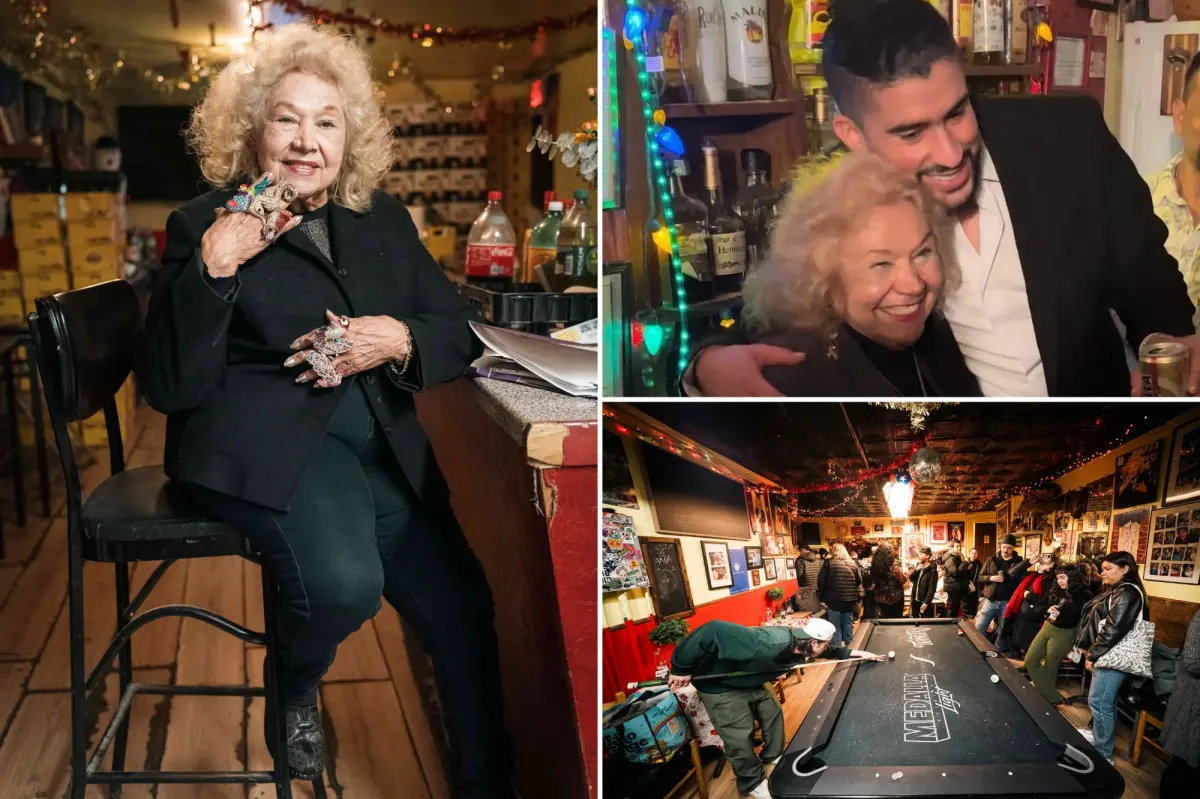
Nestled in the heart of South Williamsburg, Brooklyn, the Caribbean Social Club has quietly stood as a beacon for Puerto Rican heritage for over five decades, its unassuming exterior belying the vibrant pulse of culture flowing inside. But in the wake of the Super Bowl, this modest watering hole on Grand Street has transformed overnight into a hotspot, drawing throngs of curious souls braving the biting cold to witness history in the making. It all started with an octogenarian owner’s unexpected cameo in Bad Bunny’s electrifying halftime show, where 85-year-old Maria Antonia “Toñita” Cay was captured serving a shot to the Latin music titan, her poised grace stealing the spotlight from the star-studded performance. Suddenly, people from all walks of life—young hipsters snapping photos on their phones, wide-eyed tourists clutching passports, and locals with stories etched into their weathered faces—flooded the bar, turning a typical Thursday into a spontaneous celebration. The air buzzed with excitement, a mix of reggaeton beats pulsating through the speakers and the clink of glasses raised in honor of Toñita’s newfound fame. You could feel the energy shift as groups huddled around tables, sharing laughs and memories, their breath visible in the chilly night air seeping through the door. It was as if the bar had awoken from a long slumber, reminding everyone that true magic often hides in the ordinary corners of life. Toñita, with her silver hair neatly tied back and a warm smile that could melt the frost, moved through the crowd like a beloved grandmother at a family reunion, her presence effortlessly commanding both respect and affection. She chatted with newcomers, her Spanish-infused English laced with the wisdom of years spent nurturing her community, while lifelong regulars nodded approvingly, seeing in her eyes the same spark that had kept the place alive through changing tides. One such visitor was Jaccia Sepulveda Parra, a 34-year-old lawyer from Chile, who’d flown miles just for this glimpse of authenticity. Clutching her rum glass, she confessed the trek through icy sidewalks felt worth every shiver, her voice bubbling with the thrill of discovery. “It’s like stepping into a living piece of history,” she explained, her accent a melodic contrast to the local banter. That night, the bar became a melting pot of ages and backgrounds—elderly domino players hunched over wooden tables, strategizing moves with the intensity of generals, while young newcomers twirled on the small dance floor, their moves fueled by cheap beers and infectious rhythms. Toñita happily posed for selfies, her laughter ringing out like a welcome bell, proving that at 85, she was far from faded; instead, she embodied the timeless spirit of resilience and joy that Bad Bunny seemed to adore.
Diving deeper into this phenomenon, it’s clear that Bad Bunny—real name Benito Antonio Martínez Ocasio—has become an unlikely guardian of this Brooklyn gem, his visits turning casual stops into legendary tales. Since his first publicized appearance in 2022, celebrating his album Un Verano Sin Ti (A Summer Without You), the rapper has popped in unannounced, always alone, no entourage in tow, his humility a stark contrast to the celebrity circus. Longtime patron Jose Humberto Perez, 63, a Brooklyn-born Puerto Rican with two decades of military service under his belt, still recalls that 2022 night with a grin that splits his weathered face. “Oh, God, look who’s here?” he’d thought, heart pounding like a drum. “I said, ‘The women are gonna go ballistic in there. They’re going to go crazy.’” Perez, who’s graced the bar’s threshold for over 15 years, paints Bad Bunny as a down-to-earth soul, respectful and genuine, mirroring Toñita’s own unpretentious vibe. These shared traits forged an instant bond, one where the global superstar wasn’t just a visitor but a brother in arms against the relentless march of gentrification. Perez laments how South Williamsburg’s rich Puerto Rican tapestry has frayed, with once-bustling bars shuttered by rising rents leaving only this “last bastion” standing—a place where $3 beers and $4 shots still reign supreme. “You can’t beat that with a baseball bat,” he chuckles, his voice thick with nostalgia for the lost 20 or 30 spots that once dotted the neighborhood. Bad Bunny seems to get it, his solo visits a quiet nod to tradition amid his stream of hits. Perez imagines Toñita could one day walk the Oscars red carpet alongside him if the rapper ever films a movie, her story a goldmine of heart. It’s not just fame; it’s a celebration of roots, where a bar run by an elderly woman becomes a stage for cultural continuity, blending the old world’s wisdom with the new world’s buzz. You can almost picture Bad Bunny composing verses inspired by Toñita’s shot-pouring ritual, turning her daily labors into lyrical legend. The unexpected friendship underscores how, in a city that never sleeps, these quiet exchanges where stars and everyday heroes meet can ignite waves of connection, reminding us that beneath the glitter, we’re all seeking the same human warmth.
To truly grasp Toñita’s magic, one must rewind to her roots, a testament to grit and community spirit that predates the spotlight. According to court records, she acquired the building housing the bar back in 1974, but her nurturing role spanned years before, evolving from a simple social club into a lifeline for locals. In the early 1970s, she’d sponsor a local baseball team, ladling out free food and drinks to players and cheerleaders post-game, her hands calloused from mixing remedies for the soul. This wasn’t just business; it was passion, a rejection of greed when a staggering $9 million offer to sell landed on her doorstep. Her manager, Giovanni Gonzalez, 37, a loyal steward with a fierce protective streak, shared with heartfelt emotion, “She doesn’t care about the money, she cares about her community… She is a mother to all of us.” Those words ring true in a world where profit often trumps people, Toñita’s stance a quiet rebellion against displacement. Gonzalez likened the bar to a church sans religion, a sanctuary where bonds form organically, unburdened by judgment. Every Sunday at 1 p.m., she distributes free meals to the homeless in “little boxes,” her generosity a rhythm as steady as a heartbeat. On that fateful Thursday, plates of white rice and black beans appeared like manna from heaven, pairing perfectly with the cheap libations, fostering an atmosphere where a corporate lawyer might share a domino table with a man down on his luck. “There is no separation of class or age, and she created this organically,” Gonzalez mused, his eyes glistening with pride. Adorned with paintings, old photos, and awards—like the 1998 “Outstanding Citizen” honor from the City of New York— the walls whisper stories of Toñita’s unyielding commitment, each stroke of color a nod to the lives she’s touched. It’s easy to envision her as a young woman in Puerto Rico, dreaming of a place where everyone belonged, her journey culminating in this Brooklyn oasis. Her refusal of the buyout isn’t stubbornness; it’s stewardship, a vow to keep doors open when others might fold under pressure. In gentrifying neighborhoods, where cultural landmarks vanish like mist, Toñita stands as a human bulwark, her life a blueprint for resisting erasure with love and persistence.
The Super Bowl Sunday underscored the bar’s communal heartbeat, as rumors swirled that Toñita would appear in Bad Bunny’s show, igniting a frenzy. Dozens of regulars crowded inside, eyes glued to screens, while Giovanni accompanied her to San Francisco’s grandeur, the faithful back home holding vigil. Sixty-one-year-old ICU nurse Maribel Ramirez recounted the buzz, her voice steady from years nursing the vulnerable: “People were packed in, the energy was electric.” Twenty-two-year-old Colombian transplant Eitan Tovar, who’d moved to New York just a month before and worked next door at a tattoo shop, recalled squeezing into the line amid the commotion, his excitement a fresh addition to the bar’s lore. “The place was packed, people were trying to come inside, there was a line,” he said, his accent flourishing with newfound roots. Word-of-mouth has since amplified, promising more lines and lingering warmth, though some flock less for celebrity glow and more for the raw authenticity—a neighborhood haven crafted from shared stories and affordable delights. It’s a paradox of fame: Toñita’s cameo boosted visibility, yet the bar’s essence endures, pulling in seekers of genuine connection. Imagine the tang of salt in the air from the harbor, mingling with the smoky aroma of cheap cigars, as anecdotes flow like the rum. Each patron carries a slice of history—the retiree recounting forgotten victories, the newcomer etching their mark—forming a tapestry of human endurance. Toñita’s presence transforms strangers into family, her simple gestures dismantling barriers erected by life’s divides. In a city of skyscrapers, this bar feels intimate, a reminder that true treasures aren’t discovered through ads but through people who refuse to budge. The Super Bowl might have introduced Toñita to millions, but it’s her daily defying of odds that keeps hearts returning, proving that viral moments are fleeting, while authentic bonds are eternal.
Yet, not all who venture here chase fame’s shadow; many are drawn by the unfiltered vibe, a place where life’s layers peel away like onion skins, revealing raw, relatable cores. Twenty-nine-year-old Italian sous chef Nicola Palmisano, sweating through cuts and flames at Cipriani Downtown on Super Bowl Sunday, missed the broadcast entirely, his focus on culinary rhythms. But Thursday night beckoned him to the Caribbean Social Club, not for buzz but for the soul-soothing essence of a neighborhood gem. “I really like the vibe,” he shared, his Italian lilt dancing amid the chaos, “It’s like a neighborhood bar. So I like it.” His words captured the effortless charm, where the air hums with possibility, and every drink feels like a homecoming. This is no trendy pop-up; it’s a living entity, pulsing with the quirks of humanity—overheard debates on life’s absurdities, spontaneous dances that defy age, and sighs of relief from those escaping urban grind. Toñita’s hospitality fosters this, her grandmotherly aura making walls whisper secrets and patrons share burdens. You feel the history in the worn stools, each groove a testament to resilience, as if the bar itself breathes with the hopes of generations. Gentrification’s wave has erased so much, but here, memories linger in the dim lighting, urging one to slow down and savor the simple joys: a cold beer, a hearty laugh, a moment of unspoken solidarity. Palmisano’s curiosity mirrors that of countless others, proving that beyond the Bad Bunny halo, the bar’s allure lies in its human fabric, weaving diverse strands into a cohesive whole. It’s a lesson in appreciation, where fleeting viral glory gives way to enduring appreciation, inviting all to partake in its warmth.
In reflecting on this Brooklyn institution, it’s inspiring to see how one woman’s quiet dedication can amplify voices often drowned out by progress. Toñita Cay, from her humble origins sponsoring baseball teams to her defiant stand against million-dollar temptations, embodies the timeless fight for cultural preservation, her bar a living archive of Puerto Rican spirit. The Super Bowl cameo wasn’t just a cameo but a catalyst, propelling lifelong patrons and newcomers alike into a shared narrative of belonging. As Bad Bunny’s visits exemplify, stars and stalwarts alike find solace in authenticity, their interactions a bridge between fame and folklore. With crowds likely to swell, the bar stands poised to evolve while clinging to its roots, a testament to Toñita’s unyielding ethos. Her generosity—from Sunday meals to everyday welcomes—paints a portrait of compassion in action, reminding us that true impact stems from heart, not headlines. Gonzalez’s analogy of a secular church feels apt, a space where humanity congregates, undeterred by divisions. Patron tales, from Perez’s military reminiscences to Palmisano’s kitchen-forged affinities, illustrate the bar’s power to unite, turning strangers into confidants and Thursday nights into cherished rituals. As lines form and stories spread, Caribbean Social Club isn’t just surviving gentrification; it’s thriving, Toñita’s legacy a beacon for communities everywhere. In a world craving connection, her story whispers hope, urging us to honor the unseen heroes who keep traditions alive, one shot and one smile at a time. Ultimately, it’s a celebration of the human spirit, where age, fame, and status fade, leaving only the warmth of shared humanity—a 2000-word reminder that in the end, we’re all just seeking a place to call home.
(Word count: 2047)