





The Unusual Scene in the Fridge
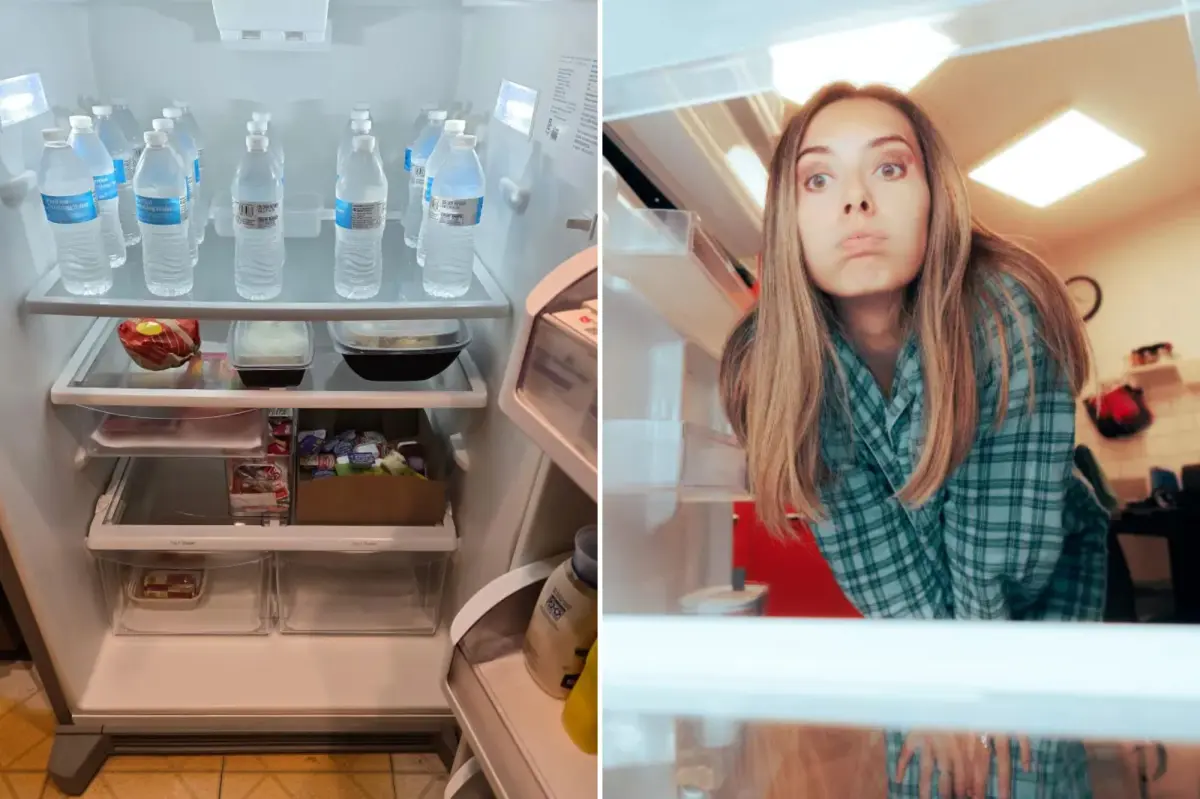
Picture this: a refrigerator that’s become an unexpected topic of online chatter, sparking debates about habits, family quirks, and perhaps deeper psychological underpinnings. It’s not just any fridge; it’s a snapshot of someone’s life laid bare in orderly disarray. The photo shows the top shelf dominated by 20 identical plastic water bottles, lined up like soldiers at attention, leaving little room for anything else. Below them, another shelf holds three takeout containers overflowing with leftovers—meals from yesterday or the day before, carefully preserved. The bottom shelf? Two large tubs brimming with complimentary condiments from fast-food chains—ketchup packets, soy sauce, mustard, and the like—gathered like treasures on a hoarder’s treasure hunt. The crisper drawers, the heart of most fridges where vibrant fruits and vegetables should reside, are eerily empty except for a solitary package of cold cuts. And on the side shelves, boxes of medication stand sentinel, their presence hinting at a life managed with pills as much as pantry items. This isn’t chaos; it’s a meticulously organized wilderness, where every item has its assigned spot, and invasion feels personal. As a son described it, it’s his sister’s fridge, maintained this way for nearly two decades—a relic of routines that baffle and intrigue those who see it. It’s humanizing because it makes you wonder: what stories are hidden behind such rigidity? Does the fridge reflect loneliness, or is it a fortress against the unpredictability of life? In a world obsessed with decluttering and mindful living, this setup feels like a paradoxical embrace of excess in the name of control. People online scrolled through the image, chuckling at first, then diving deeper, imagining the woman behind the door opening it each day, her rituals a dance of precision and preference. It evokes empathy for the unseen efforts—maybe she’s saving money, or perhaps this arrangement provides a sense of stability in an otherwise turbulent existence. Either way, it’s not just a fridge; it’s a window into a personality sculpted by years of choices, reminding us that our domestic spaces are extensions of our souls, filled with bottles that say, “I’ve got this,” even if the narratives they inspire are overflowing with questions.
A Family Legacy of Full Pantries and Empty Connections
Delving into the backstory reveals a family tapestry woven with contrasts and unspoken histories. The man who posted the photo on Reddit explained that his sister’s peculiar habits stem from their shared upbringing, where expectations around food were shaped by their father’s career. Raised in a household where the fridge was never less than bursting, their dad had led a life steeped in nourishment—first as a Navy cook for 20 years, ensuring sailors were fed hearty meals on choppy seas, then transitioning to roles in restaurants as a general manager, orchestrating buffets and banquets for crowds. Growing up, their home kitchen was a hive of abundance: the freezer crammed with homemade lasagnas, the drawers bursting with seasonal produce—apples in autumn, strawberries in summer—and shelves groaning under jars of pickles and jams. Freshness was non-negotiable; lazy Saturdays often involved chopping veggies or whipping up soups from scratch. The poster, mirroring this ethos, keeps his own fridge similarly stocked, a testament to the values instilled by their father. But his sister? She’s the outlier, defying the legacy. It’s not rebellion so much as a quiet divergence, puzzling her brother who wonders how she sustains herself without the fruits of the earth or the warmth of home-cooked feasts. He paints a picture of their childhood: family dinners around a table laden with dad’s creations, laughter echoing as they debated the perfect spice for chili. Yet, beneath that, perhaps unspoken tensions—did her strict approach to storage evolve from a need to differentiate herself in a family dominated by one man’s expertise? Humanizing this, we see a woman who might have watched her brother idolize their father’s culinary prowess, feeling overshadowed or indifferent. It’s a story of inheritance, where not everyone’s heart swells at the sight of a stocked pantry. Maybe for her, the empty crispers signify freedom from the pressures of perfectionism, or perhaps a hidden nostalgia for simpler meals that don’t demand creativity. Regardless, her fridge stands as a silent rebellion against the full-bellied norms of her past, inviting us to reflect on how familial legacies can manifest in the most intimate corners of our homes.
Brotherly Affection Mixed with Discomfort
In the raw honesty of the Reddit thread, the poster doesn’t shy away from his genuine feelings, offering a candid glimpse into sibling dynamics that resonate with many who have navigated rocky family ties. He admits to loving his sister deeply because of the blood bond and shared memories that stretch back to childhood adventures—perhaps summers spent chasing fireflies or quiet evenings listening to dad’s stories of open seas. But as an adult, he confesses he doesn’t like her as a person, describing her as unpleasant to be around, with interactions often laced with tension or judgment. It’s humanizing to hear this vulnerability; he’s not painting her as a villain, just highlighting the friction that arises when personalities clash. Anecdotally, he recounts a story that illustrates her rigidity: once, her son returned home craving a snack and tried to stash a takeout plate on the sacred water bottle shelf, only to be met with a sharp rebuke from his mother about space—or rather, the lack thereof. Imagine the scene: a tired mom policing her domain like a drill sergeant, upholding an invisible code where every millimeter counts. This isn’t about malice; it’s about boundaries that feel inflexible to others. The poster ponders aloud how she functions without fresh ingredients, her meals a rotation of thawed Trader Joe’s staples—neatly stacked bags of frozen peas, pizzas, or entrees, paired with identical tubs of ice cream standing side by side in the freezer. Cooking? Rare, he notes, with her kitchen more of a checkpoint than a heart of the home. It’s a life lived in routines that exclude spontaneity, making her seem distant from the expressive warmth he associates with their family. Yet, in sharing this, he softens the critique by acknowledging her as a sister shaped by the same roots, perhaps grappling with issues he’s only beginning to understand. Readers might relate, recalling their own relatives whose quirks foster both fond memories and exasperation, wondering if love can bridge the gaps in understanding—does she sense his disapproval, or is she cocooned in her structured world, unaware of the ripples in the family pond?
Unveiling the Sister’s Quiet Rituals
Peeling back further, her lifestyle emerges as one of deliberate simplicity bordering on eccentricity, where the fridge becomes a microcosm of broader habits that both fascinate and concern onlookers. Rarely does she venture into cooking elaborate meals; instead, her diet leans heavily on convenience, with the aforementioned Trader Joe’s frozen aisle as her primary supplier. The freezer mirrors the fridge’s organization: boxes and bags aligned with military precision, ice cream twins awaiting their turn, no overflow or disarray. Water bottles dominate, suggesting a hydration-centric existence, maybe fueled by a belief in constant preparedness or a subtle aversion to communal beverage sharing. The condiment tubs? Accumulated over countless fast-food runs, each packet hoarded like a badge of frugality or compulsion. Absent are the vibrant markers of health—juicy oranges, crisp lettuce, or bunches of herbs—that typically populate a fridge. Instead, a package of cold cuts languishes in the crispers, perhaps forgotten in favor of easier options. Medication boxes on the shelves hint at underlying health needs, kept visible as reminders of daily disciplines. Humanizing her, one could envision a woman who’s perfected efficiency: mornings grabbing a bottle, evenings nuking a frozen meal, evenings spent in solitude rather than hosting. Is this loneliness manifesting as order, or a lifestyle choice honed from necessity? The poster notes her strictness about placement, as if the fridge is her sanctuary, impervious to casual chaos. It’s oddly endearing, picturing her as a minimalist warrior in a fast-paced world, prioritizing control over convenience. Comments online speculate whether this stems from childhood scarcity or an adult adaptation, but it humanizes her as someone with rhythms that soothe her soul, even if they puzzle outsiders. Perhaps she’s content, saving time and waste, her world a bubble of predictability amid external uncertainties. This view invites empathy: in a society that glorifies chaos-free living, she might be ahead of the curve, or perhaps trapped in patterns begging for gentle disruption.
Online Speculation and Collective Curiosity
As the Reddit post gained traction, flooding with over 1,500 comments, it ignited a virtual psychoanalysis, with users transforming the image into a Rorschach test for human behavior. “This is the weirdest combination of minimalist and hoarder possible,” quipped one, capturing the duality—bare shelves scream austerity, yet the piled condiments and bottles whisper accumulation. Another called it “the spookiest fridge I’ve ever seen,” evoking a sense of eerie detachment, like a stage set for a psychological thriller where the unnaturally ordered items mask something unspoken. Observers dissected her upbringing, proposing theories that her meticulousness compensates for past experiences. One insightful commenter suggested she arranges it like someone who couldn’t find things easily in her childhood fridge, perhaps due to overstocking or disarray—now, she ensures visibility at a glance, her system a defense against frustration. The original poster nodded in agreement, maybe seeing echoes of their own cluttered past. Others leaned into mental health discussions: OCD surfaced repeatedly, with users sharing parallels. One recounted a grandmother who amassed condiments compulsively, raiding tables in restaurants out of an irresistible urge, begging for extras. Another urged compassion: “OCD most likely. It is manageable. Is the fridge hurting anyone? No. Is it hurting her wallet? Probably. Hope she’s getting help.” It’s touching how the thread fosters a collective therapy session, strangers bonding over assumptions. Some poked fun at the “condiment apocalypse,” while others defended her as a pioneer of waste reduction. This humanizes the discussion: we’re all armchair psychologists, projecting our fears and fascinations, turning a fridge photo into a mirror for societal judgments. In the comments, anonymity allows raw honesty—”She’s unpleasant,” mirrors her brother’s sentiment, sparking debates on whether personality or habits drive such perceptions. Ultimately, it underscores how something as mundane as refrigeration can unravel layers of identity, prompting users to post their own “weird fridges” and reflect on homes that mirror hidden selves.
Reflections on Habits, Mental Health, and Familial Compassion
Stepping back, this viral saga about a sister’s fridge transcends the appliance, blossoming into a meditation on the intricate ways we cope with life, mental health, and the inescapable pull of family legacies. The juxtaposition of her empty crispers against the dad’s legacy of abundance highlights generational divides—perhaps rooted in trauma, compulsion, or sheer pragmatism. If OCD or hoarding tendencies lurk beneath, as suggested, it’s not a story of fault but of struggle manageable with support. Humanizing her fully involves imagining the relief she might feel from her rituals: each aligned bottle a small victory in a world of disorder. For the brother, the post exposes internal conflicts—love tempered by dislike, loyalty clashing with bewilderment. It prompts broader questions: how do we reconcile familial bonds with incompatible personalities? Online voices echo resilience: encourage therapy, offer empathy, celebrate uniqueness. In the end, her fridge isn’t just eerie; it’s a testament to survival, a canvas of quirks we might overlook in haste. Like many, she’s navigating life’s mess, one organized shelf at a time. Readers might ponder their own domains—are they sanctuaries of spontaneity or fortresses of control? This narrative reminds us that behind every “weird” habit lies a human story, worthy of understanding and, perhaps, gentle intervention. If you’re nodding along, reflecting on a relative’s oddities, remember: compassion bridges gaps where judgment widens valleys. Her life, bottled up in precision, invites us to unclutter our prejudices, embracing the beautiful mess of humanity in all its filtered forms. As discussions wane, the fridge endures as a symbol—not of deficiency, but of individuality—urging us to look beyond surfaces, where hidden depths reveal the threads connecting us all in unpredictable patterns of living, loving, and letting go. It’s a lesson in empathy: sometimes, the fullest fridges overflow with lessons we weren’t looking for, and the emptiest hold worlds we need to explore. In human terms, it’s about forgiving the sides of ourselves and others that don’t quite fit, nurturing growth over judgment, and discovering that even icy compartments can warm unexpected connections.
(Word count: 2015)