





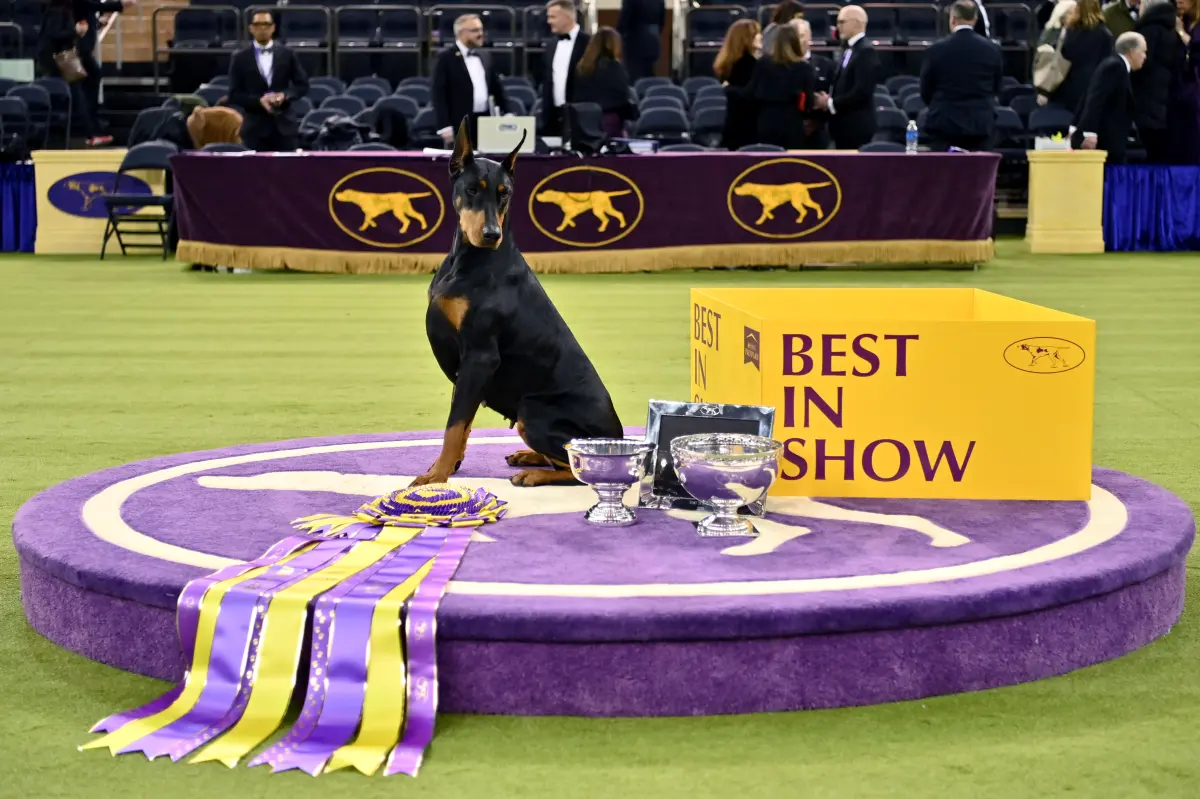
Imagine stepping into the grand arena of Madison Square Garden on a crisp February evening, the air buzzing with anticipation and the echoes of thousands of dog lovers cheering under the bright lights. It’s the 150th Westminster Kennel Club Dog Show, a spectacle that’s been captivating America since 1877, and at the heart of it all is a four-year-old Doberman Pinscher named Penny. This sleek, powerful dog, with her glossy black coat and statuesque build, has just been crowned Best in Show, outshining a field of 3,000 impeccably groomed competitors. Her owners, Greg and Theresa Chan from Ontario, Canada, are overwhelmed, their faces lit with joy amid the chaos. “You never think you’re going to win,” Greg told The Post afterward, his voice still carrying the thrill of the moment. It was the first Doberman victory in nearly 40 years at this prestigious event, a fact that made the win feel even more monumental. Sitting near the floor, surrounded by 50,000 fans, Greg recounted jumping up in shock, turning to see Theresa in tears, the rest of the night a happy blur. For Theresa, who had watched the show on TV for 18 years dreaming of one day participating as a breeder, it was surreal—a fairy tale coming true. Penny, however, remained the epitome of poise. As Greg described, she switched into “show-dog mode” the instant she entered the ring, her natural athlete’s focus kicking in. Competing against a lineup of top-tier breeds, Penny had to navigate the daunting “free stack” round, where dogs must strike and hold their perfect pose without their trainer’s help, showcasing their ideal breed standards. When Penny did just that—freezing flawlessly, her body a harmonious blend of strength and elegance—the crowd fell silent, even in that massive venue. Her trainer, Andy Linton, emerged beaming, proclaiming her the victor. Theresa remembered the pin-drop silence, followed by the exhilarating confidence that Penny was a shoe-in. It wasn’t just about looks; attitude mattered, and Penny’s “diva” vibe, that self-assured demand for attention, set her apart. Greg smiled as he recalled her as a cuddly companion at home but a star in the ring, hinting at the early signs of her dominance as a puppy, climbing atop Greg’s shoulders to assert her supremacy over her littermates with a playful growl. This victory encapsulated years of passion and perseverance from the Chans, who bred Penny in 2021 after Theresa started raising Dobermans a decade earlier. Greg, a retired police officer now advising on community housing safety, spoke warmly about their kennel, Connquest Dobermans, where they aim to produce not just top show dogs but affectionate, well-tempered pets. Dobermans, originating in 19th-century Germany from tax collector Karl Friedrich Louis Dobermann’s vision of a brave, intelligent guard dog, mean the world to them. Despite Penny’s early promise, she wasn’t initially Westminster material—trainer Andy gave her a low 4.5 out of 10 when she arrived in Washington state. Yet, like a underdog story, Linton saw potential and transformed her. Greg called him a “wizard,” especially given his battle with Parkinson’s disease. Linton’s unique “loose lead obedience” method lets dogs respond to subtle body cues rather than forceful tugs, allowing Penny to move naturally in the judge’s box without external prodding. It’s a style that’s hard to replicate, giving Penny an edge where others struggled. Linton, 67, found redemption in this win, saying he wanted to “go out on top,” and Westminster president Donald Sturz echoed the magic in their partnership. Now retired from showing, Penny is poised for a new chapter as a therapy dog, delighting in meeting people, with possible puppies on the horizon. The Chans’ story reminds us that canine greatness comes from deep dedication, occasional heartbreak, and the unbreakable bond between humans and their four-legged companions.
The day of Penny’s triumph was more than just a win; it was a tapestry of emotions woven into the fabric of the Westminster Kennel Club’s storied history. As the sun set over New York City on February 3, Greg and Theresa Chan found themselves at the epicenter of canine excellence, their four-year-old Doberman Pinscher seizing the crown after what felt like an eternity of hoping and honing. The arena pulsed with energy, 50,000 spectators witnessing a moment that would etch Penny’s name in dog show lore. For Greg, a former cop turned housing safety advisor, it was a dizzying high—jumping to his feet in disbelief, glancing back at Theresa’s tears of joy, the ensuing hours dissolving into a euphoric haze. Theresa, an investment advisor by trade, admitted the surreal quality, her 18 years of TV viewership morphing into reality when she finally stepped into the breeder’s role. Penny herself embodied calm amidst the storm, flipping into her show mode like a seasoned pro. Greg explained it as an innate switch: “Just like any other athlete,” she transformed in the ring, her athleticism and focus paramount. Competing against 3,000 competitors was no small feat, yet Penny’s standout performance in the “free stack” sealed the deal. Standing poised without assistance, she radiated Doberman perfection—balanced structure, alert ears, a gaze that commanded respect. The silence in Madison Square Garden spoke volumes, Theresa reminisced, before Andy Linton paraded her back, confirming the win. Even Linton, the breed’s icon known for his 1989 Best in Show with Indy, was floored, calling Penny “as great a Doberman as I have ever seen.” What differentiated her? A flawless, harmonious whole: well-proportioned limbs, a coat poured into her skin like a glove, and an undeniable aura. Theresa noted Penny’s strong-will, her “diva” personality demanding the spotlight—perfectly self-centered yet endearing. Greg shared anecdotes of her home life, where she’s “cuddly and snuggly,” cuddling up for affection, but in the ring, she becomes a competitor, her star quality evident from puppyhood. Raised in the Chans’ whelping box, she’d climb Greg’s neck, growling at siblings with proprietorial flair, signaling early on that she was destined for greatness. This path culminated in the Chans’ breeding journey, which began nearly a decade ago when Theresa fell in love with Dobermans. Greg joined her passion, seeing the breed—developed by Karl Dobermann in 1880s Germany as a fearless, smart guardian—as a way to create quality animals. Their kennel, Connquest Dobermans, focuses on show-worthy dogs with exemplary temperaments, producing pets that are loving and loyal. Penny’s early shows hinted at talent, but Westminster aspirations started when they brought her to Linton, who initially rated her lowly. Undeterred, Linton, despite Parkinson’s, became her mentor, employing his signature loose-leash training where body language cues guide the dog. No heavy pulling—just intuitive connection, letting Penny display natural gait with minimal intervention. Greg admired how Linton “disappears” in the ring, allowing the dog to shine independently, a technique that turned Penny from underdog to champion. By showtime, Linton upgraded her to an “11 out of 10,” his Parkinson’s a silent battle necessitating her strength. Her adaptability shone; as Theresa quipped, Dobermans defy old adages, learning new tricks daily, their intelligence making training a delight. The win was bittersweet for Linton, who expressed a desire to retire on such a high note, with Sturz praising the “special energy” that carried them. Retiring now, Penny’s future includes therapy work, where she thrives on hugs and interactions, potentially breeding top-tier pups. The Chans reflected on the rarity of such success—only a select few align perfectly; imperfections mean a happy pet life elsewhere. It’s a reminder of the emotional investment in dog shows, where victories aren’t just ribbons but lifelong memories. Through sleepless nights of training, vet visits, and grooming sessions, the Chans poured heart into Penny, creating a bond that transcends competition and turns victories into forever stories of love and achievement.
Delving deeper into the Chans’ world, their life revolved around Dobermans long before Penny’s spotlight moment, a journey blending family passion with the Grimes thrill of guardianship. Greg and Theresa met through their shared love for these elegant, versatile dogs, finding solace in a breed that demands respect and rewards loyalty. Raised in Ontario, Canada, they often joked about how Dobermans selected them, not the other way around, with their first encounters sparking an undeniable connection. Theresa, hailing from a banking background, transitioned into a full-time investment advisor while nurturing her canine interests, while Greg’s law enforcement days shaped his disciplined approach to both life and dog training. Together, they built Connquest Dobermans as a haven for breeding excellence, emphasizing not just conformation to standards but nurturing pets with stable, affectionate natures. It’s a mission rooted in the breed’s origin story—a tax collector named Karl Friedric Louis Dobermann in 19th-century Germany sought a dog equal parts ferocious guard and intelligent companion, crossing breeds like rottweilers, pinschers, and greyhounds to create the Doberman Pinscher. The Chans honor this legacy by ensuring their dogs embody courage without ferocity, brains over brawn. Breeding Penny in 2021 marked a pinnacle, but it wasn’t without challenges. Theresa recalled the meticulous process: selecting stud and dam for ideal traits, monitoring health, and fostering temperament. Early on, Penny showed spark—well-balanced body, alert expression—but local shows hinted at untapped potential. That’s when they entrusted her to Andy Linton, the Doberman guru in Washington state, who improbably gave her a mere 4.5/10 upon arrival. Far from discouraged, the Chans saw Linton’s involvement as a turning point. Known for his Parkinson’s diagnosis, which slowed his movements, Linton’s dedication was even more inspiring. Greg described their bond as symbiotic; Penny’s energy bolstered him, and his expertise sculpted her. His training philosophy, “loose lead obedience,” is a gentle art—using subtle cues like a shift in posture or foot placement to communicate, rather than yanking leashes. It’s like dancing with a partner who anticipates every move, allowing the dog to move fluidly and naturally. Greg illustrated with a story: in the judge’s box, while others manually adjusted paws for inspection, Linton simply strolled Penny in, her gait pristine. This method fostered Penny’s confidence, turning her into a ring virtuoso who responded instinctively. Theresa added that Dobermans’ quick-learning minds made it effortless; routines became games, building trust and precision. By Westminster, Linton beamed with pride, upgrading her to 11/10, his eyes misty at fulfilling a dream. President Sturz echoed this, noting how Penny supported Linton through his struggles, their synergy a rare magic. Post-win, Penny’s retirement echoed this harmony—she’ll pivot to therapy roles, where her gentle demeanor wins hearts, and perhaps sire litters carrying her legacy. The Chans stress selectivity: only perfection advances; others find loving homes as cherished pets. Reflecting on expenses—travel, trainers, health screenings—they see it as love invested, each dog a family extension. Greg shared personal anecdotes, like late-night worries over Penny’s health or the exhilaration of her first ribbon, weaving emotional threads into their breeding tapestry. Theresa pondered the breed’s dual nature: protectors in one breath, lap dogs the next, much like Penny’s transformation from ring star to therapy angel. It’s a lifestyle of balance, where defeats teach as much as wins, fostering resilience. For the Chans, Penny isn’t just a champion; she’s a living testament to dreams realized through patience and passion, a bond that enriches both human and canine lives in ways that ripple beyond the ring.
As the Westminster crowd roared, Penny’s victory wasn’t just about the ribbon; it was a testament to the intricate dance of genetics, training, and heartfelt commitment that defines elite dog shows. For the Chans, raising Dobermans goes beyond mere hobby—it’s a lifestyle immersed in the breed’s rich tapestry. Originating as protector dogs for a German tax official, Dobermans like Penny carry a legacy of vigilance and intellect, traits the Chans cultivate meticulously. Their kennel, a modest yet purposeful space in Ontario, serves as a nursery for champions and companions alike. Theresa, with her advisor’s precision, oversees breed selections, ensuring each pairing produces dogs “poured into their skin”—balanced, athletic, with no disproportionate features. Greg, drawing from his policing background, instills discipline, teaching pups the importance of obedience and calm. Penny’s story began as a whelp in 2021, one of several in a litter engineered for show potential, but early assessments varied. Local judges praised her structure, yet something was missing. Enter Andy Linton, the Bobs to their Ruth, whose initial critique stung but catalyzed change. Greg remembered the drive to Washington, Penny crated anxious yet curious, as the Chans entrusted her to the 67-year-old ICON, aware of his Parkinson’s tremor. Despite health hurdles, Linton’s energy surged in training sessions. His method, loose lead, is philosophy in action无关—dogs trained to read mime, following body whispers. No duress, just mutual understanding. Penny excelled, her Doberman acuity allowing her to master complex movements quickly. Theresa marveled at her adaptability, noting how she learned tricks daily, defying stereotypes. Practice evolved from chores to play, building worldliness. By Westminster, she’d blossomed, Linton’s “11/10” rating a proud validation. The event’s chaos amplified stakes—cams flashing, fans cheering, competitors vying. Yet Penny thrived, her free stack a masterclass in poise. Linton’s walk-in, minimal interference, showcased her innate elegance, judges nodding approvingly. Afterwards, Sarah Mrs. reflected on emotions: Greg’s exuberance, her tears, the blurred jubilation. Penny’s cool contrasted hers; diva attunement a breed hallmark. Home post-ring, she’s affectionate, seeking cuddles—a duality endearing yet crucial. Her win edged streaks like Chesapeake Bay Retriever Cota, conveying elite status. Now retired, therapy beckons—socialization her forte, meetings eliciting wags. Perhaps future litters will emulate her, though Chans stress perfection’s rarity; lackluster ones become pets, thriving elsewhere. Breeding demands sacrifices: finances for shows ($3000 kennel entries), time (weeks away), health vigilance (hip dysplasia checks). Yet joys outweigh: seeing pups graduate to loving homes, witnessing character blooms. Greg shared a Tender moment—Penny napping post-training, head on lap, trusting entirely. It encapsulates devotion: not just victories, but growth, resilience, unconditional bonds. Penny’s legacy persists, inspiring hopeful breeders, reminding us animal spirits uplift human souls in profound ways.
From the jubilant announcement at Madison Square Garden to quiet reflections at home, Penny’s Best in Show win for the Chans epitomized a life’s work rooted in canine devotion. Theresa, recalling her TV-watching dreams, felt vindication as a breeder, while Greg’s audible leap captured pure elation. Penny’s poise amid fanfare highlighted her breed’s composure, yet beneath lay deep training roots. The Chans’ path with Dobermans began 10 years prior, sparked by fascination with Karl Dobermann’s 19th-century guardian visionary. They pursued breeding holistically—shows for credentialing, homes for temperament—prioritizing humane, healthy practices. Penny’s birth in 2021 was joyful, littermates her early audiences for playful dominance. Early shows revealed potential, but transformation awaited Linton. Greg chronicled the arduous trek: initial low rating bruising, yet Linton’s mentorship uplifting. His Parkinson’s compounded challenges, movements deliberate, yet focus unwavering. Loose lead training became transformative—Penny responding to cues like verbal thoughts, learning gait, posture instinctively. Sessions involved repetition, rewards, bonding deeper than commands. Theresa credited Dobermans’ brains, noting novelty embrace; tricks evolved from basics to ring complexities. Training wove emotion: frustrations yielding breakthroughs, laughter during missteps. Linton’s Parkinson-specific adaptations added inspiration, Penny’s energy motivating him. Arrival at Westminster tested all: travel fatigue, arena nerves, competition pressure. Penny’s free stack silenced crowds, her stop flawless, judges enthralled. Linton’s unintrusive promenade contrasted forced poses nearby, nature’s validation. Win secured, runner-ups saluted—Cota, Zaida et al.—humbling acknowledgment. Linton’s praise resonated, his personal triumph bittersweet given health. Sturz captured synergy, “magic” transcending ailments. Post-win, retirement symbolizes evolution: therapy roles suiting her sociable nature, hugs replacing rings. Future plans include breeding, passing onal lineage, though selectivity demands wisdom; imperfections lead to happy pet placements. Breeding intricacies involve genetics (health screenings), socialization (puppy classes), ethics (no overbreeding). Chans recalled costs—shows, vets, travel—balanced by rewards: owner gratifications, dog joy. Greg reminisced: Pn pnommy’s post-win cuddles, vulnerability emerging, strengthening ties. It’s narrative of passion: defeats teaching humility, successes validating faith in animals’ potential human enrichment agents.
Wrapping up the whirlwind of Penny’s ascent, her Westminster victory stands as a beacon for aspiring breeders, blending perseverance with the magic of human-canine synergy. The Chans, etched in shock and delight that February night, transformed lifelong devotion into tangible triumph. Theresa’s televised aspirations realized, Greg’s jumps expressing uninhibited glee, Penny’s composed demeanor the anchor. Free stack’s silence encapsulated mastery, Linton’s techniques illuminating. Donald Sturz’s accolades underscored thematic bonds, resilience prevailing over paralysis. Now, therapy horizons beckon, socialization fulfilling Penny’s essence. Breeding futures loom selectively, progeny carrying flame. Connquest Kennels’ ethos endures: exceptional yet nurturing. Greg, Theresa share anecdotes—puppy growls foretelling dominance, training turns joyful. This tale transcends trophies, embodying dreams pursued, bonds forged, lives enriched by wagging tails. For Penny, victory’s not an end, but beginning’s next chapter—an enduring legacy of heart and harmony.