


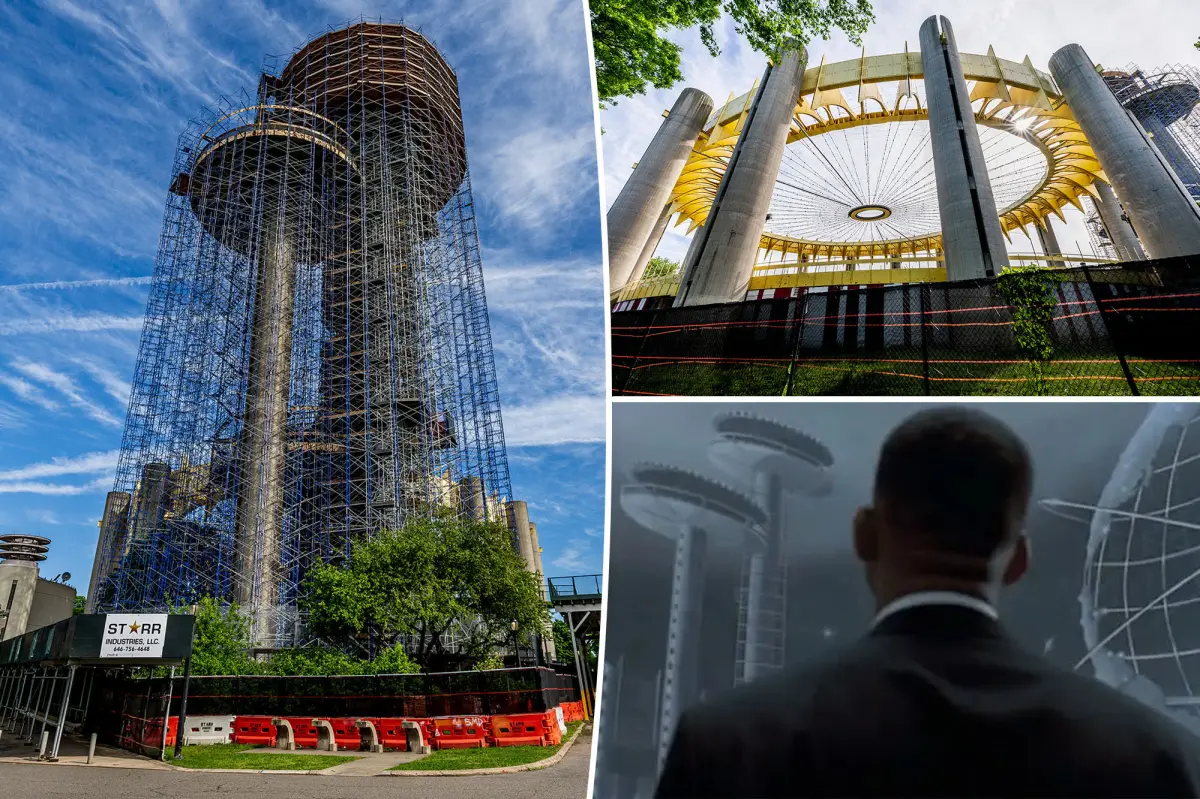
A Space-Age Marvel’s Second Chance: The Revival of the New York State Pavilion
Standing majestically in Flushing Meadows-Corona Park, Queens, the New York State Pavilion has been an enigmatic fixture of the New York skyline for decades. This architectural wonder, which many younger New Yorkers know only as “that strange concrete structure by the expressway” or perhaps from its cameo as an alien spacecraft in the 1997 blockbuster “Men in Black,” is finally getting the attention it deserves. After years of neglect that left it rusting and deteriorating, this iconic remnant of the 1964 World’s Fair is now undergoing a $50 million restoration that promises to breathe new life into one of New York’s most unique landmarks. The transformation represents more than just a structural renovation—it’s the resurrection of a symbol that once embodied American optimism and technological promise during the mid-20th century.
The New York State Pavilion, affectionately nicknamed the “Tent of Tomorrow,” stands as a testament to retro-futuristic design with its massive elliptical crown and three observation towers that soar up to 226 feet high, evoking the aesthetics of “The Jetsons” cartoon. Commissioned by then-Governor Nelson Rockefeller and designed by renowned architect Philip Johnson, the Pavilion was intentionally created to be the most impressive structure at the 1964 World’s Fair—a bold statement about human achievement in an era of rapid technological advancement and space exploration. Architecture critic Ada Louise Huxtable captured its essence perfectly when she described it as a “runaway success… a sophisticated frivolity… seriously and beautifully constructed. This is carnival with class.” For the 51 million visitors who attended the fair, the Pavilion represented not just a building but a portal to the future, showcasing what human ingenuity could accomplish.
For longtime residents like Helen Day, who experienced the World’s Fair firsthand, the Pavilion evokes powerful memories of a magical moment in New York’s history. “You walked down the roads, and everything was wide and beautifully constructed and just a magical place,” she reminisced to CBS News. Day’s perspective highlights the generational divide that has long surrounded this structure—those who remember its glory days and those who have only ever known it as a mysterious, deteriorating landmark. “There were two groups of people,” she explained, “those who experienced it firsthand, and those who had never experienced it, who would drive past it on the expressway and wonder what it was.” This restoration project offers a bridge between these two perspectives, allowing younger generations to finally understand and appreciate what their elders have been cherishing in memory for decades.
The Pavilion’s journey from architectural marvel to neglected ruin and back toward restoration reflects the cyclical nature of urban landmarks. After its triumphant debut, the structure didn’t immediately fade into obscurity—it enjoyed a second life as a roller skating rink and concert venue, bringing disco lights and guitar amplifiers to a space once dedicated to world’s fair wonder. But by 1976, its massive suspension roof was declared unsafe and demolished, leaving the skeletal frame exposed to the elements. Rain, sun, and an unwelcome colony of pigeons took their toll on the structure for decades. The pavilion might have been lost forever had it not been added to the National and New York State Registers of Historic Places in 2008—a designation that saved it from the wrecking ball and set the stage for its current revival. The $56.8 million stabilization effort approved by the city’s Parks Department represents a commitment not just to preserving history but to reimagining how historical structures can continue to serve and inspire communities.
Local historians and preservationists view the restoration with a deeply personal connection, seeing it as long-overdue recognition for a treasured piece of Queens heritage. Queens Historical Society executive director Jason Antos expressed this sentiment to the Queens Chronicle: “It’s a wonderful thing for Queens. For so many decades it was inaccessible and now can be enjoyed as the ultimate historic relic of New York City’s last and greatest World’s Fair.” Similarly, Forest Hills resident and historian Michael Perlman described the project as “a dream come true,” highlighting the emotional investment many locals have in seeing this landmark revitalized. The restoration validates decades of advocacy by community members who refused to let the Pavilion be forgotten or demolished, instead fighting for its recognition as an irreplaceable piece of cultural heritage that deserves preservation for future generations.
The restoration is progressing methodically, with the first phase already completed last year. This initial work focused on repairing cracked concrete, replacing suspension cables, and reinforcing the iconic towers—essentially stabilizing the structure to prevent further deterioration. The next phases could potentially reopen the observation decks, allowing visitors to once again experience the retro-futuristic heights that made the Pavilion so memorable. With guided tours potentially beginning as soon as late 2026, the project transforms what was once merely a vision of tomorrow into a tangible part of today’s New York City landscape. The Pavilion’s journey from World’s Fair centerpiece to abandoned ruin to restored landmark mirrors broader themes of urban renewal and historic preservation in American cities. It stands as proof that with sufficient care, resources, and community support, even the most neglected architectural treasures can be brought back from the brink—allowing new generations to experience the optimism and imagination of past eras while creating new memories and associations of their own.