


A Mother’s Journey: Correcting Flat Head Syndrome in Twins
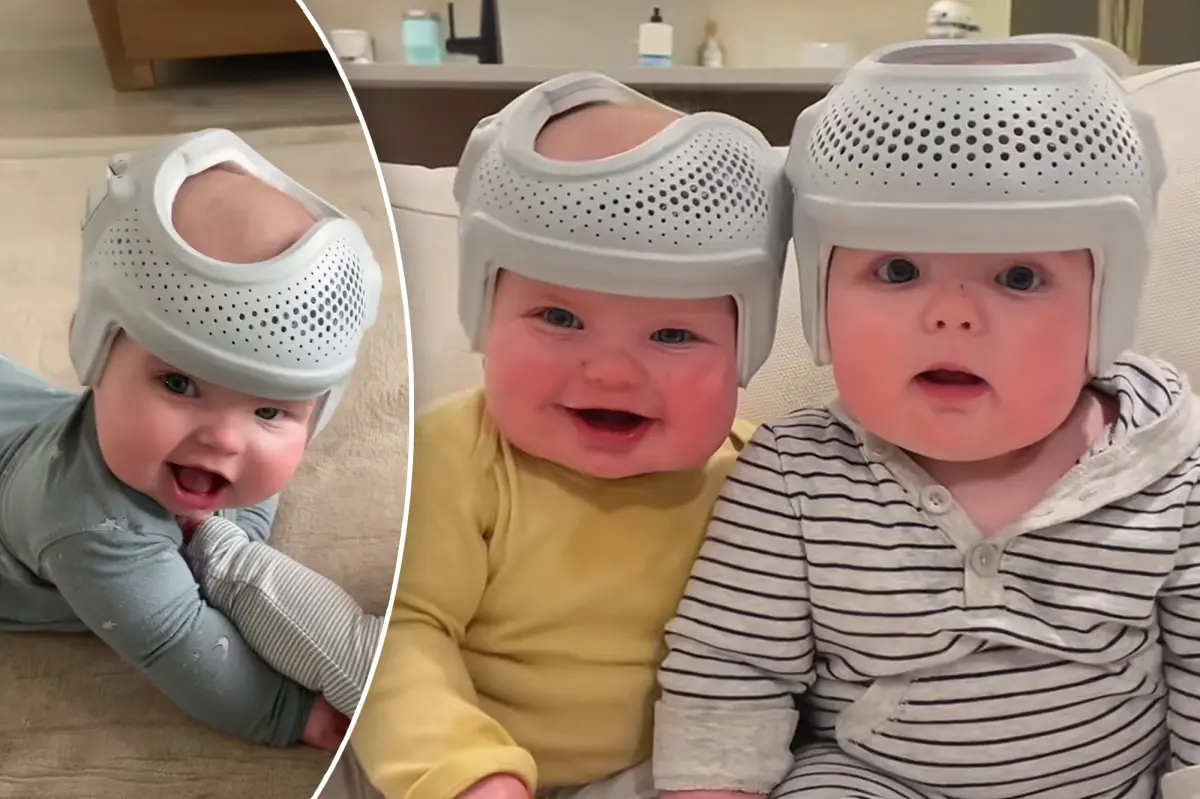
Madeline Lawrence, a 32-year-old mother of three from Utah, has found herself at the center of a social media controversy as she documents her journey treating her newborn twins for plagiocephaly, commonly known as flat head syndrome. While most parents might shy away from sharing medical interventions online, Lawrence has embraced transparency, posting videos of her twins Nico and Ash wearing their specially designed helmets – despite facing significant criticism from internet commenters. Her videos have garnered millions of views, bringing both support from fellow parents and harsh judgment from critics who question her decision to have her babies wear corrective helmets for 23 hours daily.
The twins’ flat head syndrome was first noticed when they were about two weeks old. “It probably started in the womb, probably from a lack of space in there being that they’re twins,” Lawrence explained. Born prematurely with low birth weights, the babies initially wore beanies that concealed the condition. Once discovered, Lawrence consulted with their pediatrician who recommended helmet therapy at the four-month mark, after the babies had developed sufficient neck strength to support the devices. Each custom helmet costs $700 out-of-pocket, significantly less than the typical price range of $1,500 to $5,200 that many families face without insurance coverage. The helmets are created using 3D imaging technology, with foam lining that can be adjusted as the babies grow, encouraging their heads to develop into a more rounded shape.
Plagiocephaly affects approximately one in eight healthy infants, according to data from the University of Illinois Hospital and Health Sciences. While the condition doesn’t impact brain development or intelligence, it can cause noticeable asymmetry in severe cases, potentially affecting the positioning of ears and creating asymmetry in the face, neck, or jaw. The condition has multiple potential causes, including birth-related pressure, sleep positioning (especially with the “back to sleep” campaigns that reduce SIDS risk), insufficient tummy time, and complications from multiple pregnancies. Experts recommend helmet therapy as an effective intervention, particularly when started before nine months of age and maintained for at least 15 hours daily – though Lawrence’s doctor recommended the more intensive 23-hour schedule.
The results of the helmet therapy have been remarkable for the Lawrence twins. Madeline proudly shares that her daughter, who has now completed treatment, started with 14 millimeters of asymmetry and improved to just 3.75 millimeters after six weeks. Meanwhile, her son Nico continues his treatment, with his asymmetry reduced to between six and seven millimeters. Medical experts typically recommend continuing treatment until asymmetry reaches one to three millimeters. “I’m just more inclined to keep his on longer since he’s a boy and might not always have hair to cover up any long-term flatness,” Lawrence explained, demonstrating the thoughtful consideration behind her parenting decisions. While the twins also participate in regular tummy time to strengthen their neck and shoulder muscles, Lawrence credits the helmets with making the most significant difference.
Despite the positive medical outcomes, Lawrence has faced harsh criticism online, with commenters calling the extensive helmet usage “crazy” and “unnecessary,” with some even describing it as “sad.” Such reactions reflect a broader misunderstanding about the condition and its treatment. Lawrence, however, remains undeterred by the negativity, comparing the intervention to orthodontic braces: “If it were me, and I had a head that was that flat, which could potentially cause asymmetry to my face, I’d want my parents to do what they could to fix it,” she said. “I kind of compare putting my babies in helmets to kids wearing braces. If it’s fixable, why not.” This practical approach demonstrates her commitment to her children’s long-term well-being over temporary comfort or aesthetic concerns.
What began as simply documenting her family’s medical journey has evolved into something much more meaningful. “After first it was really stressful, but as I’ve kept posting about their helmet therapy, I really just wanted to help destigmatize it,” Lawrence reflected. Her videos have become a source of support and information for other parents facing similar challenges. “I get so many messages from moms saying how long they felt when they were going through this and how much they appreciate my TikToks.” By sharing her twins’ progress openly, Lawrence has created a community of support around what was once a relatively unknown condition, turning potential isolation into connection. “My content is all about spreading awareness and positivity,” she affirms, standing confidently by her decision to prioritize her children’s health despite the criticism. Through her openness, Lawrence has transformed a personal medical intervention into an educational platform, helping countless other families navigate the complexities of infant plagiocephaly with greater confidence and knowledge.