






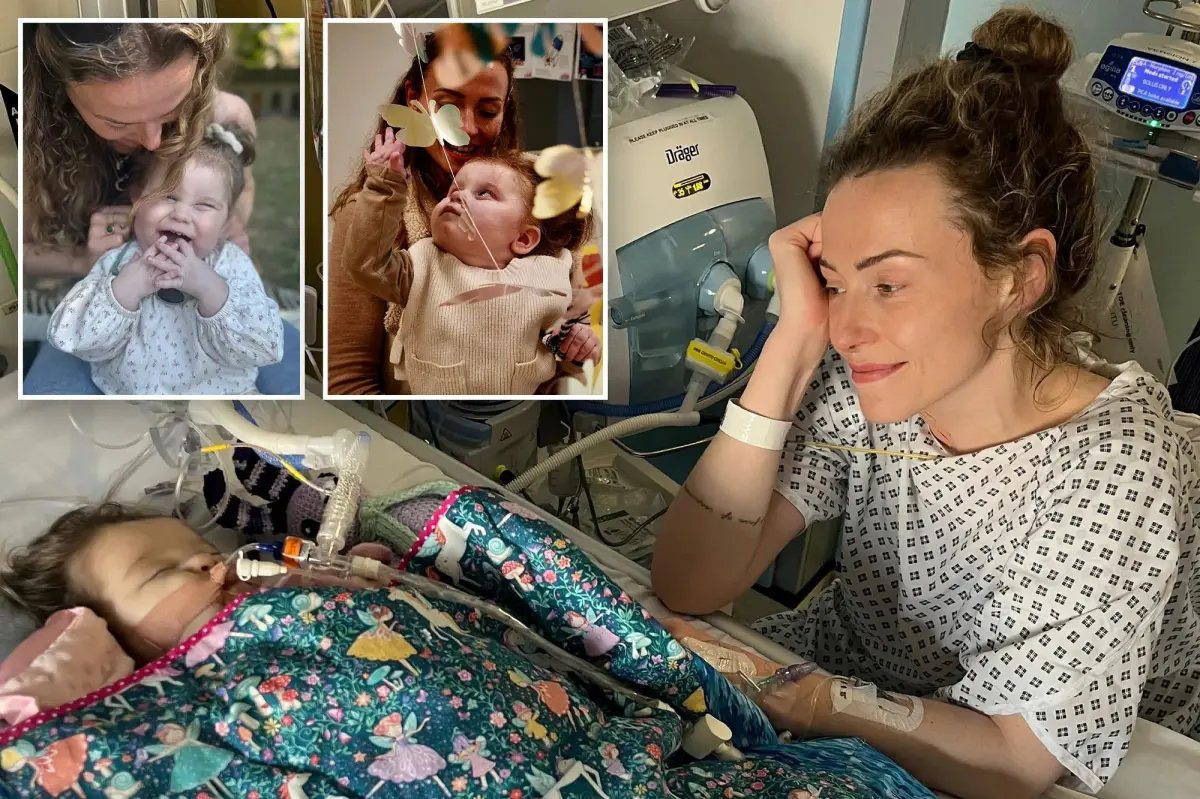
A Mother’s Gift: The Journey of Saving Her Daughter’s Life
In a profound display of maternal love, Elle Daniel, a 35-year-old yoga teacher from London, donated part of her liver to save her two-year-old daughter Ruby’s life in June 2025. Ruby was born with an extremely rare genetic condition called PMM2-CDG (Phosphomannomutase 2 – Congenital Disorder of Glycosylation), which affects multiple body systems and manifests differently in each person. For little Ruby, this meant significant developmental delays, preventing her from crawling or speaking at an age when most children are running and forming sentences. The condition also caused serious liver failure, which ultimately necessitated the transplant. This life-changing surgery came after a frightening period when Ruby’s health deteriorated dramatically – the color drained from her face, she experienced constant nausea, and eventually suffered seizures that landed her in intensive care. Though the liver transplant has dramatically improved Ruby’s quality of life, Elle continues to raise awareness about PMM2-CDG, as her daughter still faces many challenges associated with this rare condition.
Ruby’s medical journey began shortly after birth, when doctors had to drain fluid from her heart when she was just nine weeks old. As she grew, it became apparent that her development wasn’t progressing typically. By age two, she remained unable to crawl or speak, and her body struggled with basic functions – her kidneys showed signs of distress, and her digestive system couldn’t properly absorb nutrients, leaving her significantly smaller than other children her age. The first serious signs of liver failure appeared when Ruby was one year old, when her complexion became alarmingly pale and she suffered from persistent nausea. “Last year, all the color drained from her, and she was feeling sick most of the time,” Elle explained. Then came the seizures, which doctors attributed to toxic waste products building up in Ruby’s blood due to her failing liver. By December 2024, medical professionals determined that a liver transplant was Ruby’s best hope, and Elle didn’t hesitate to volunteer as a donor. “It was a very natural instinct for a parent,” she said. “I’m fit and healthy, so I figured my liver would be good to go.”
The path to transplantation wasn’t straightforward. After Elle underwent numerous compatibility tests, doctors initially scheduled the procedure for May 2025. However, Ruby developed kidney complications that forced them to postpone until June. When the day finally arrived, Elle’s surgery lasted four and a half hours as doctors removed a portion of her liver – an organ with the remarkable ability to regenerate itself. The piece given to Ruby would grow into a full-sized liver, while Elle’s remaining liver would eventually return to normal size. After her surgery, Elle endured intense pain and anxiously awaited news about her daughter, who was still in the operating room. “The nurses were coming in to give me updates,” Elle recalled. “I just knew she was going to be OK.” The separation was difficult; Elle couldn’t see Ruby for two days following the surgeries as she was completely incapacitated. Their eventual reunion was emotional and marked the beginning of a new chapter in their journey.
The transformation in Ruby following the transplant has been nothing short of remarkable. Elle spent five days recovering in the hospital, while Ruby remained at King’s College Hospital for two months. Blood tests that previously indicated liver failure now show normal function, confirming the procedure’s success. With her new liver properly absorbing nutrients and fat, Ruby has experienced significant physical growth. “She used to look so teeny compared to other children, and now she’s bigger than some of my friends’ children,” Elle marveled. The toddler’s energy levels have soared, and her motor skills have improved dramatically – she can now sit up independently, a milestone previously beyond her reach. “It’s quite amazing to see,” Elle said. “She went from looking like a really poorly child to being much more vibrant. Her life has really improved due to the transplant.”
Despite these impressive improvements, Ruby’s journey is far from over. The transplant addressed her liver failure but not the underlying genetic condition affecting multiple body systems. Additionally, like all transplant recipients, Ruby must take immunosuppressant medications to prevent her body from rejecting her new liver. This necessary treatment has created new challenges, as her compromised immune system leaves her vulnerable to infections. “Due to her suppressed immune system, Ruby is currently getting bug after bug, causing her difficulties in her chest,” Elle explained. The reality is that while the transplant saved Ruby’s life and improved her quality of living, it didn’t cure her rare genetic disorder. The family continues to navigate the complex medical landscape of PMM2-CDG, which affects fewer than 1,000 people worldwide and remains poorly understood by the medical community.
Hope shines on the horizon, however, as medical research advances. Elle shared that three new treatments and a potential cure for PMM2-CDG are currently in early-stage clinical trials. Passionate about improving outcomes for her daughter and others with the condition, Elle is actively raising funds for research through the CDG UK Just Giving page. “So little is known about her condition, so I’m trying to raise awareness of it,” she explained. Through sharing their story, Elle hopes to shine a light on this ultra-rare disorder and support the development of more effective treatments. Meanwhile, she continues to celebrate each of Ruby’s small victories while providing the extraordinary care her daughter needs. Their story stands as a powerful testament to a mother’s love and the remarkable resilience of both parent and child in the face of seemingly insurmountable challenges. As Ruby continues to grow stronger with her new liver—a living gift from her mother—her future holds more promise than seemed possible just months ago.