



The Simple Packaging Hack That’s Changing Lives
In the midst of everyday frustrations, few things compare to the maddening experience of purchasing a new pair of scissors, only to realize you need scissors to open the packaging they come in. This circular problem has frustrated consumers for generations, creating what experts now refer to as “wrap rage” – that genuine anger and physical frustration caused by seemingly impenetrable packaging. However, a Brisbane mother of four has recently shared a brilliantly simple solution that has taken social media by storm, leaving thousands wondering how they never discovered it themselves.
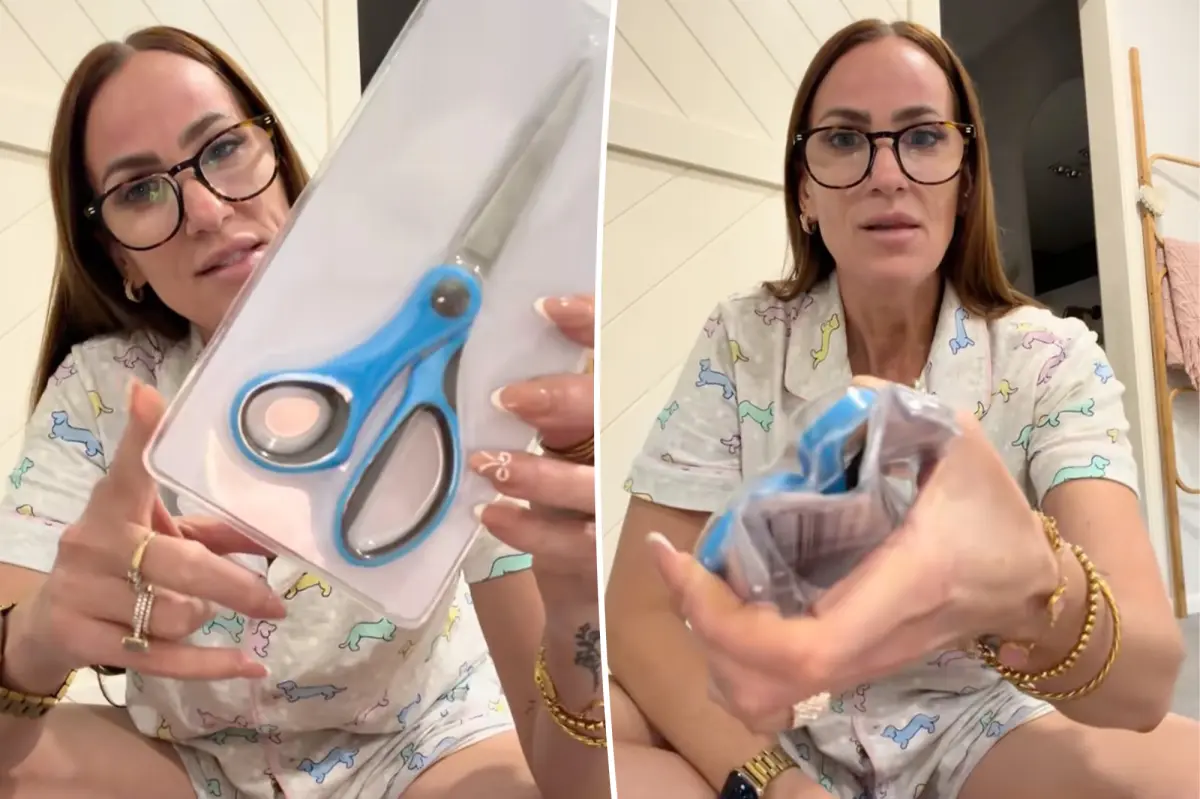
Amy Freeman, a 40-year-old mom from Brisbane, found herself genuinely shocked when she learned about this packaging hack and felt compelled to share it with others on Instagram. “I was literally shocked when I found it out myself, so I had to share it. I didn’t think it’d be as well received as it was,” she told news.com.au. Like most of us, Freeman had spent years struggling with those thick, heat-sealed plastic blister packs that seem deliberately designed to resist opening. The traditional approach—using scissors to carefully cut around the edges, often resulting in jagged plastic pieces and occasionally minor injuries—had been her go-to method until she witnessed someone using a completely different technique.
The genius of Freeman’s hack lies in its simplicity. Rather than cutting, tearing, or stabbing at the plastic packaging, Freeman demonstrates that all you need to do is firmly squeeze the package between your hands. In her viral video, she holds up a blister pack containing scissors and applies pressure by squeezing it. Almost magically, the packaging bows outward, creating a gap at the bottom that allows her to easily tear the package in half and remove the scissors in one clean motion. “It’s that simple,” Freeman explains in the video, clearly still amazed by the discovery herself. “So much stuff comes in this type of packaging,” she adds, highlighting how widely applicable this technique could be for countless consumer products.
The response to Freeman’s packaging hack has been nothing short of phenomenal, with her comment section flooded by grateful followers who express both amazement and slight frustration that such a simple solution has eluded them for so long. “This is by far the best hack I’ve ever seen. Why isn’t it written somewhere on the packet?!!” demanded one user, echoing the sentiments of many. Another thankful commenter wrote: “GET OUT!!!! Thank you so much for that, you’ve just changed my life. I’m forever in your debt.” The cross-generational appeal of the hack was evident as well, with one commenter joking, “Well, I’m 61 and just found this out,” while another suggested, “This should be taught at school.” These responses highlight not just the usefulness of the tip but also the universal struggle with packaging that seems designed specifically to challenge human dexterity and patience.
The underlying issue that makes Freeman’s hack so valuable relates to the intentional design of modern packaging. These blister packs and clamshell containers aren’t accidentally difficult to open—they’re specifically engineered to be theft-proof in retail environments and durable enough to protect products during shipping and handling. Manufacturers have prioritized security and product protection over consumer convenience, creating packaging that effectively serves its commercial purpose while simultaneously generating frustration at the point of use. The phenomenon has become so widespread that “wrap rage” is now recognized as a genuine consumer experience, one that Freeman’s simple squeeze technique aims to alleviate.
While many users celebrated this newfound knowledge, several commenters noted important caveats to the technique. Not all packaging yields so easily to the squeeze method, with several people reporting mixed results. “Didn’t work for me with my Kmart phone charger. My fingers were sore after five minutes,” reported one user. Others suggested that the success of the technique depends largely on the quality and thickness of the packaging: “It will only work on cheap quality products/packaging. If it’s a branded product it’s unlikely this will work as the plastic is thicker.” These observations highlight an important reality—while Freeman’s hack represents a valuable addition to the consumer’s arsenal of packaging-opening techniques, it’s not a universal solution for every type of sealed container. Nevertheless, for many common household items packaged in standard blister packs, this simple squeezing technique could eliminate the ironic scenario of needing scissors to open scissors, or any of the countless other packaging challenges that have become an accepted but unnecessary part of modern consumer life.