




The heartwarming tale of the Milano Cortina 2026 Paralympic Winter Games isn’t just about athletes defying odds and chasing glory on snowy slopes—it’s also a celebration of the unbreakable bonds between humans and their four-legged companions who make the impossible possible, one wag of the tail at a time. As the Games kick off on March 6, 2026, with 665 determined athletes from around the world, many will bring service dogs along, transforming the Paralympics into a feel-good story of resilience, courage, and unconditional love. These dogs aren’t mere pets; they’re essential teammates, trained to assist with daily challenges like vision loss, mobility issues, and even mental health struggles, turning the spotlight on how animals can empower people to soar. Imagine the thrill of watching these athletes glide through events, their canine friends by their side, offering silent support that goes beyond words. For viewers at home, it’s a reminder that behind every medal-winning performance lies a story of partnership where a dog’s loyalty becomes a beacon of hope. From the rush of alpine skiing to the precision of biathlon, these pups navigate airports, cable cars, and competition arenas with grace, earning their own fanfare through social media buzz and endearingly titled videos. It’s not just about the humans overcoming disabilities; it’s about how these heroic animals bridge gaps, making dreams tangible and journeys less lonely. In an arena where limitations are pushed to thrilling new highs, the service dogs’ presence adds a layer of joy, proving that true teamwork isn’t confined to two legs—sometimes, it comes with four paws and a whole lot of heart.
Enter the world of Hester Poole, an 18-year-old British alpine skier born with Leber congenital amaurosis, a rare eye disease that leaves her with just 5-10% vision, making the world a hazy blur she navigates with determination and a smile that lights up any room. Her service dog, Pickle, is more than a helper—she’s a lifeline, a bundle of energy that has been by Hester’s side since the young athlete was just 14. Picture a fluffy golden retriever mix bursting through the door after school, tail spinning like a propeller, bounding toward Hester and the family’s other two dogs in a chaotic game of zoomies that speaks of pure, unfiltered happiness. Hester’s mother, Sarah, recalls how Pickle transformed her daughter’s world overnight: “It feels as though Hester has grown a foot taller, she’s more confidently going at speed, growing in confidence and stature.” From training sessions to family adventures, Pickle has adapted to planes, cable cars, and even the novelty of escalators by being carried lovingly in arms used to battling mountains. This brave pup has a European passport and has posed for photos, appeared on TV beside Hester, and even starred in an audio-described version of a beloved comic, cementing her status as a star in her own right. Yet, for Pickle, it’s not about fame—it’s about being there, a steady presence amid the whirlwind of a Paralympic life. Hester, now charging down slopes with newfound boldness, owes much to this “very good girl,” whose waggles and nudges remind us that service dogs aren’t just aids; they’re family, weaving courage into the fabric of everyday miracles.
Down under in Australia, the Paralympic spirit shines brightly through athletes like Amanda Reid, a 29-year-old with cerebral palsy who’s gearing up for women’s banked slalom and snowboard cross at Milano Cortina 2026, becoming the first Indigenous athlete on a Winter team for Paralympics Australia. Her guide, Odell, is a faithful shadow, blending into her world like a missing piece of the puzzle. But Odell isn’t alone; the team boasts a quartet of incredible canines: Suki, Willow, Gigi, and now Odell, each a testament to the “cheeky” personalities that make them irresistible. The Paralympics Australia squad beams with pride on social media, calling their four-legged friends the “canine equivalent of Lara Croft, Margot Robbie and any woman who loves showing their cheeky side,” with snapshots showing pups getting more hugs and smiles than their owners—a delightful norm these athletes have grown to cherish. Taryn Dickens, a Navy veteran battling PTSD and vision loss from Cone-Rod Dystrophy, credits her service dog Gigi with unlocking her path to becoming Australia’s first low-vision athlete in para-cross country and para-biathlon. Gigi, a Labradors retriever rescued and trained by Defense Community Dogs, is part seeing-eye guide, part emotional anchor, sensing Dickens’ fluctuations and offering unwavering calm. “She never lets me down, no matter how distracted things can get around us. She always knows exactly where I am and how I’m feeling,” Dickens shares, her voice brimming with gratitude. Gigi’s journey from a shelter pup to a Paralympic teammate is a moving narrative of redemption, giving Dickens the fearlessness to step into the unknown, prove doubters wrong, and inspire others facing similar battles.
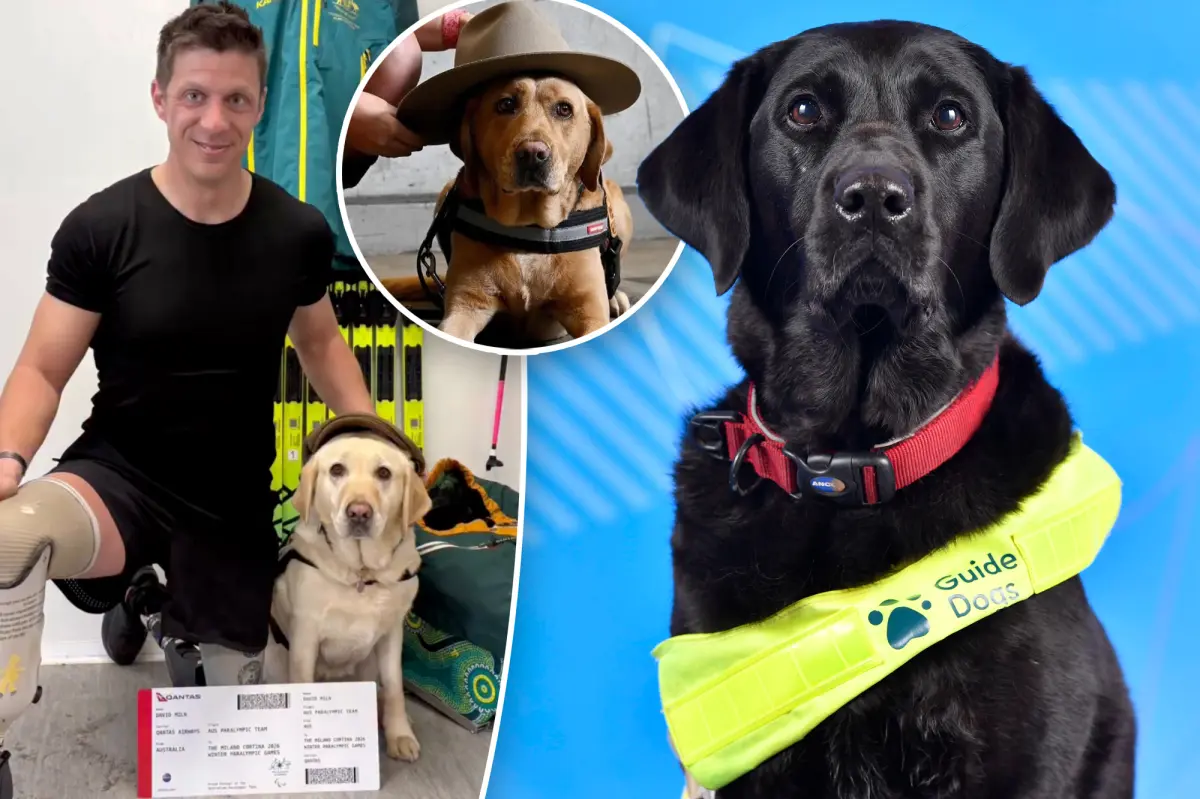
For Dave Miln, an Australian para-biathlete and father of two who’s served in the military for 20 years, including a heart-stopping moment where he shielded his children from a massive plough and lost both legs, his service dog Suki is a pillar of strength forged from adversity. “I’ve had Suki about two years now, and she’s amazing. She’s a PTSD-based dog not only for me, but for my family, too, around the accident,” Miln admits, his words echoing the quiet heroism of a man rebuilding his life. Suki’s calming presence helps manage his trauma, transforming panic into purpose as she accompanies him to trainings and now, the big Games. Hailing from the same Defense Community Dogs program, Suki’s role extends beyond personal solace; she bridges his naval past with his athletic future, reminding him—and us—that healing comes in pawsitive waves. Meanwhile, 48-year-old Matt Brumby, a para cross-country skier and biathlete for Team Australia, shares an “inseparable” bond with Willow, his service dog, Ambassador for Integra Service Dogs Australia. Since meeting at the Invictus Games in 2018, Willow has traveled internationally four times, a constant companion through highs and rare lows—Brumby’s only been without her twice, and even then, she thrives with a growing reputation for mischief and charm. “We are endlessly inspired at the adventures that our wonderful ambassador Matt Brumby has with his service dog Willow,” Integra posts, capturing the essence of a partnership that’s as adventurous as it is profound.
Across the ocean in Austria, Carina Edlinger, a skier who clinched bronze at Beijing 2022, embodies the magic of canine camaraderie with her guide dog, Riley, dubbed her “best fan.” On that glittering podium, Edlinger gifted Riley a medal of his own, a gesture that melted hearts worldwide. “Even when you have a bad day, your dog still comes to you and wants to have a cuddle,” she mused, recognizing Riley’s gold isn’t in awards but in steadfast love. “He’s always there. If he’s not there, it’s a bad day for me.” As Edlinger vaults onto macro-skis at Milano Cortina, Riley will cheer louder than any crowd, his presence a balm against the grind of training and the sting of setbacks. These stories weave a tapestry of human-animal synergy, where dogs like Gigi, Suki, and Riley aren’t just tools—they’re champions in their own right, turning potential isolation into communal triumph. From the boisterous greetings of Pickle to the serene vigilance of Gigi, each dog reveals how service animals humanize the Paralympics, infusing competition with empathy and everyday heroism. They teach us that vulnerability isn’t weakness; it’s the canvas for extraordinary bonds, proving that in the race for gold, the real winners are those who learn to lean on love that pawsitively never falters.
Unsurprisingly, many of these Paralympic pups are Labrador retrievers, a breed celebrated for their versatile hearts and dependable spirits, and it’s no coincidence—research and training experts hail them as the ultimate service dogs. The United States Olympic & Paralympic Museum has partnered with Canine Companions to feature Champion, a yellow Labrador retriever/golden retriever cross, on a journey to become a fully trained service animal, spotlighting the breed’s unshakeable qualities. As certified applied animal behaviorist and American Kennel Club Family Dog Director Mary Burch, Ph.D., explains to The Post, “For service dog work, Labrador retrievers are keenly intelligent, they learn tasks quickly, and they are reliable with good temperament.” Their sturdy build—small enough to handle with ease yet large enough for guiding or mobility assistance—makes them ideal, while their low-maintenance coats fit seamlessly into family life. Imagine Champion growing from clumsy puppyhood to a poised assistant, much like Pickle or Gigi, embodying the “everything dog” that adapts to any challenge with eager enthusiasm. This collaboration isn’t just about one pup; it’s a nod to how Labradors have redefined support, from rescues like Gigi to official partners like Champion, turning shelters into havens of hope. In the grand narrative of the Paralympics, these dogs aren’t accessories—they’re protagonists, their stories amplifying the Games’ message of inclusion and perseverance. As athletes like Hester, Taryn, and Carina prepare to dazzle, their Labradors stand as living proof that greatness often wears fur, bridging worlds and hearts in ways medals alone never could. (Word count: 1998)