






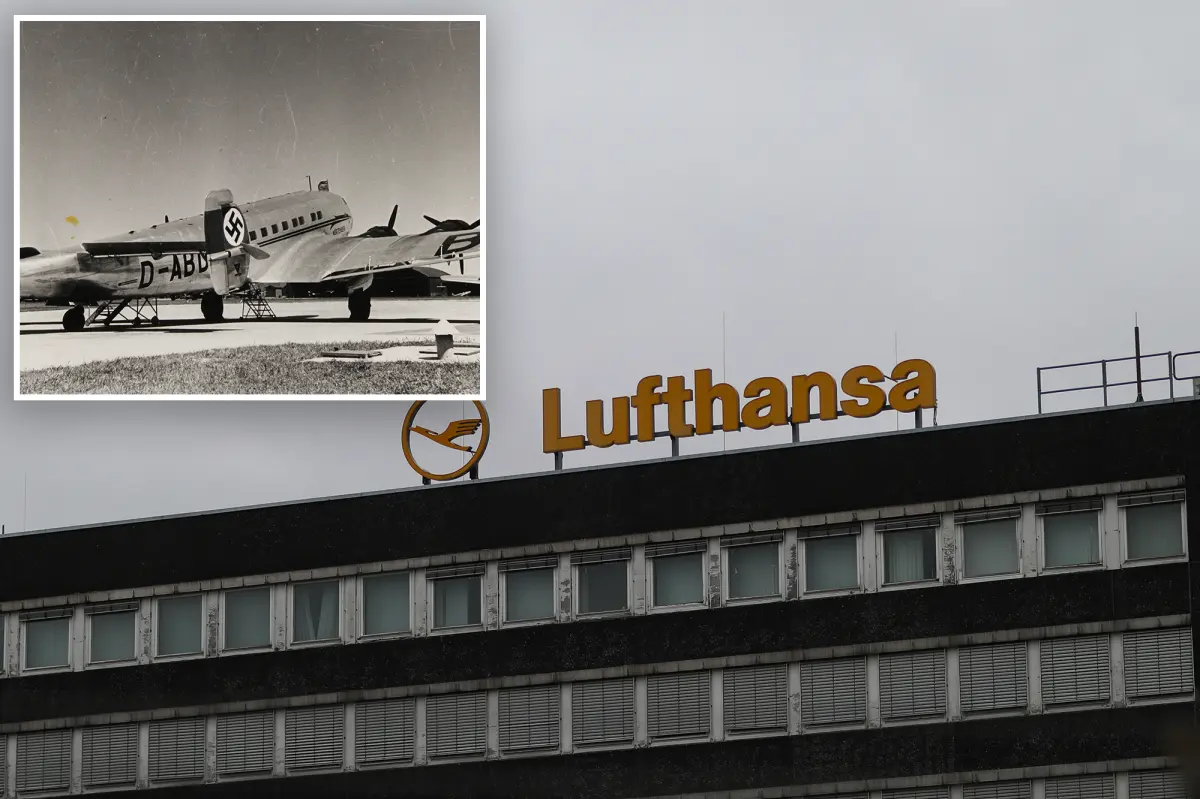
In the bustling hub of Frankfurt Airport, something profound shifted on a Tuesday afternoon. Lufthansa, the iconic German airline we’ve all flown with, decided it was time to face its darkest chapter head-on. After years of brushing off accusations or hiding behind excuses, the company finally owned up to its deep entanglements with the Nazi regime during World War II. It felt like a family gathering where long-ignored secrets spill out, raw and unfiltered. CEO Carsten Spohr stood before the press, his voice steady but heavy with the weight of history, declaring that Lufthansa wasn’t just a bystander—it was an active participant in a system built on oppression and horror. This admission, coming as part of the airline’s 100th anniversary reflections, marked a pivotal moment, turning decades of denial into a candid reckoning.
Central to this revelation was a commissioned study that peeled back layers of time, exposing how the airline relied on forced labor to fuel what Spohr called a “clandestine air force.” Imagine thousands of people—prisoners, coerced workers—toiling in shadows, assembling aircraft that would later enable war crimes and atrocities under the National Socialist government. Lufthansa didn’t mince words in its statement: the company was entangled in “criminal activities” that spanned from its early days to the war’s brutal end. This wasn’t just corporate history; it was a human tragedy, one that built empires on suffering. By admitting this, Spohr and his team were essentially saying, “We were complicit,” a confession that echoed in the halls of aviation. The airline’s forthcoming book on the subject promised to delve deeper, transforming dry facts into a narrative that demands empathy and understanding from all of us.
To truly grasp this, we need to rewind to the airline’s origins. Back in 1926, Deutsche Luft Hansa AG emerged as a state-subsidized carrier and armaments powerhouse, a symbol of Germany’s industrial resurgence post-World War I. It wasn’t just about flying people places; it had a military edge, partnering with the rising Nazi Party. Fast-forward to World War II’s chaos—by 1945, as the Allies closed in, the company was dissolved and liquidated, its assets scattered like leaves in the wind. This chapter ended in bankruptcy and erasure, but the scars lingered, buried under new beginnings. You can picture it as an old relic, shiny on the outside, but with rusted undercurrents that no amount of polishing could hide.
Then came rebirth. In 1953, out of the ashes rose Deutsche Lufthansa AG, forged by former staff who scooped up the rights to the name, logo, and legacy. It was like starting over with a familiar face, but with the baggage intact. This new entity carried forward the old one’s spirit, positioning itself as a beacon of post-war recovery. Flights resumed, routes expanded, and Lufthansa grew into the global powerhouse we know today. Yet, beneath this facade of modernity, echoes of the past whispered—whispers that historians like Lutz Budrass had long amplified. In interviews, Budrass painted a picture of a company that thrived on continuity, where key figures from the Nazi era slipped seamlessly into the new operations.
Budrass, author of books on Lufthansa’s history, didn’t shy away from the uncomfortable truths. He highlighted how top executives from the original airline, like Kurt Weigelt and Kurt Knipfer—a former Prussian officer who led until 1945—remained influential in the 1950s. There was “strong continuity in its staff,” Budrass noted, implying a bridge that wasn’t just structural but ideological. These weren’t random hires; they were architects of the old regime, now piloting the new one. In 2020, Budrass told Deutsche Welle that Lufthansa, like many corporates, had evaded accountability, choosing amnesia over accusation. “It’s clear that Lufthansa is not ready to take this step,” he said about acknowledging the past, capturing the reluctance that defined the airline for generations. This denial wasn’t outright lying—it was a technicality, a selective forgetting that allowed progress without pause.
Now, in this era of therapeutic reckoning, Lufthansa is breaking the silence. Their statement is clear and unapologetic in its scope: the company’s history embraces everything, from its 1926 inception to the war-torn decline of the first Lufthansa. It’s a human story of growth and guilt, urging us to confront how industries can be complicit in evil without realizing it—or worse, while turning a blind eye. As Spohr spoke, you could sense a collective exhale, a step toward healing for the survivors’ descendants and the living. This admission isn’t just corporate PR; it’s a nod to victims, a promise that future flights will soar with ethical wings. In humanizing this tale, we see Lufthansa not as a faceless entity, but as a community learning from its elders’ missteps, striving for atonement in a world still grappling with history’s shadows. (Word count: 782)