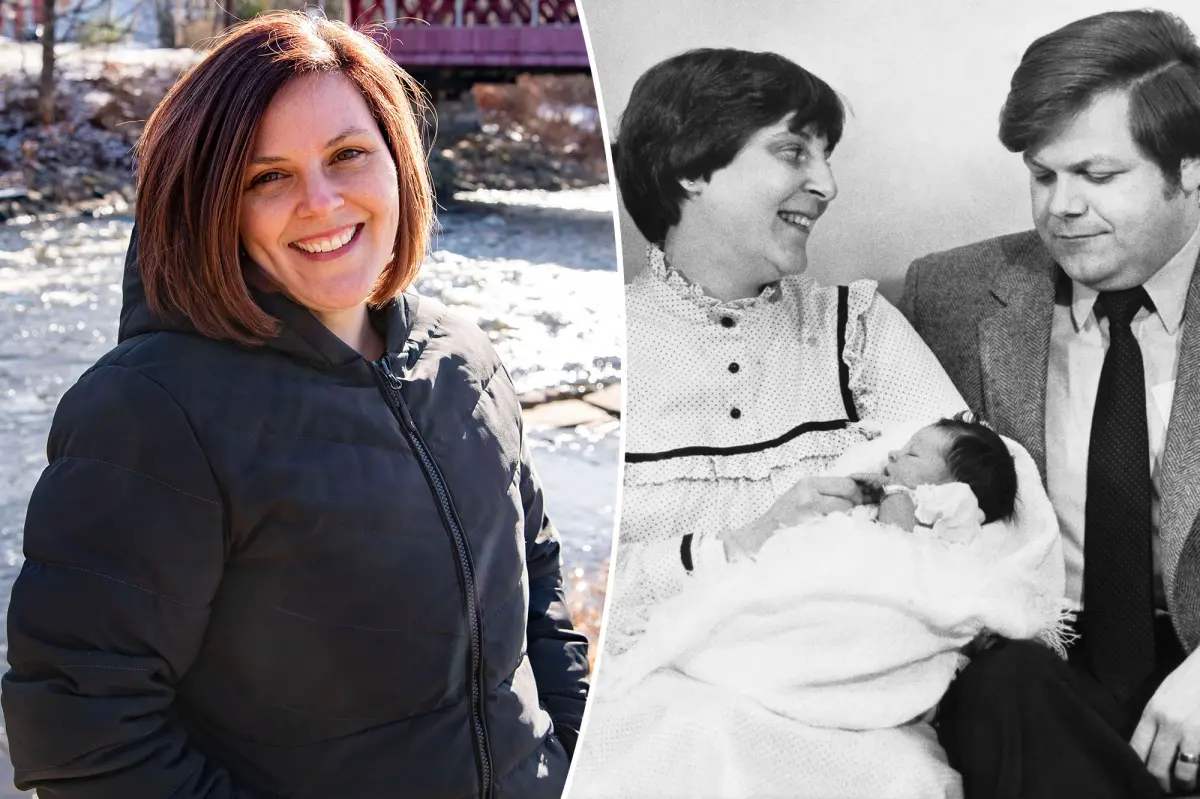
Elizabeth Carr might seem like just another 44-year-old from the East Coast at first glance, but there’s something extraordinary about her that rewrites a chapter of American history. Born on December 28, 1981, in Norfolk, Virginia, she’s not your typical millennial—she’s the first baby in the United States conceived through in-vitro fertilization, or IVF. Imagine waking up one day and realizing you’re a living milestone, a pioneer in fertility science that has touched millions of lives. Carr, who works in public relations and now calls Boston home, spoke to Britannica about her journey, and it’s heartwarming how she views herself. “I really feel like a big older sister to a lot of children around the world,” she shared, her voice carrying the warmth of someone who’s embraced her role in the spotlight without letting it define her entirely. She’s an advocate, a storyteller, someone who humanizes a scientific breakthrough by reminding us that behind every medical triumph is a person with hopes, dreams, and yes, a belly button just like everyone else’s. But Carr’s story isn’t just about her; it’s about perseverance, love, and the quiet revolution happening in families across the globe. She reflects on IVF being in its infancy even today, almost half a century after her birth, and how we’ve only scratched the surface of its potential. It’s stories like hers that make you pause and think about how technology intertwines with human emotion, turning what could be a sterile lab procedure into a lifeline for countless families.
What strikes me most about Elizabeth’s story is how her arrival was anything but ordinary, yet it led to something profoundly relatable. Her parents, Judith and Roger Carr, weren’t facing infertility in the traditional sense—they could conceive, but Judith just couldn’t carry a pregnancy to term. Picture this: three heartbreaking ectopic pregnancies, where the fertilized egg implants outside the uterus, leading to ruptured tubes and severe internal bleeding. Judith was recovering from surgery when her OB-GYN, fresh from a fertility conference, casually mentioned this new thing called IVF. He talked about a husband-and-wife team, Howard and Georgeanna Jones, setting up a clinic in Norfolk and seeking patients. Judith and Roger, practical folks from Massachusetts, thought, “What do we have to lose?” It was 1981, and IVF was cutting-edge, almost experimental. Massachusetts hadn’t legalized it yet, so back then, they journeyed to Virginia for help. The Joneses called just two weeks later, urging them to come quickly. Imagine the mix of hope and fear—the vulnerability of making that trip, trusting strangers with the most intimate dream: starting a family. Judith got pregnant through IVF, endured the emotional rollercoaster of early pregnancy fears, and nine months later, Elizabeth was born. It’s a reminder that behind every miracle is a story of human struggle, of doctors collaborating with couples to push boundaries. Carr’s birth sparked a media whirlwind—think newborn press conferences and Life Magazine covers—turning her into a symbol, but her parents insisted on showing the world that IVF just meant creating a normal child, one who grows up to laugh, love, and live like anyone else.
The day Elizabeth entered the world, her parents chose to embrace the spotlight, believing it could normalize IVF and erase stigmas. Carr recalls her “first press conference” at just three days old, surrounded by cameras and curious onlookers. Doctors offered to keep things private, but Judith and Roger wanted people to see that their baby was just like the rest—a healthy girl with ten fingers and ten toes, destined for a regular life. Yet, decades later, Carr still fields odd questions that reveal how misunderstood IVF remains. “A frequent question I get is, ‘Do you have a belly button?'” she laughs, thinking back to the “test-tube baby” label that used to haunt her. People imagined her grown in some lab vial, like a science experiment, but the truth is far more human and ordinary. Conception happened in a simple Petri dish, where her mom’s egg met her dad’s sperm, forming an embryo that was gently transferred into Judith’s womb. Nine months of natural gestation followed, leading to a birth as wondrous as any other. It’s endearing how Carr dismantles these myths with patience and humor, becoming a bridge between cold science and warm family bonds. She shares how her own life has been a blend of the usual—school, jobs, friendships—with the occasional query that pulls her back to her origins. For Elizabeth, it’s not about fame; it’s about connection. She reflects on feeling like a “big older sister,” watching as IVF evolves, creating generations of families who might otherwise never exist. In her advocacy, she carries the torch lit by her parents’ bravery, proving that one family’s story can illuminate countless others.
Over the years, IVF has exploded from a niche procedure to a global phenomenon, and Elizabeth Carr’s birth marked the U.S. chapter’s beginning. Before her, the world knew only Louise Joy Brown from the UK, born in 1978, who became history’s first IVF baby. Since then, advancements have turned IVF into a lifeline, though it’s still pricey— a single cycle can cost over $25,000 in the U.S. Today, it accounts for about 2.6% of American births, and experts predict the market will hit a staggering $49.12 billion by 2033, driven by better tech and rising infertility rates. But beneath the statistics are personal narratives, like Carr’s, where science meets soul. She talks about how IVF is no longer just for couples battling infertility; it’s for military families timing deployments, cancer patients preserving fertility, or LGBTQ+ individuals building families. “By last count, there was something like 12 million of us IVF babies,” Carr beams, her pride evident. These are not just numbers—they’re 12 million stories of resilience, of embryos becoming children who skip, play, and dream. Carr’s perspective humanizes the data: she sees herself as part of a vast kinship network, a sister to siblings conceived in labs worldwide. It’s powerful to imagine a global family tree rooted in Petri dishes, branching into lives full of joy, challenge, and unbreakable bonds. As technology refines IVF—minimizing risks, improving success rates—Carr remains optimistic, yet grounded, knowing we’re still early in this journey toward accessible parenthood.
Reflecting on her own childhood, Carr paints a picture of normalcy amidst the extraordinary. Growing up in a loving, stable home, she navigated the usual rites of passage: first crushes, school dances, awkward teenage years. Yet, the subtle weight of her origins lingered—a reminder during biology class discussions or family gatherings where her story surfaced. “I’m proud of it, but it’s just a part of me, like having blue eyes or curly hair,” she explains softly. Her advocacy work stems from this duality, aiming to demystify IVF by sharing honest anecdotes. For instance, recalling her parents’ media blitzes, she admires how they championed “regular” parenthood in an era of skepticism. Judith and Roger weren’t celebrities; they were everyday people— he a professional, she a devoted mother—whose courage opened doors. Elizabeth channels that spirit, educating audiences about misconception-free fertility options. It’s touching how she frames IVF as a democratizing force, accessible beyond wealth or circumstance, morphing from a last-resort taboo to an inclusive tool. Stories like hers foster empathy, bridging divides for those who feel IVF’s touch. In a world where technology often feels impersonal, Carr’s life reminds us of its humanity: the late-night talks with her parents about their fears, the quiet triumphs of her siblings (she later gained a brother through IVF), and the communal joy of belonging to a pioneering generation.
Ultimately, Elizabeth Carr’s legacy is one of hope and humanity, weaving her personal tapestry into the broader fabric of reproductive medicine. She’s not defined by her birth; she’s empowered by it. Advocating tirelessly, she speaks at events, shares her experiences on social media, and collaborates with organizations promoting family-building options. Her message resonates: IVF isn’t about creating “perfect” babies but nurturing diverse families in a world that’s more understanding than ever. With about 12 million IVF-conceived individuals globally, Carr feels a deep kinship, excited for the future as science alleviates pain and expands possibilities. Yet, she acknowledges imperfections—emotional strains, societal stigmas, access barriers—balancing optimism with realism. Through her lens, IVF is a beautiful mess of human ingenuity and compassion. Families like hers, forged in labs yet lived in homes, remind us that love boils down to connection, not conception method. As Carr looks ahead, she envisions a reality where IVF is seamless, stigma-free, and universally embraced—a world where her “older sister” role evolves into affirmation for all. Her story isn’t just history; it’s a heartbeat, pulsing with life’s interconnections, proving that from one couple’s leap of faith, countless hearts have found their rhythm. In humanizing IVF, Elizabeth Carr turns science into soul, inspiring us to celebrate the extraordinary in the everyday. And in doing so, she invites us all to see that family, at its core, is about love’s timeless embrace, no matter how it begins. (Word count: 1,998)