


The Dating Rules Debate: A Young New Yorker Sets Standards and Sparks Controversy
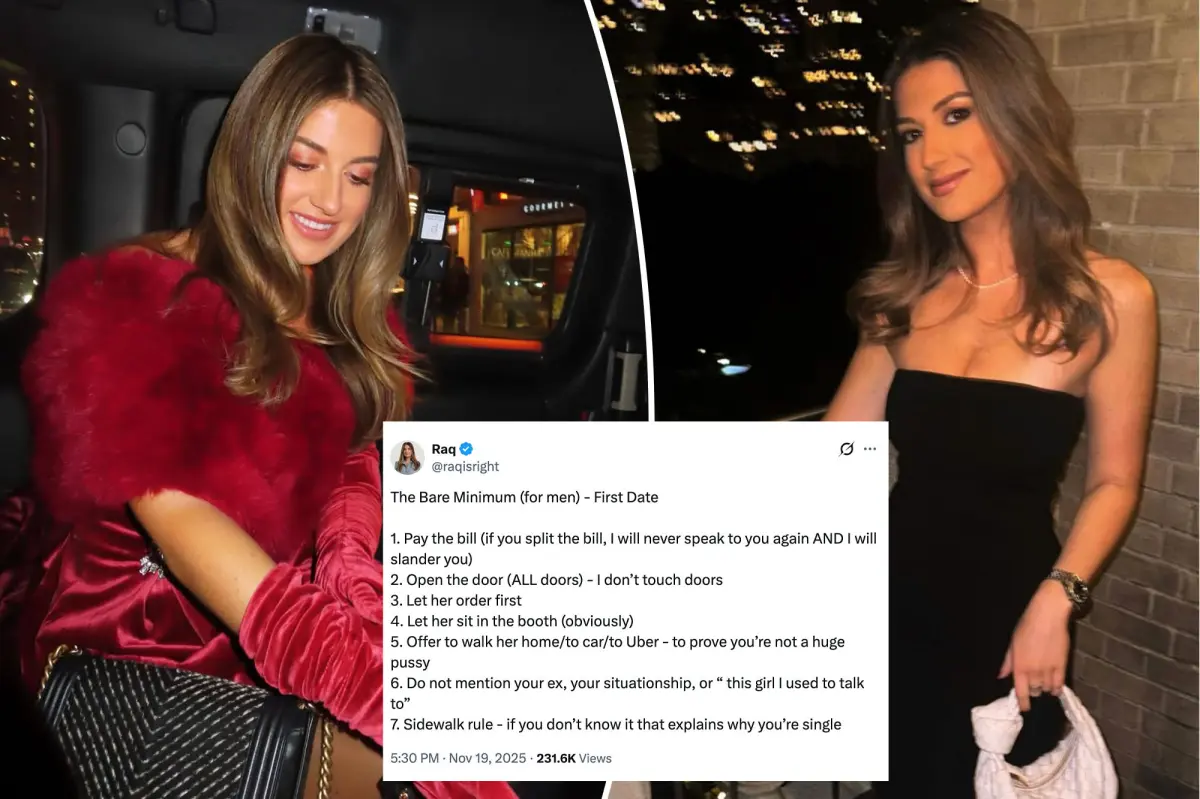
In the concrete jungle of New York City, where dating often feels like navigating a minefield, one twentysomething woman named Raq has ignited an impassioned online debate. Frustrated with what she describes as the city’s “complete cesspool” of eligible bachelors, Raq created and shared a list of “bare minimum rules” for men on first dates that quickly went viral on social media platform X, garnering over one million views. Her blunt assessment of NYC’s dating scene pulls no punches: men are “either gay, too good to be true, or ran through,” she told The Post in an interview. The dating landscape in Manhattan, according to Raq, is a uniquely challenging terrain that those in suburban areas could never fully comprehend. “The best man in the entire world, the guy who seems like he’s a f–king catch is actually pure evil,” she lamented, highlighting the disillusionment that led her to create her controversial dating guidelines.
Raq’s seven rules represent what she considers the absolute baseline for acceptable male behavior on a first date, and they don’t leave much room for modern interpretations of dating etiquette. The list begins with perhaps her most contentious stipulation: “Pay the bill (if you split the bill, I will never speak to you again AND I will slander you),” firmly rejecting the increasingly common practice of splitting expenses. Her other requirements include chivalrous gestures like opening “ALL doors” (which she claims she doesn’t touch), letting women order first, offering the booth seat, walking her home safely, avoiding discussion of exes or previous relationships, and adhering to the “sidewalk rule” (presumably walking on the street side of the sidewalk). These traditional expectations stand in stark contrast to more progressive dating norms that have emerged in recent years, particularly in cosmopolitan areas like New York City, where many singles now embrace more egalitarian approaches to courtship.
The response to Raq’s dating manifesto proved as divisive as one might expect in today’s polarized social media landscape. Many women voiced enthusiastic support, with commenters calling the rules “standard etiquette” and “pretty simple, yet still so complex.” These supporters seemed to echo Raq’s frustration with what they perceive as declining standards among modern men, suggesting that her guidelines represent nothing more than basic respect and consideration. However, for every supporter, there appeared to be at least one critic ready to challenge her perspective. Detractors accused Raq of entitlement, with one commenter pointedly noting, “Funny how ‘bare minimum’ for men always comes with maximum entitlement for women.” Others took issue with her tone, particularly regarding her declaration about not touching doors, suggesting it made her seem “high maintenance and undateable.” The heated exchanges in the comments section revealed deeper societal tensions around changing gender roles, expectations, and the eternal question of who should pay on dates.
While some might dismiss Raq’s rules as overly demanding or out of touch with contemporary dating norms, her online persona suggests a more nuanced position than initial impressions might indicate. Known for sharing provocative lists on both X and Instagram, her content often carries a partially tongue-in-cheek quality that blends genuine frustration with deliberate provocation. This approach has helped her build a following and establish herself as a voice for a particular segment of New York’s dating population – specifically, those who identify as moderate or conservative but don’t align with the most traditional right-wing values. Raq describes herself as a political moderate and has been organizing social mixing events under the brand “Make America Hot Again,” aimed at helping singles meet what she calls “normal city conservatives” in real-life settings rather than through dating apps.
Raq’s positioning within the dating landscape reflects a broader cultural moment where traditional values and progressive norms continue to clash and coexist in complex ways. She explicitly distances herself from the ultra-traditional conservative ideal that young women should “be married by 22 and like on a dress in a farm, milking cow,” stating plainly, “I’m just not doing that.” Instead, she seems to occupy a middle ground that appeals to what she calls “Barstool conservatives” – a reference to the sports and pop culture media company known for its irreverent, often politically incorrect content. “Me and my friends, you know, like we drink, we like to have fun,” she explained, painting a picture of young conservatives who embrace some traditional values while rejecting others, particularly those that might limit their enjoyment of city life and youth culture.
The controversy surrounding Raq’s dating rules ultimately speaks to a larger conversation about how heterosexual relationships are evolving (or not evolving) in contemporary urban America. Her upcoming event, aptly titled “Death of the Dating Apps,” suggests a growing disillusionment with technology-mediated connections and a desire to return to more authentic in-person encounters. Described as “a little bit of a mish mash,” these gatherings aim to create spaces where like-minded singles can meet without the filters and algorithms that have come to dominate modern dating. Whether one views Raq’s approach as refreshingly straightforward or problematically regressive likely depends on personal values and experiences in the dating world. What remains clear is that even as society progresses, fundamental questions about courtship, gender roles, and mutual respect continue to provoke passionate debate among singles navigating the often treacherous waters of modern romance, particularly in high-pressure environments like New York City.