




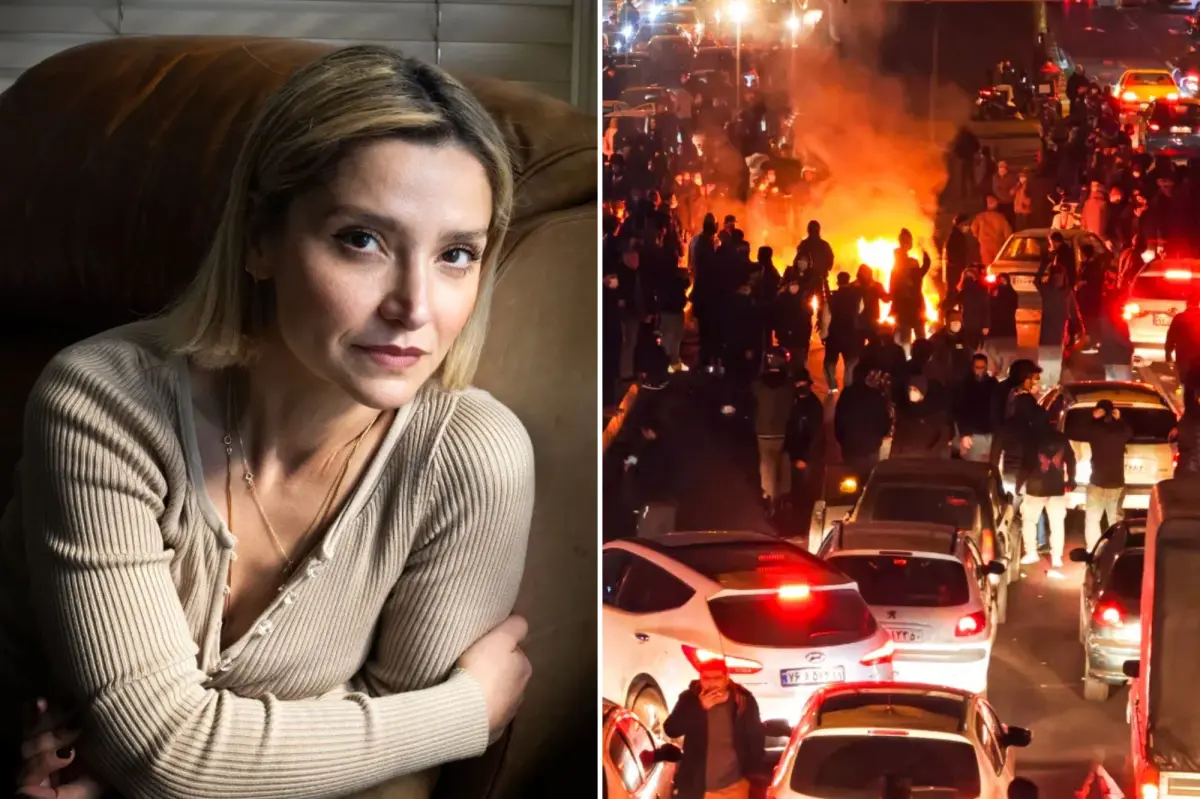
In the heart-wrenching chaos of the Iranian uprising, stories of unimaginable brutality keep surfacing, and one voice amplifies them all: Tara Grammy, a Tehran-born actress and playwright now based in Los Angeles. Just last Saturday, soldiers in Iran stormed a young shopkeeper’s home at gunpoint, dragging the 28-year-old man from his terrified parents’ arms, handcuffing him right there on the doorstep. His crime? Simply protesting the regime that claims to rule in the name of faith. In front of his pleading family, he was whisked away, now staring down the abyss of possible execution. These aren’t isolated incidents— they’re threads in a tapestry of horror that Tara has been weaving together from firsthand accounts smuggled out of a heavily censored country. At 37, Tara, whose real-life stage is the global spotlight, has transformed from comedian to unyielding advocate. “It’s barbaric,” she declares, her voice cracking with the weight of it all, as if she’s not just reporting but reliving the pain. “They are doing this to their own people.” Her Instagram feed, once filled with Persian makeovers and immigrant family antics, has become a lifeline for Iranians risking everything to expose the truth. Through messages and videos—often sent via VPNs to dodge the regime’s iron grip on the internet—Tara shares raw footage of guards firing on unarmed crowds, turning her platform into a beacon for the silenced. It’s a role she never sought, but as the protests escalated last month, she became the unwitting conduit for cries that might otherwise vanish into digital nothingness. Imagine the fear her contacts live with: every message, every pixelated video could lead back to them, inviting vengeance from a regime that views dissent as heresy. Yet, they persist, because, as Tara puts it with deep admiration, “They’re fearful, but they’re brave—they’re very brave.” For Tara, this activism has altered the trajectory of her career, perhaps her life, as threats against her mount. But she replies with defiant resolve: “If I live in fear, then the regime has won.” In her eyes, the world must see Iran’s hidden agony, or the regime’s shadows will engulf more lives.
Tara’s journey to this advocacy roots back to her own escape from Iran’s turmoil. Born in Tehran in 1988, just nine years after the 1979 Revolution overturned the pro-Western monarchy, she witnessed the Islamic Republic’s oppressive dawn. Her mother, terrified of raising a daughter in such an environment, recalled harrowing moments like the time regime guards with machetes terrorized their street, scattering pedestrians in blind panic. Realizing Tehran was no safe haven for a child’s bright future, her mother fought tirelessly for visas. At age six, they finally immigrated to Canada, where Tara blossomed into a storyteller. She penned the acclaimed play “Mahmoud,” capturing the adrift lives of Iranian expats in Toronto, blending humor and heartache. Then came Los Angeles, where she carved fame through witty sketches like “Persian Makeover With Manijeh!” and the web series “My Immigrant Family,” even hosting “Persia’s Got Talent.” Her Instagram grew to over 300,000 followers, a lively forum for laughter and light. But as fame brought visibility, desperate messages began flooding in: videos of shootings, stories of waning hope. Tara didn’t hesitate; she posted them all, becoming the voice for those who couldn’t speak. It was a pivot fueled not by ambition but by a bone-deep empathy—she understood the pull of a homeland fractured by fear. For years, she’d carried memories of pre-revolution utopia whispered by her family, a lost paradise of freedom and possibility. Now, through her sources’ braveness, she fights to reclaim that dream, her career secondary to the human cost. “They know the only way anything can change is if the world stops the regime,” she says, echoing the quiet pleas of Iranians defying death to send her their truths.
The uprising Tara chronicles didn’t erupt from nowhere; it simmered in the economic despair that has ravaged Iran for years. Middle-class Iranians, once the backbone of society, found themselves dissolving into poverty—no meat on tables, no roofs over heads, as inflation spiraled out of control. Tara explains it poignantly: “The middle class is practically dissolved… People can’t afford to buy meat and pay their rent. The economy is now so bad that a lot of these people have nothing to live for anymore.” Prosperity drained away, leaving a void where anger and desperation bred rebellion. But it was the younger generation—tech-savvy and worldly from secret glimpses of the internet—who ignited the fuse. Exposed to lives beyond Iran’s walled boundaries, they dreamed of modernity, rights, and futures untainted by theocratic repression. “They grew up with the internet and they know what the rest of the world looks like,” Tara shares, her tone imbued with the youthful spirit they’ve lost. Then, late last year, the currency collapsed, a final straw. Protests began on December 29, swelling into a tidal wave across all 31 provinces. By January 8 and 9, millions flooded the streets, unified in defiance. Yet, the regime struck back ruthlessly, cutting internet access and unleashing the military. Official tallies claim 7,000 dead, but Tara’s sources whisper of a higher toll, stories of ordinary people pushed to the brink. From her Los Angeles perch, Tara stayed glued to her phone, heart pounding as each update arrived. Her own heritage amplified the pain—she wasn’t just an observer; she was connected, through blood and memory, to a people crying out for liberation.
The violence Tara relays is beyond comprehension, a litany of atrocities that strips humanity bare. Desperate to crush the spirit of the uprising, soldiers turned to pellet guns, blasting protesters in ways that blinded and maimed for life. But escalation came swiftly: live ammunition on those fateful January days, with orders seemingly tailored for execution. “They clearly got a shoot-to-kill order, because it seems all were shot between the eyes, in the neck or in the chest,” she reveals, her words heavy with sorrow. Discrimination had no place here—a deaf man, simply using sign language, mistook for inciting signals, gunned down in cold indifference. In Rasht, fleeing protesters ducked into a bazaar, only to see it ablaze, set alight by the very forces meant to protect. Hospitals, sanctuaries of healing, became slaughterhouses; soldiers entered under cover of night, executing the wounded. “In pictures that came out from the morgues, there were all these bodies with catheters and heart monitors still attached,” Tara recounts, her voice breaking. “Executed. Hundreds, maybe even thousands.” Machete attacks were commonplace, vehicles encircling the unarmed before vicious blades fell. And the sexual violence—men and women alike subjected to unspeakable horrors, captured and tortured in hidden sites. One chilling story from Tara: an acquaintance’s children escaped, but their friends—three youths—endured three days of rape by multiple assailants, stripped and abandoned on a highway, left to crawl home shattered. By January 10, the regime had subdued the protests, but the brutality lingered, soldiers knocking down doors for reprisal. “They just opened fire and killed all three of them in their house,” Tara describes a mother’s slaughter, her grief a mirror to countless others. In the aftermath, Iran feigned normalcy, but paranoia stalked the streets—marked souls peering from behind curtains, mourning both the dead and the dream of a free homeland.
As the 40th day since January 8 and 9 dawned, Iranians marked Chehelom, the sacred Persian ritual of final mourning, where families bid eternal farewell before-life resumes its fractured rhythm. But in Iran, that rhythm crumbles under grief’s weight. Pictures and videos emerge, stories unfolding of senseless deaths, prompting mothers to dance defiantly on graves—not in joy, but rebellion against a regime that thrives on sorrow. “They don’t want to mourn, because they know the Islamic Republic wants them to mourn,” Tara explains, her own eyes welling. “It’s just so heartbreaking.” One source, her face half-hidden by gauze after a pellet gun shattered her eye, dares not step outside, fearing recognition as a protester. “Now, when she leaves the house, she’s really scared.” Hate for the regime intensifies, even among formerly apathetic; the barbarism has unified opposition. “People hate the regime more than ever now,” Tara affirms, a fire in her voice. Behind closed doors, Iranians grapple with betrayal, the utopian Iran of their parents’ tales now a recurring nightmare. Tara, born of that dream, carries it in her very being—her son’s name, Deyer Azad, meaning “free homeland,” a testament to untamed hope. For expatriates like her, maintaining global awareness feels urgent, lest Iran fade into oblivion’s embrace.
Amid whispers of potential US intervention, a flicker of desperate hope emerges for Iranians. The Trump administration pushes hard to dismantle Iran’s nuclear ambitions and missile programs, with a massive military buildup signaling possible strikes. Some of Tara’s contacts, in their quiet agony, welcome it—not from patriotism, but exhaustion. “That is how desperate they are, how bad this regime is,” she shares, underscoring their plight. “They want this regime out.” Tara joins bandwagon for change, rallying with tens of thousands in Los Angeles alongside exiled princess Noor Pahlavi, while Munich and Toronto explode with solidarity—350,000 strong in the latter. Yet, uncertainty looms; intervention could ignite chaos or liberation. Tara admits to cycling through hope and fear, the disappointment crushing when revolutions falter. “I’m scared to hope, because the disappointment is so hard, but you have to have hope, or what’s the point?” Her words resonate with millions of Iranians worldwide, holding onto fragments of that pre-1979 utopia. Through advocacy and unrelenting exposure, Tara keeps the flame alive, humanizing a crisis that demands action before more lives are extinguished. In her storytelling, she reminds us: Iran’s struggle is not abstract; it’s pulses in every mother’s tear, every protester’s blood, a universal cry for justice that echoes far beyond teary headlines. As expatriates dream of return, the regime’s grip tightens, but Tara’s platform continues to bridge the divide, giving voice to the voiceless and igniting a quiet, persistent revolution of empathy and resolve.