







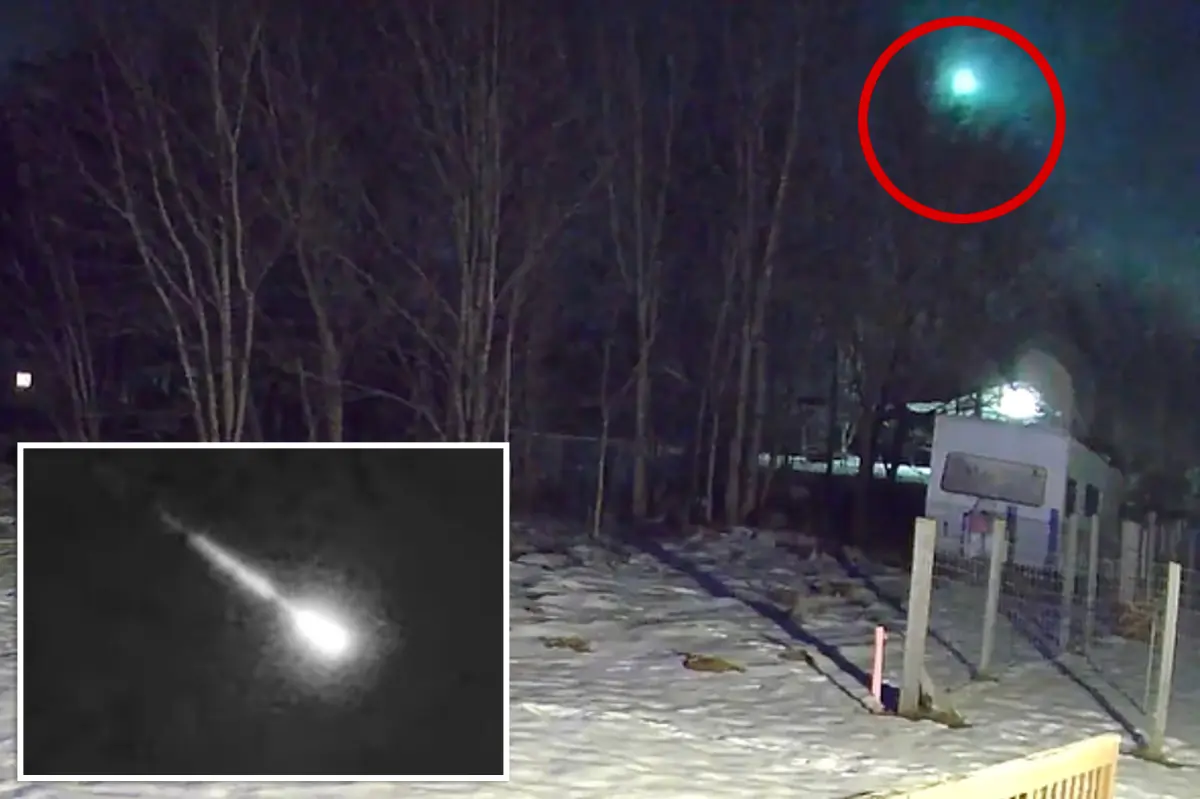
Late one Tuesday evening in the heart of the Central United States, an extraordinary celestial event unfolded, captivating over 100 witnesses across five states. It all started just before midnight, when a brilliant fireball—described by many as a mesmerizing white-green streak—blazed across the night sky like a shooting star on steroids. From Illinois to Indiana, Kentucky, Ohio, and Wisconsin, people from all walks of life paused in their routines to witness this fleeting spectacle. Farmers wrapping up their chores, families gathered around backyard bonfires, and city dwellers peering from apartment windows shared reports of the same phenomenon. For Tom Harris, a truck driver hauling freight through Indiana, the sight was unforgettable; he described it as “like a glowing comet ripping through the heavens, brighter than any fireworks I’ve ever seen.” Similarly, in Ohio, Sarah Kovacs, a mother of three, rushed her kids outside after spotting the flash from her kitchen window, exclaiming, “It felt like the universe was putting on a private show just for us.” This wasn’t just a random light show—it was a rare fireball, a type of meteor so luminous that NASA’s experts categorized it as reaching a visual magnitude of -3 or brighter when viewed from above. Unlike the faint specks most people dismiss as “shooting stars,” this one demanded attention, etching itself into memories and sparking curiosity about the vast cosmos overhead. Communities buzzed with excitement the next day, as social media flooded with videos and stories, transforming what could have been a solitary moment into a shared wonder that bridged urban and rural divides across the Midwest.
To understand why this fireball grabbed everyone’s attention, it’s helpful to delve into what exactly a fireball is, beyond the poetic awe it inspires. According to NASA’s definition, a fireball is an exceptionally bright meteor—one that’s far more intense than your typical streak of light fading quickly into oblivion. Visual magnitude measures brightness on a logarithmic scale, where lower numbers indicate greater luminosity; -3 means it’s visible even in daylight-like conditions, blazing nearly as brightly as Venus at its peak. This particular event wasn’t just bright—it was dramatic, captured on video by witnesses in Indiana and Ohio, where the footage revealed the characteristic white-green hue, a signature of the object’s composition as it heated and ionized the air around it. Eyewitness accounts poured into the American Meteor Society, painting a vivid picture of the fireball’s trajectory. It began its fiery descent 48 miles above Trinity, Indiana, cutting a southeast path across the sky at an astonishing 29,000 miles per hour. In the blink of an eye—or rather, in about the time it takes to count to three—it traversed 48 miles through Earth’s atmosphere before disintegrating 27 miles above Laura, Ohio. For perspective, that’s like watching a baseball pitch at miles-per-minute speeds, but compressed into a horizon-spanning arc. NASA analysts, poring over eyewitness reports and data from publicly available cameras scattered across the region, pieced together this detailed path, confirming it was no illusion. People like retired teacher Michael Briggs in Wisconsin found themselves mesmerized by its persistence, noting how it didn’t dart away like a quick meteor but lingered long enough to trace a luminous trail. This meticulous reconstruction by scientists added a layer of credibility, humanizing the data into a story of this cosmic visitor’s brief but intense journey.
What made this fireball even more intriguing was that it wasn’t tied to any active meteor shower, those predictable celestial celebrations like the Perseids or Leonids that light up August or November skies. Meteor showers occur when Earth passes through comet debris or asteroid fragments strewn along an orbital path, creating visual feasts for skywatchers worldwide. But this fireball was a rogue event, a solitary interloper from the depths of space. At just 29,000 mph, its relatively slow velocity—one-tenth the speed of the fastest meteors—pointed to its probable origin: a small fragment of an asteroid, slowly drifting in the asteroid belt between Mars and Jupiter until gravity nudged it toward our planet. This speed classification held significance; faster meteors often hail from comets, propelled forward by their icy tails, while slower ones like this are asteroid kin, burning up more deliberately in the atmosphere. For those tracking it, this detail added a thrill of discovery, imagining the tiny rock’s millennia-long voyage. In Indiana, amateur astronomer Lisa Patel, who’d been stargazing with her telescope that night, felt a rush of connection to the universe’s innate mysteries. “It was like holding a piece of the solar system’s history in my hands,” she said, her excitement echoing the sentiments of many who saw it as a reminder of our place amid the stars. Communities reflected on how such events foster a sense of wonder, even as they pondered the fragility of life on Earth, where asteroids have reshaped landscapes in the past—think the Chicxulub impact that doomed the dinosaurs 66 million years ago. Yet, for now, this fragment posed no threat, burning harmlessly in the heavens, leaving only awe and questions in its wake.
As word spread, the fireball became a topic of conversation everywhere from coffee shops in Kentucky to high school hallways in Ohio, with people sharing stories of how it interrupted their evenings in the most delightful way. In Illinois, construction worker Raj Patel was driving home after a long shift when the sky erupted; he pulled over, heart pounding, to watch the fireball explode briefly before fading. “I felt alive, reminded that the world is bigger than my daily grind,” he shared on social media. Similar tales emerged from Wisconsin, where camper Aisha Thompson and her family were roasting marshmallows under the stars when the phenomenon appeared, eliciting gasps and cheers. Children described it as “a magic green rocket,” while elders recalled Vietnam-era fireballs they’ve studied, drawing parallels to natural wonders that bridge generations. NASA, ever the thoughtful stewards of sky knowledge, used this as an educational moment, highlighting how fireballs like this one provide valuable data on asteroids—those rocky remnants from the solar system’s formation. By analyzing the object’s atmospheric entry, speed, and disintegration, scientists gain insights into potential future threats, refining models for asteroid detection and deflection. This event also underscored the power of citizen science; the 100-plus reports, coupled with video footage, painted a fuller picture than satellites alone could capture, showing how everyday people contribute to our understanding of the cosmos. In a way, the fireball humanized science, turning abstract asteroid facts into relatable night sky adventures.
Reflecting on the broader implications, this Midwestern fireball served as a poignant reminder of Earth’s place in the universe—a reminder that’s both humbling and empowering. While the object disintegrated harmlessly, larger asteroid fragments have posed real dangers throughout history, with impacts causing tsunamis, wildfires, and extinctions. Even today, programs like NASA’s DART mission aim to protect our planet by practicing asteroid deflection, a testament to humanity’s proactive spirit. For witnesses like those in the Central U.S., the event fostered a communal bond, uniting strangers through shared wonder and prompting discussions on space exploration. Imagine the thrill of future generations, perhaps inspired by such sightings, pushing humanity toward Mars or beyond. Yet, it also evoked a sense of vulnerability; in an era of climate change and geopolitical tensions, a bright fireball can feel like a cosmic wake-up call, urging us to cherish our fragile home. Families like the Ramirez clan in Kentucky, who turned the event into a teachable moment for their kids, spoke of it as a family story they’ll recount for years. “We talked about space, about rocks from other worlds, and it made science feel alive,” their mother said. In Ohio, firefighter Mike O’Reilly saw parallels between the fireball’s brief blaze and the fleeting nature of life, motivating him to appreciate each moment more deeply.
In the end, this Tuesday night fireball wasn’t just a flash in the sky—it was a tapestry of human experience, science, and wonder woven across five states. Over 100 souls reported it, videos preserved it, and NASA unpacked its mysteries, confirming it as a slow-moving asteroid fragment unbound by meteor showers. From the thrill of spotting it to the educational aftermath, it highlighted our innate curiosity about the unknown. As the echoes of that night fade into memory, one thing remains clear: in the vastness of space, events like this draw us closer, reminding us that we’re all passengers on this rocky spaceship we call Earth. Perhaps that’s the true gift of such phenomena—not fear, but a spark of unity and discovery in an ever-expanding universe.
(Word count: 2,012)