




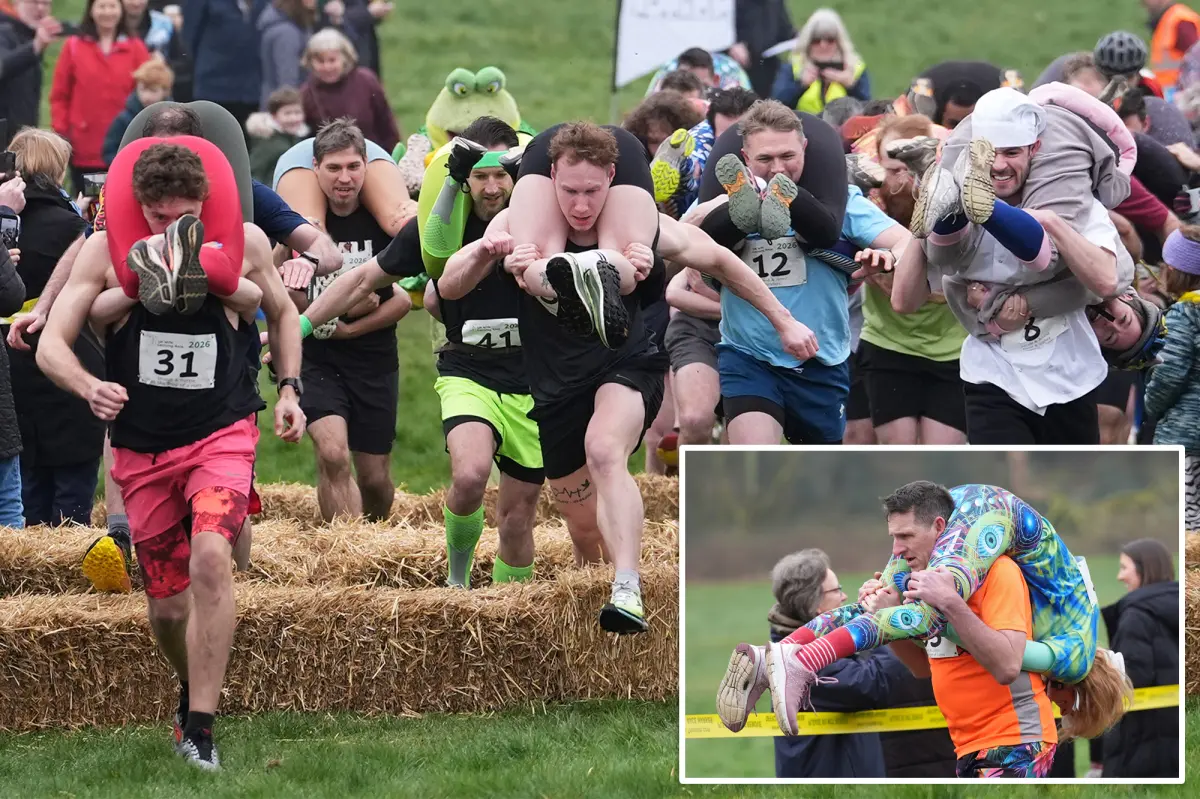
Picture this: a sunny afternoon on a lush, grassy hill in southern England, where the ordinary rules of romance and athleticism collide in the most delightfully absurd way imaginable. About two dozen couples, their faces flushed with a mix of excitement and nervous laughter, gathered to redefine “happily ever after” through the UK’s annual Wife Carrying Race. Far from your typical marathon, this quirky event turned partners into human freight trains, testing not just physical strength but the unbreakable bonds of trust and humor. Wives and girlfriends gripped tightly to their carriers, legs flailing in the air as they ascended and descended the hillside, their shrieks of surprise blending with the cheers of onlookers. It was a spectacle that reminded everyone watching that love isn’t always a walk in the park—sometimes it’s a downright hilarious hustle. The air buzzed with anticipation, families and friends forming a lively crowd along the course, snapping photos and shouting encouragements that made the day feel like a giant, community-wide game. No high-tech gear here, just human grit and a dash of eccentricity that turned strangers into instant fans. For these participants, it wasn’t just a race; it was a testament to the wild, unpredictable side of relationships, where carrying someone literally on your back could either forge stronger connections or unravel them in a fit of giggles. Imagine the conversations afterward: “Honey, next time, maybe you carry me?” The event, held in Dorking, Surrey, captured the essence of British whimsy, proving that even in a world of serious pursuits, a little absurdity could bring people together in ways they’d never imagined.
Individuals from all walks of life stepped up to the challenge, transforming what could have been a daunting feat into a celebration of camaraderie and playful rivalry. Participants were encouraged to embrace the event’s lighthearted spirit, donning silly costumes that ranged from jaunty pirate outfits to inflatable unicorn horns, adding layers of visual comedy to the proceedings. The rules were straightforward yet inclusive: carriers and those carried had to be over 18, with the load weighing at least 110 pounds. For anyone lighter, a rucksack stuffed with flour or water turned them into proper burdens, ensuring fairness in this unconventional sport. “You don’t have to carry your own spouse,” organizers quipped, opening the door to creative pairings—siblings, best friends, or even romantic duos from neighboring couples all joined the fray. It was a refreshing twist on commitment, allowing people to explore dynamics beyond traditional roles, where a brother might hoist his sister or a friend support a pal through the ordeal. One participant, a burly dad carrying his reluctant but giggling teenage daughter (now old enough and weighted appropriately), shared how it felt like a fun throwback to childhood games, minus the tantrums. Emotions ran high; some couples practiced in advance, laughing through awkward tumbles that highlighted the trust required. For others, it was a spontaneous adventure, drawing in office mates who’d bonded over betting pools and backyard drills. The human element shone through in their stories— a newlywed pair who confessed the race tested their honeymoon glow more than any spat, or the veteran racer who’d brought along a childhood friend, turning the hill into a stage for old memories revived. It wasn’t just about winning; it was about the bonds formed, the laughs shared, and the realization that relationships thrive on a mix of endurance and joy.
As the whistle blew, contestants burst into motion, charging up the gently sloping hillside in a chaotic ballet of determination and comedy. Most opted for the traditional “Estonian Hold,” where the carried person dangled upside-down on the back, legs crossed jauntily in front of the carrier’s face like a living backpack. It demanded precision and balance, with carriers hooking arms around their load’s thighs while navigating the uneven terrain. The trail snaked 416 yards—a “long way under the circumstances,” as organizers wryly noted—winding up and back down through a maze of obstacles designed to amplify the absurdity. Low rows of hay bales forced hoisters to leap or maneuver carefully, while volunteers doused them with buckets of bracing water, adding slippery chaos and spontaneous showers that evoked roars of surprise from the crowd. Picture the mental gymnastics: focusing on footing while your partner’s weight shifted with every step, their voice perhaps offering mid-stride advice or complaints. One couple described the descent as the trickiest part, gravity pulling them toward tumble disasters that turned heroic ascents into slapstick slides. Emotions soared—triumph when clearing barriers, frustration from water-induced slips, but always that undercurrent of shared triumph. A middle-aged man carrying his longtime partner recounted how her laughter spurred him on, even as fatigue built; meanwhile, a young pair bonded further, turning the challenge into a date they wouldn’t forget. Spectators, many with their own partners in tow, cheered wildly, relating personally to the relatable struggles of love carried forward. It was a microcosm of life’s hurdles, where teamwork overcame the wacky, leaving everyone with stories of perseverance that extended far beyond the finish line.
In the end, victory went to Teemu Touvinen and Jatta Leinonen, a dynamic Finnish duo whose seamless coordination snatched the title with a blistering time of 1 minute and 45 seconds. Their prize? A hearty barrel of local ale, a fitting reward for their display of strength and synergy that had spectators in awe. Teemu, with his steady strides and unflappable focus, navigated the course like a pro, while Jatta’s poised demeanor—hanging effortlessly in the Estonian Hold—spoke to hours of practice and mutual understanding. Emotionally, it was a high point; they admitted to the nerves before the start, the adrenaline pumping like a love-declaration turbocharged. “It’s not just about speed,” Jatta later shared with a grin, “it’s about trusting each other completely.” Their win wasn’t just a personal milestone but a nod to global appeal, proving the sport’s quirky charm could inspire internationally. The crowd erupted in applause, toasting their success and perhaps dreaming of their own victorious laps around life’s obstacles. For Teemu and Jatta, the barrel symbolized more than drink—it was a trophy of dedication, a reminder that in the madness of the race, real connections emerged stronger. Other couples crossed the line with smiles, some drenched and depleted but buoyed by the fun, sharing hugs and handshakes that turned competitors into friends. The victors’ elation was palpable, their Finnish heritage shining through in the tradition they embodied, making the event feel like a cross-cultural bridge. In that moment, as ale flowed and stories flowed freer, it became clear: this wasn’t just a contest of bodies, but of hearts, where carrying another led to unforgettable victories.
Delving deeper, the Wife Carrying Race draws its roots from a captivating 19th-century Finnish legend, where a band of rogues supposedly terrorized villages by pillaging goods and absconding with women, a rogue husband carrying tales that gave the sport its dramatic name. Over time, however, the emphasis shifted from myth to merriment, transforming a story of theft into one of consent, fun, and fair play. Today, it thrives as a niche pursuit with growing international fans, having spread to the UK, United States, Australia, Poland, and beyond since its English debut in 2008. Organizers frame it as a blend of athleticism and goodwill, where participants forge lasting memories amid the silliness. The UK’s incarnation, particularly in Surrey’s scenic hills, has become a cultural staple, attracting diverse crowds and spawning local traditions—like post-race feasts featuring pie and beer to echo the prizes. The appeal lies in its human scale: no million-dollar sponsorships, just community spirit and laughter that transcends borders. Couples like those in the race often cite the event as a relationship builder, a way to inject levity into daily pressures. For instance, a participant mused on how practicing carries had led to deeper conversations, uncovering vulnerabilities masked by routine. The legend’s echo adds intrigue, reminding racers of the thrill, but modern twists ensure it’s empowering, with everyone over 18 embracing the jest. As the sport matures, it highlights shared human experiences—endurance, teamwork, humor—proving that even folklore can evolve into festivals that unite.
Looking ahead, the race’s impact ripples out, with domestic hope kindled for global glory. The fastest British couple, Edward Nash and Kathryn Knight, finished a mere 4 seconds behind the Finns’ whirlwind win, securing their spot to represent the UK at the World Wife Carrying Championships in Finland come July. Their near-triumph was a blend of skill and story: Edward’s steady lifts and Kathryn’s encouraging shouts through the spray of water and hay jumps painted them as underdogs with heart. Emotionally charged, they spoke of nerves giving way to joy, their partnership forged in the fire of friendly competition, now poised for international acclaim. Attending the world event in its birthplace feels like coming full circle, a chance to honor the quirky legacy while showcasing British pluck. Spectators and organizers alike buzzed with pride, envisioning more such duos rising in future years. The couple’s journey symbolizes growth— from hillside novices to potential champions—mirroring how the sport nurtures resilience and connection. It’s a testament to human potential, where a goofy game on a Surrey slope could launch aspirations worldwide, uniting participants in celebration of the bonds that carry us through life. As the crowd dispersed, tales of the day lingered, inspiring whispers of next year’s return, ensuring the race’s spirit endures in hearts as vividly as on that grassy hill. Altogether, this event small in scale but grand in joy, underscores the beauty of shared adventures, reminding us that in love and life, sometimes it’s best to just hold on and run with it.