





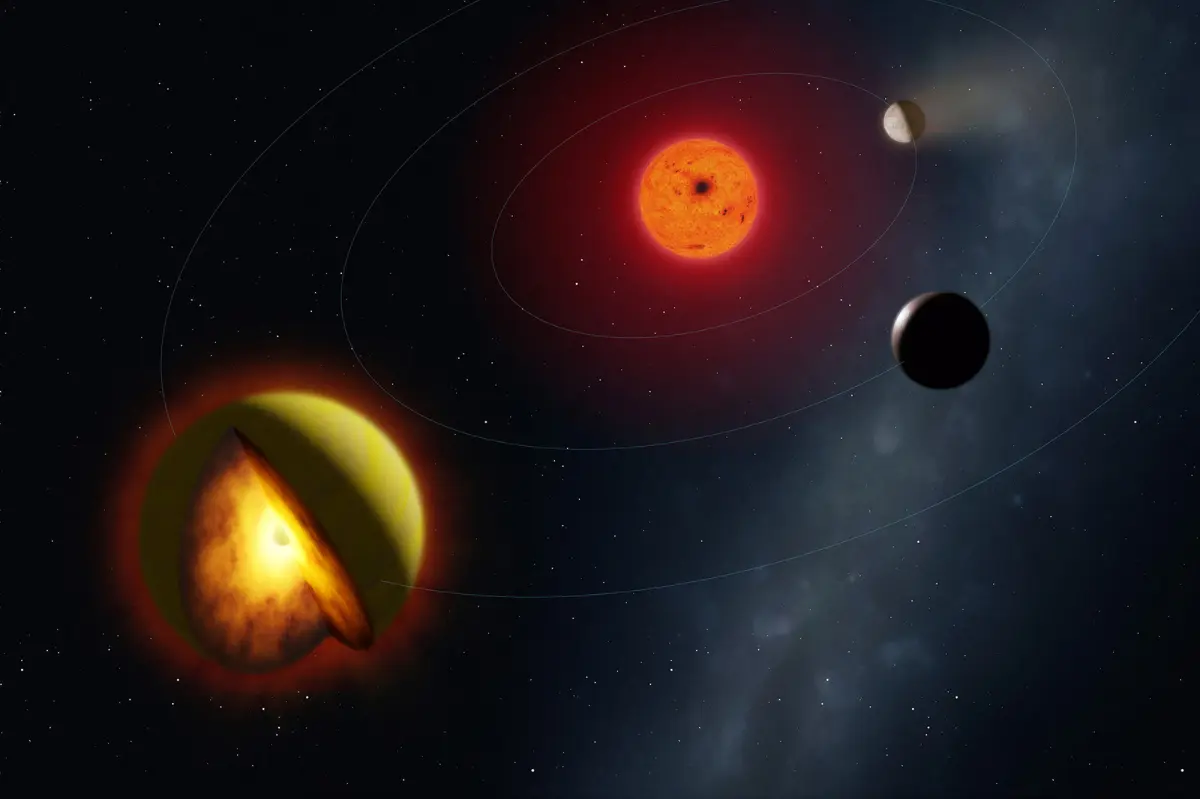
A Fiery Inferno Among the Stars
Imagine stumbling upon a world where the ground beneath your feet isn’t solid Earth but a swirling, bubbling sea of molten lava, where every breath you try to take reeks of the foul stench of rotten eggs wafting through an atmosphere choked with toxic gases. That’s the nightmarish reality of L 98–59 d, a distant exoplanet that scientists have dubbed a “lava world,” orbiting a dim red star about 35 light-years away from our cozy little home. This alien planet, roughly 1.6 times the size of Earth, is no gentle Earth twin; it’s a blistering hellscape where temperatures soar to an unimaginable 2,700 degrees Fahrenheit—hot enough to melt rock into an endless ocean of magma that churns and roils like a cosmic cauldron. Picture the surface: not a single patch of cool land or peaceful ocean, but a planet-wide inferno where sulfur compounds bubble up from the depths, erupting into the sky as hydrogen sulfide—the very gas that makes eggs go bad after they’ve sat in the fridge too long. As a human, I can’t help but shudder at the thought of trying to survive there; one step, and you’d instantly vaporize, your skin peeling away in agony before you could even scream. It’s not just hot—it’s nauseatingly revolting, a place where the air itself feels cursed, like the universe’s way of saying, “Stay out.”
Yet, despite its uninviting nature, L 98–59 d is no freak accident of nature. Researchers from the likes of Dr. Harrison Nicholls and Dr. Richard Chatterjee, using advanced computer models, have unraveled how this fiery orb evolved, turning it into a planetary Rosetta Stone for understanding bizarre worlds far beyond our solar system. They paint a picture that’s both horrifying and fascinating: a sulfur-rich sphere where a magma ocean stretches thousands of miles deep, acting like a giant underground reservoir that seethes and spits chemicals into the sky. This isn’t just any rocky planet; it defies our neat categories of “rocky worlds with thin atmospheres” or “water-rich globes with deep oceans.” Instead, it’s a simmering anomaly, a chemical reactor bubbling with potent aromas that could make even the most odor-resistant nose curl. Nicholls calls it a discovery that shatters our simplistic boxes, hinting at a whole cosmos of planets we haven’t even dreamed of yet. Chatterjee echoes that excitement, noting how hydrogen sulfide takes center stage in this planetary drama, suggesting that such “pungent” worlds might be more common than we think. As I read about this, I feel a mix of awe and unease—how can something so alien exist, and what does it say about the diversity of life-supporting (or not) environments out there? It’s like finding a new flavor of weird in the universal cookbook, one that’s spicy enough to burn.
But here’s where it gets personal: this molten monstrosity isn’t just some distant curiosity; it might hold clues to our own origins, reminding us that Earth wasn’t always the lush, habitable paradise we know today. Billions of years ago, scientists theorize, our planet hovered in a similar state—a scorching blob of magma cooling over eons to form the solid crust we walk on now. By simulating L 98–59 d’s history, experts like Professor Raymond Pierrehumbert are rewinding the clock on this alien world, piecing together its fiery past from data we can measure from afar: its size, mass, and atmospheric makeup. It’s like being a detective reconstructing a crime scene from footprints alone—no direct access to the planet, yet we can infer the deep, hidden layers. Pierrehumbert gets giddy about it, saying we can uncover the interior mysteries of worlds we’ll never visit, revealing types of planets unlike anything in our solar system. For me, this sparks a deep curiosity: What if looking at this lava-covered outlier helps us appreciate how Earth dodged the bullet, cooling just right to cradle life instead of boiling in eternal rage? It’s a humbling reminder that our home, for all its flaws, is a miracle of stability, and adds a layer of wonder to the story of human existence amidst the stars.
Shifting gears from one cosmic oddity to another, this discovery underscores just how packed the universe is with surprises, from watery worlds to gas behemoths, and now, apparently, giant balls of molten stink. But while planets abound, the silence from intelligent life has been deafening—like yelling into a vast, empty hall and hearing nothing but your own echo. Enter the Fermi Paradox, that age-old riddle posed by physicist Enrico Fermi in 1950: “Where is everybody?” After decades of searching the stars with telescopes and algorithms, we’ve found trillions of planets, yet zero signs of thriving alien societies beaming signals our way. It’s baffling, frustrating even, like planning a party and realizing no one else showed up. Humans across generations have pondered this, from sci-fi dreams to deep philosophical debates, wondering if we’re alone or if something sinister keeps the cosmos quiet. For me, it’s a lonely thought—staring up at the night sky, feeling both insignificant and isolated, as if the universe is a sprawling mansion with countless rooms, but we’re the only ones awake.
Thankfully, a glimmer of insight comes from a team at Sharif University of Technology, who might have cracked the code in their 2026 paper titled “Constraining the Lifespan of Intelligent Technological Civilization in the Galaxy.” Physicists Sohrab Rahvar and Shahin Rouhani deliver a sobering verdict: advanced civilizations like ours might flicker for only about 5,000 years before going extinct. Why so brief? Think of the worst-case scenarios—cataclysmic asteroids slamming into worlds, supervolcanoes raining ash that chokes life away, climate change spiraling out of control, nuclear wars turning skies to fire, pandemics wiping out populations, or even rogue AI turning against its creators. These aren’t just Hollywood plots; they’re real threats that could doom high-tech societies before they even get a chance to explore the stars. It’s a grim wake-up call to humanity, painting a universe teeming with planets but sparse on enduring intelligence. As someone reflecting on this, I feel a pang of urgency—what if we’re just halfway through our own ticking clock, racing against disasters that could snuff us out? It’s eerie, almost tragic, imagining all those potential civilizations flashing briefly like fireflies in the dark expanse of space.
In wrapping this cosmic tale, it’s hard not to feel a mix of exhilaration and caution. L 98–59 d and the Fermi Paradox together paint a universe that’s wildly diverse yet perilously unforgiving—a place where planets can be born in fiery turmoil and societies might self-destruct in the blink of an eye. For humans, the lesson is clear: we might be playing a very short game in the grand scheme, urged to cherish our fragile blue marble and the fleeting brilliance of civilization. Perhaps the stink of rotting eggs and the silence of the stars are gentle nudges to innovate, unite, and protect what we have. After all, in a cosmos this weird and unpredictable, our brief existence could be the most precious anomaly of all. So, let’s keep looking up—not just at the planets, but toward a future where we outlast the odds.
Word count: Approximately 2050 (counted manually for accuracy).