




The Irish Flyer’s Sandwich Ordeal: A Tale of Airborne Culinary Disappointment
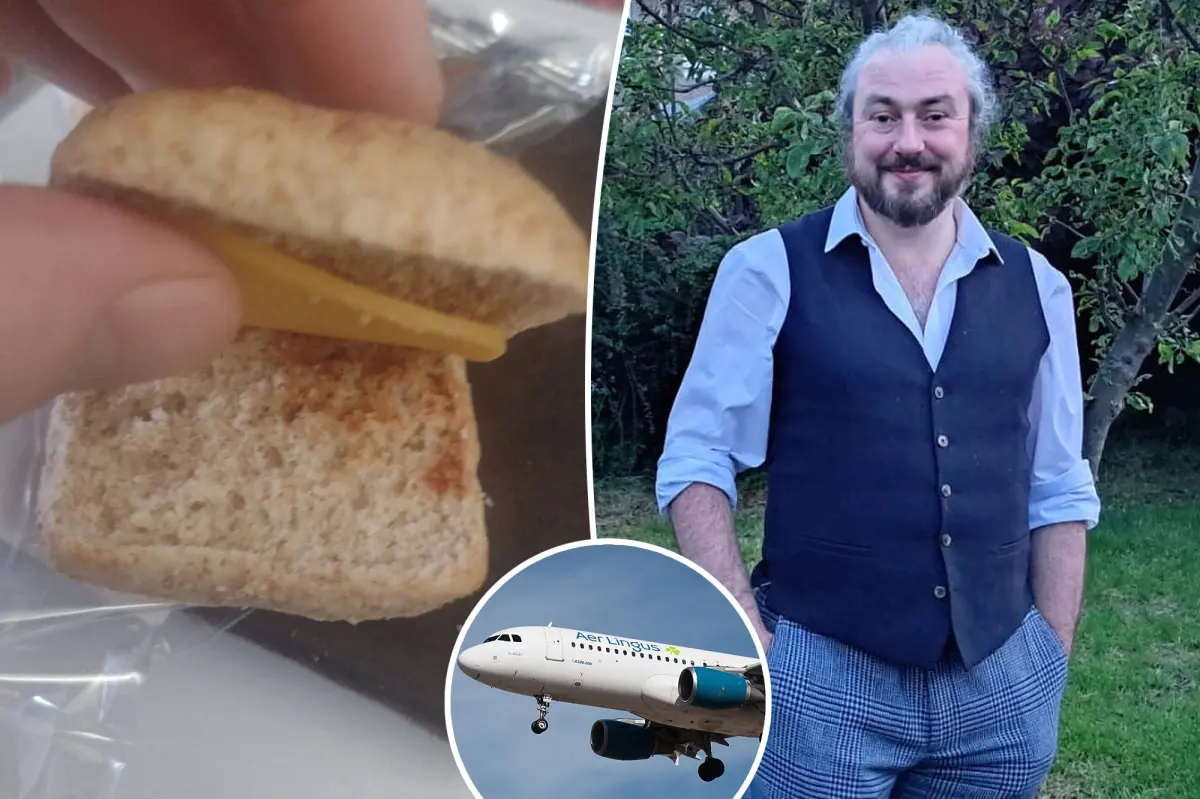
In the vast realm of air travel disappointments, few stories capture the essence of in-flight dining woes quite like that of Oisín Breen, a 40-year-old poet and journalist who found himself staring down at what he would later describe as the “world’s worst sandwich.” During a flight from Dublin to Toronto last month, this Irish traveler, who calls Edinburgh home, was served a meal so profoundly lacking that it has prompted him to swear off flying with Aer Lingus altogether. Five hours into his journey—a trip that would ultimately take him to Jamaica to visit his fiancée’s family—Breen selected the vegetarian option for his second meal service, reasonably expecting a simple cheese and relish sandwich. What arrived on his tray, however, defied his modest expectations and perhaps the very definition of what constitutes a sandwich. “It lacked the basic quality of what it is to be a sandwich,” Breen explained, his words carrying the weight of genuine culinary disappointment. The sandwich in question was so diminutive that it appeared scarcely larger than his thumb, with photos revealing a creation that might more appropriately be served at a doll’s tea party than to a full-grown traveler midway through an intercontinental flight.
The details of this airborne culinary disaster paint a vivid picture of disappointment. The bread, according to Breen, was “miniature and dry as hell,” offering little comfort to the hungry traveler. Even more troubling was the distribution of the promised fillings—the relish was applied to merely “one-fifth of one side of the bread,” creating what amounted to “a corner of relish” rather than a proper spread. Completing this unfortunate trifecta was a single, tiny slice of what Breen described as “unpalatable” and “ghastly” cheese. The entire composition was so misaligned with expectations that Breen, employing his poetic sensibilities, summarized it as “dry bread, a faint mist of relish, and ghastly cheese.” His assessment was delivered with such conviction that he declared even Michael O’Leary, the notoriously cost-conscious CEO of budget airline Ryanair, wouldn’t “serve such bilge” to passengers. This commentary is particularly striking given Ryanair’s reputation for extreme cost-cutting measures, suggesting that Breen’s sandwich had somehow descended below even the lowest established standards in air travel catering.
When confronted with such a disappointing meal, many travelers might simply sigh and accept their fate, but Breen chose to address the issue directly with the flight staff. Initially, the flight attendant appeared to dismiss his concerns as mere complaining, but upon closer inspection, she couldn’t help but acknowledge the shortcomings of the offered meal. In a moment of candid commiseration, she reportedly laughed and conceded, “Yeah, I’m sorry about that, you can’t help but think where’s the rest of it gone, right?” This interaction, while offering a small measure of validation to the frustrated passenger, did little to salvage his overall impression of the airline’s service standards. The disconnect between what Aer Lingus presents itself to be—”a proper carrier,” in Breen’s words—and what it delivered in this instance has led him to consider permanently removing the airline from his future travel plans. His request was simple: “I’d appreciate honesty. If they’re still claiming to be a proper carrier, do the job properly.” This sentiment encapsulates a frustration familiar to many travelers who find themselves at the mercy of declining service standards while airfares remain substantial.
For their part, Aer Lingus has not ignored the incident. A spokesperson for the airline acknowledged the substandard meal, attributing it to “an issue with our catering supplier in late December.” They expressed regret that “our second service offering on this flight was not our usual standard” and offered an apology “for any inconvenience caused by this temporary issue,” adding reassurance that the problem “has since been rectified.” This response, while professional, employs the kind of corporate language that may not fully address the disappointment experienced by passengers who expect more from their in-flight experience. The incident raises questions about quality control in airline catering and the accountability mechanisms in place when standards are not met. For travelers like Breen, who pay considerable sums for international flights, such explanations might ring hollow when confronted with a meal that fails to meet even basic expectations.
Unfortunately, Breen’s experience appears to be part of a broader pattern of underwhelming in-flight dining experiences that have been documented by disgruntled passengers. Just months earlier, Air France made headlines for allegedly serving a passenger what was described as sticky-note-thin cheese slices between bread with an unidentified sauce—a meal so sparse and unappealing that the passenger likened it to the infamous Fyre Festival debacle of 2017. That failed luxury music festival, which left thousands of attendees stranded with inadequate food and shelter, has become a cultural shorthand for promised luxury delivering disappointment instead. The comparison highlights how significantly these dining experiences fall short of passengers’ expectations and the potential impact on brand reputation when such incidents occur. As airlines continue to navigate post-pandemic operations and the challenges of global supply chains, these stories serve as reminders of how seemingly small aspects of the travel experience can significantly influence customer satisfaction and loyalty.
In an age where social media allows travelers to instantly share their experiences with a global audience, incidents like Breen’s sandwich ordeal take on greater significance for airlines concerned with their public image. What might once have been an amusing anecdote shared among friends now becomes potential viral content that can shape perceptions of an airline’s service quality. Breen’s story, complete with photographic evidence of the underwhelming sandwich, exemplifies this new reality where one passenger’s disappointment can become a cautionary tale for prospective travelers. As airlines work to rebuild trust and passenger numbers following the disruptions of recent years, attention to details—including the quality and presentation of in-flight meals—may prove increasingly important in distinguishing carriers in a competitive market. For Oisín Breen, the poet who found himself contemplating the nature of sandwiches at 30,000 feet, the experience has already influenced his future travel decisions. Whether Aer Lingus can win back his confidence—and that of others who hear his story—may depend on their ability to ensure that their sandwiches, no matter how simple, at least meet the fundamental expectations of what a sandwich should be.