



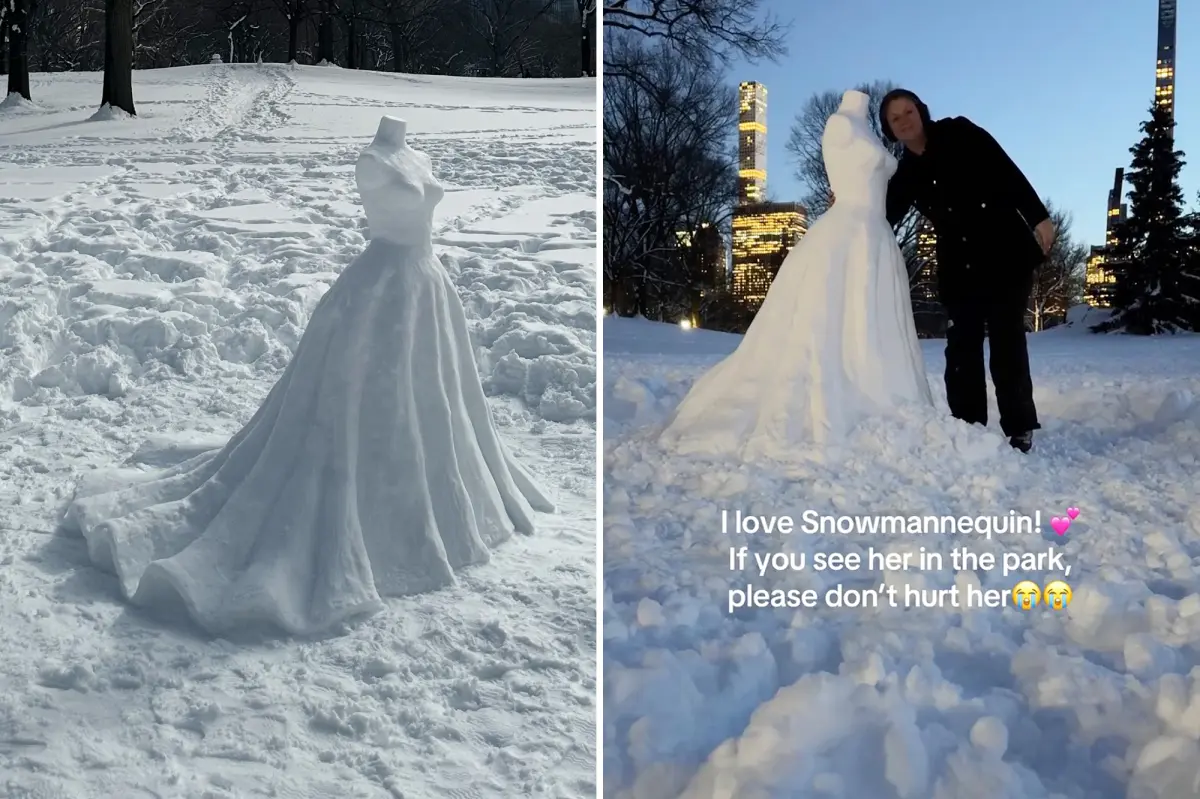
In the heart of Manhattan’s Upper West Side, where the city pulses with endless energy, lived Colette Komm, a wedding dress designer whose creativity knew no bounds. Inspired by the magic of Central Park after a fresh snowfall, she embarked on an audacious project: sculpting a lifelike mannequin entirely out of snow. Imagine waking up to a winter wonderland transformed into a canvas for art—Colette, with her background growing up in the rainy skies of Vancouver, always found solace in crafting beauty from the unexpected. She wasn’t just a designer; she was a storyteller through fabrics and forms, weaving dreams for brides. But on this chilly Tuesday afternoon, armed only with two serrated bread knives—TikTok influencers and backyard chefs alike would recognize these as unexpected tools—she set out to bring whimsy to the urban wilderness. It wasn’t about profit or fame; it was about reclaiming joy in a city that often forgets to pause and play. As snowflakes danced around her, Colette couldn’t help but smile, feeling like a child again, ready to shape the impossible. Her spirit, resilient and unyielding, had been forged through years of turning threads into tales of love and elegance. Yet, this snow mannequin wasn’t just any creation—it was “Snowmannequin,” a headless, armless dress form that embodied human grace frozen in time. By the time she finished that crisp day, three hours later, the piece had become an instant sensation, amassing whispers on social media that would soon erupt into a viral storm. Colette remembered the sheer thrill of it, the way her fingers numbed but her heart warmed, proof that sometimes, the coldest medium can ignite the warmest reactions.
To begin, Colette faced the raw challenge of the snow itself—a transformed landscape that demanded respect. Fresh powder, like that of a child’s ideal winter dream, allows for effortless rolling into perfect spheres for snowmen, but Central Park’s freeze-thaw cycles had hardened the drifts into stubborn chunks. Imagine the irony: a designer, accustomed to delicate lace and intricate beading, reduced to manual labor in subfreezing temperatures. She knelt in the snow, gloves forgotten in her excitement, scooping up icy bits with bare hands that ached from the cold bite. Each handful felt like a small victory, a testament to her determination. As the pile grew, she hugged it tightly, compressing the snow with her body weight, laughing at the absurdity of it all. This wasn’t sculpting porcelain or silk; it was wrestling with nature’s fleeting art. Vanished were the pristine white fields of her Vancouver childhood, replaced by the gritty reality of New York snow—rutted by footsteps, tainted by city grime. Yet, Colette persevered, her breath forming clouds as she worked, envisioning the mannequin emerging from the chaos. The bread knives, repurposed from everyday kitchen duty, became extensions of her will, carving away hunks of snow with surprising ease once the foundation was set. She felt alive, connected to the elements in a way fabric never allowed, each shave of ice revealing the form beneath. Strangers passing by slowed to watch, their faces lighting up with curiosity and delight. A small crowd began to gather, clapping and cheering like spectators at an impromptu performance. “This is snow impressive!” one bystander yelled, and Colette beamed, her cheeks flushed not just from wind but from shared human connection. In those moments, she wasn’t alone; the city itself seemed to rally around her, turning a solitary endeavor into a communal celebration.
As the afternoon wore on, the transformation unfolded in exquisite detail, each cut revealing the mannequin’s lifelike silhouette. Colette worked meticulously, her knives dancing across the snow like a conductor’s baton, smoothing curves and defining contours that mimicked the allure of a runway model. The headless design was intentional—a dress form pure and simple, devoid of distractions, inviting viewers to project their own stories onto it. She poured her expertise from years of wedding gown design into every chisel: the elegant slope of shoulders, the subtle flare of hips, the flowing drape that spoke of romance and poise. Her mind wandered to brides past— nervous young women twirling in veils of her creation—who’d entrusted her with their dreams. Here, in snow, she crafted a universal symbol of femininity, resilient yet delicate, standing tall amidst the frozen parkscape. The West 72nd Street entrance buzzed with passersby, some pausing to photograph, others offering words of encouragement. Colette’s heart swelled with gratitude; this wasn’t just art, it was an exchange of warmth in winter’s embrace. She chatted with onlookers, sharing laughs and stories, her Vancouver roots surfacing in tales of childhood snow forts that had ignited her sculptural spirit. Exhaustion crept in as muscles protested the cold, but the joy of creation fueled her—each flake carved away felt like shedding inhibitions, embracing vulnerability. By the end of those three hours, Snowmannequin stood proud on the south side of Terrace Drive, west of Bethesda Fountain, a testament to human ingenuity and the magic of snow. It was more than a viral stunt; it was a love letter to creativity, a reminder that even in the harshest conditions, beauty could bloom.
The next morning dawned crisp, and Colette returned to her frozen muse, eager to refine and enhance. But life, as it does, intervened whimsically. Upon arriving, she discovered an alteration—some prankster had balanced a giant snowball atop the neck, transforming her headless dress form into a bizarre, lopsided head. It was comical, yet frustrating, like discovering a signature altered on a cherished design. “This is a mannequin,” she chuckled to herself, gently removing the addition to preserve her vision. The snow, still malleable in parts, allowed for the delicate task of carving the hem—the signature flourish of a wedding gown, ruffled and cascading like waves on silk. Hour after hour, she worked, her fingers deft despite the chill, weaving intricate folds that blurred the line between snow and satin. Emotions flooded her: pride in her craft, a touch of solitude in the vast park, and an underlying excitement as Instagram notifications began pinging. Yet, amidst the refinements, Colette reflected on her journey—from Vancouver’s misty shores to New York City’s concrete dreams—how snow had always been her muse, a blank slate for imagination. This project bridged worlds: the practical artistry of dressmaking with the ephemeral joy of winter play. As she carved, memories surfaced—of family snowball fights, of quiet afternoons sketching gowns in rainy weather—reminding her that creativity is eternal, adaptable to any medium. The hem took shape beautifully, a swirling testament to patience and passion, turning Snowmannequin from mere sculpture into a story etched in ice.
As word spread, Snowmannequin’s fame exploded, drawing a mosaic of visitors to its snowy stage. Overnight, views on Instagram and TikTok shot past 8 million, turning Colette’s impromptu sculpture into a digital phenomenon. People flocked from near and far, their phones raised like offerings, capturing the wonder that had sparked their curiosity. One woman, breathless from a trek starting at 96th Street, exclaimed, “I’ve been wandering for hours just to see this!” Her eyes sparkled with the thrill of discovery, a shared human rush that transcended screens. Crowds converged, each hailing from different platforms—TikTok, Instagram, even Reddit threads—as if the piece had unified virtual worlds into real-life congregation. Colette’s live stream on TikTok amplified the magic, with 750 viewers witnessing the hem’s birth in real-time, their comments a chorus of awe and encouragement. It was touching, this virtual hug from strangers, validating her gamble in the snow. Families with kids posed beside it, laughing; couples lingered, perhaps imagining their own fairytale moments mirrored in the frozen form. Colette interacted with them all, her voice warm despite the cold, sharing anecdotes that humanized the art. One viewer messaged about feeling down, only to find solace in Snowmannequin’s elegance—proof of art’s healing power. The designer felt a profound connection, her heart full as the city embraced her creation, transforming a solitary act into a beacon of joy. It wasn’t just viral; it was viral humanity, reminding everyone of simple pleasures amidst life’s hustle.
In a humorous twist that capped the adventure, a police car rolled up, its siren silent but presence commanding. Colette’s heart skipped—kneeling with giant knives in hand, she imagined the worst, visions of misunderstandings flashing like a bad comedy. “Oh no, it’s a cop, and I’m armed with these things,” she thought, her laughter bubbling nervously. But the officer, a kind soul with a curious glint, approached not to arrest but to admire. “I just have to see this,” he said, grinning at the spectacle. Relief washed over her, followed by genuine warmth as they chatted about the park’s hidden gems and unexpected art. It was a reminder of New York’s eclectic soul, where law enforcers and artists coexist in harmony. Colette continued refining Snowmannequin, now with an official endorsement of sorts, her confidence soaring. By the end, the piece wasn’t just a mannequin in snow—it was a symbol of perseverance, joy, and human connection. Weeks later, as it melted into spring, Colette carried memories that warmed her longer than any coat. Reflecting on it all, she realized the truest magic lay not in the sculpture’s perfection, but in the lives touched. From Vancouver wanderer to Manhattan muse, Colette Komm had carved out more than snow; she’d sculpted a legacy of wonder, one oblivious cop and cheering stranger at a time. The city, with its relentless rhythm, had paused for art, and in that pause, humanity shone brighter than any snowball on a frigid day. (Word count: 2000)