


New York’s Marathon Swimmer: A Record-Breaking Journey in Handcuffs
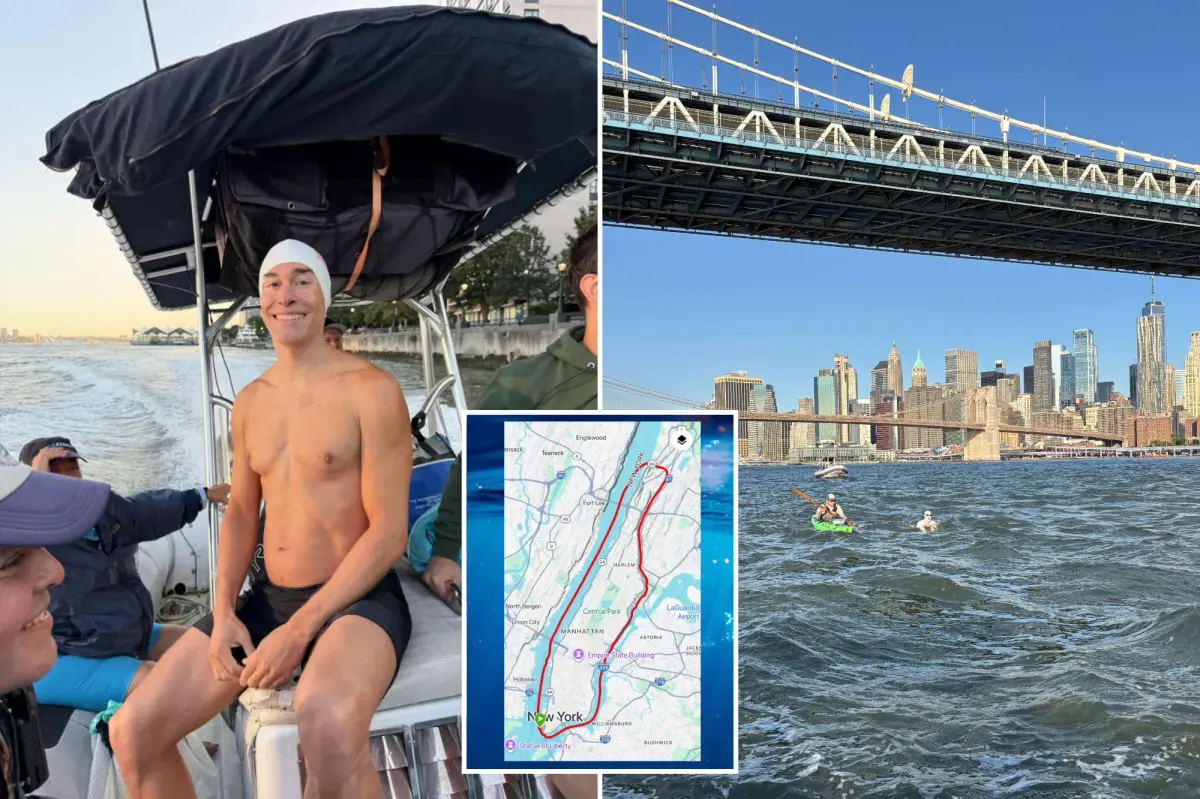
In an extraordinary display of human endurance and determination, 49-year-old New Yorker Michael Moreau completed a 28.5-mile swim around Manhattan Island with his wrists bound in handcuffs. This September feat earned him two Guinness World Records: the longest open-water swim in handcuffs and becoming the first (and fastest) swimmer to circumnavigate New York City’s waterways while shackled. Completing this aquatic circuit in less than 10 hours, Moreau conquered the East River, navigated through the Harlem River, and descended the Hudson River—all without the full use of his arms. When asked about his motivation for such an unusual challenge, fellow marathon swimmer Capri Djatiasmoro, who supported Moreau during his journey, simply replied, “Why do anything?” The thrill of open-water swimming, as Djatiasmoro describes it, produces a natural high comparable to “a great workout or incredible sex” for those unfamiliar with the sport’s euphoric effects.
For Moreau, the handcuffed marathon swim represented a convergence of his innate aquatic abilities, unfinished ambitions, and a desire to explore the furthest boundaries of human potential in water. “When I started hearing these stories about people who had not given up on the opportunity to really test the limits, I thought, ‘Why can’t I do this thing?'” Moreau explained. Born with an instinctual affinity for water—reportedly able to swim before walking—Moreau had been a decorated competitive swimmer in high school and college before hanging up his goggles for nearly two decades. The water called him back in his mid-40s when he encountered stories of endurance swimmers like Diana Nyad and Ross Edgley. Rather than revisit familiar pool competitions, Moreau turned to ultramarathon open-water swimming, which presented entirely new challenges: unpredictable currents, varying conditions, marine life encounters, and complex logistics involving boat traffic, tidal patterns, and support crews.
Moreau’s journey to the Manhattan circumnavigation began with intensive preparation. He hired a coach, prioritized training over social life, and initially set his sights on conquering Hawaii’s treacherous Molokai Channel—a 42-kilometer deep-ocean crossing completed by only about 100 swimmers in history. After successfully completing this challenge in 2023 with the 14th fastest time ever recorded (13 hours and 11 minutes), Moreau sought something more unconventional. Inspired by Egyptian swimmer Shehab Allam’s 2022 record of swimming 11.6 kilometers in handcuffs, Moreau recognized a technical puzzle worth solving: “If up to 90% of a swimmer’s propulsion comes from their arms, how does one swim when their hands are tied?” The solution, he determined, was to leverage his historically strong breaststroke kick. After surpassing Allam’s record with a handcuffed swim in Hawaii in May 2025, Moreau set his sights on the ultimate challenge—swimming around Manhattan with restrained wrists, which he believed would define his open-water career.
The world of open-water swimming in New York harbors a passionate subculture of athletes who regularly undertake extraordinary challenges beneath the mainstream radar. Annual events like circling the Statue of Liberty or swimming under the Brooklyn Bridge attract dedicated participants, while approximately 100 people annually pay $5,500 to attempt the prestigious 20 Bridges Swim Around Manhattan—just one component of open-water swimming’s “Triple Crown.” Some athletes push boundaries further with superhuman feats like swimming against Manhattan’s currents, powering around the island using butterfly stroke, or even combining the aquatic circuit with running the borough’s perimeter. Despite public perceptions about New York’s water quality (“Oh my God, you swim in the Hudson River? I wouldn’t stick my finger in there,” as Djatiasmoro notes is a common reaction), these swimmers embrace the urban waterways. However, even experienced open-water swimmers like Djatiasmoro initially expressed skepticism about Moreau’s handcuffed attempt, concerned particularly about safety: “With limited arm mobility, how would a crew swiftly hoist him, if necessary, out of harm’s way?”
Undeterred by concerns, Moreau committed fully to preparation, relocating to access a 24-hour pool and training in rough conditions off Coney Island. He reached weekly training distances approaching 65,000 yards (37 miles)—all while maintaining his demanding career as a creative director and practicing with restrained wrists. “I’m training in a pool with a silicone ring tied around my arms and everybody is thinking I’m doing this weird drill,” he recalled, acknowledging the periods of self-doubt: “There’s a lot of second-guessing… Is this even worth the trouble?” Through visualization exercises and mental conditioning, Moreau learned to overcome fears of potential dangers like motorboats, sharks, and waterborne bacteria, focusing instead on controllable factors: “You try to manage everything that is in your control.” On September 9, 2025, Moreau began his historic attempt, supported by a crew including Djatiasmoro, his sister, boat captain, kayaker, and a Guinness World Records official. While he experienced initial euphoria reaching Hell Gate ahead of schedule, the Harlem River segment hit “like a brick wall,” and even the “home stretch” down the Hudson presented a dangerous current near Lincoln Tunnel construction that threatened to pull him under a barge—a peril he only fully appreciated after completing the swim.
As Moreau approached the finish at Brookfield Place, his kayaker delivered motivating news: with a final push, he could complete the circuit in under 10 hours—significantly better than his 11-hour target and comparable to times achieved by unshackled swimmers. Summoning his remaining strength for a sprint-kick, Moreau finished in 9 hours and 41 minutes, an achievement that overwhelmed him with emotion: “It was the culmination of everything that led up to it—the uncertainty, the amount of doubt in my mind about: Have I gone past even what is humanly possible?” Despite emerging with bacterial cellulitis in both legs (a painful but treatable condition), Moreau views his accomplishment as transformative: “This is really a testament that there’s no limit to how big you can dream. You should never stop doing that.” Though he remains contemplative about his next challenge, Moreau’s extraordinary feat redefines what determination and specialized training can achieve, even when conventional wisdom suggests impossibility. His handcuffed circumnavigation of Manhattan stands as a powerful metaphor for overcoming self-imposed limitations and embracing the unexplored potential within us all.