




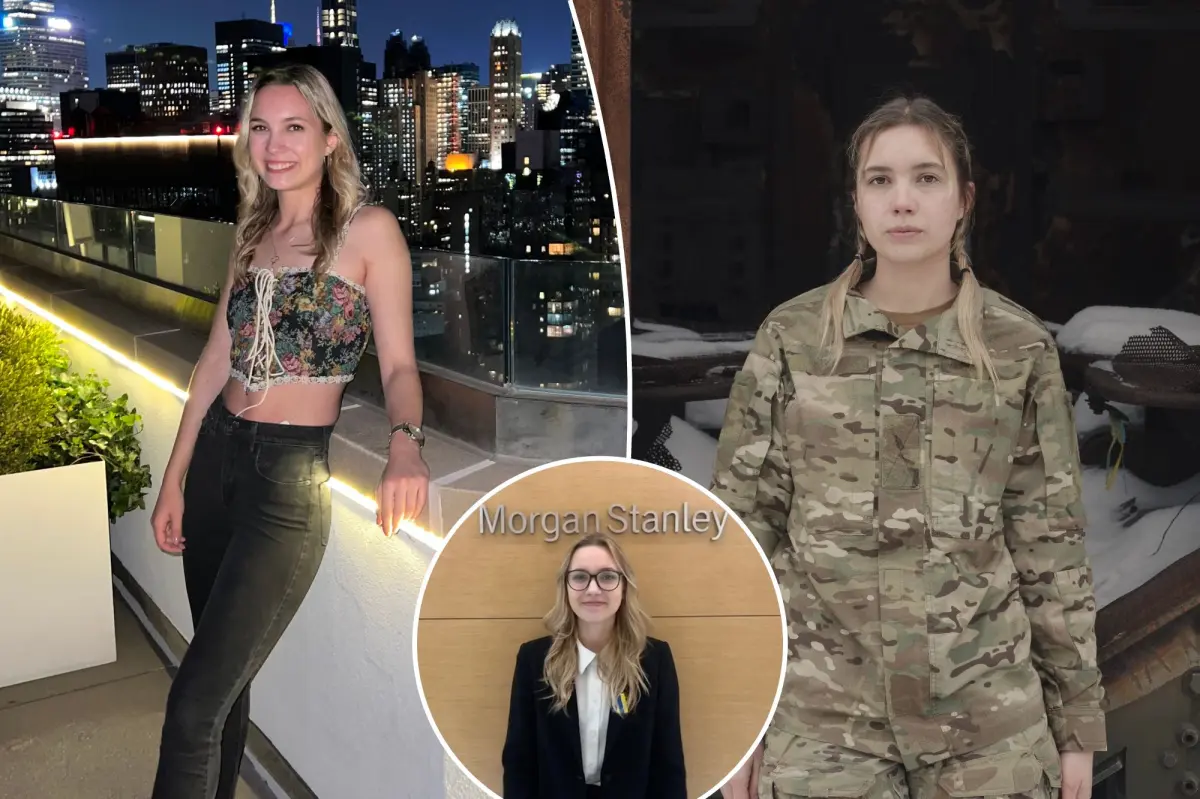
Viktoriia Honcharuk’s life seemed picture-perfect in the glittering heart of New York City. At just 22, she had snagged a prestigious job as an investment banking analyst at Morgan Stanley, complete with a stylish Midtown apartment overlooking the bustling streets, a loving boyfriend who shared her ambitious dreams, and nights out at exclusive spots like the members-only Zero Bond club, surrounded by like-minded finance friends. Diners at upscale restaurants became routine, where she’d laugh over cocktails, celebrating promotions and the endless possibilities that Manhattan promised. “It was a dream come true for me,” she reflected now at 25, her voice carrying a mix of nostalgia and resolve. “The crazy, perfect life,” where every day felt like a high-stakes game of adrenaline and luxury. But beneath that sheen, echoes of her Ukrainian roots tugged at her, a quiet pull she couldn’t ignore.
Then, in December 2022, everything flipped in just two weeks. Honcharuk, a Ukrainian citizen born in the far-off year 2000, watched from afar as Russia’s invasion ravaged her homeland. The news hit like a thunderclap, shattering her double life—part glam New Yorker, part distant daughter worrying for her family back home. Unable to stand idly by, she took a drastic leave from Morgan Stanley just before Christmas, traded her corner office in the Big Apple for the chaos of war-torn fields, and enlisted as an emergency combat nurse. No prior experience, just raw determination fueled by guilt and patriotism. “I was afraid of blood, afraid of needles,” she admitted, but that fear paled against the need to act. Arriving in Ukraine, she underwent a frantic crash course in life-saving skills: applying tourniquets, administering IVs, stabilizing horrific wounds under pressure.
Her transformation felt almost surreal, a young woman who’d once navigated boardrooms now confronting the raw brutality of combat. As a medic stationed perilously close to the front lines—sometimes just 800 meters away—she raced into danger in makeshift ambulances, pulling shattered soldiers from the mud and shrapnel. The sights were gut-wrenching: limbs lost, eyes gouged out, bodies wrecked by artillery and bullets. She’d witness their pain firsthand, yet marvel at their resilience. “They’re cracking jokes about cool prosthetics,” she recalled, her voice breaking with admiration. Those moments in the ambulance, amid the stench of blood and fear, instilled in her a profound sense of purpose. “Every evacuation was an inspiration,” she said, her heart swelling with respect for these warriors who donated everything yet clung to humor and hope.
Honcharuk’s path to this harrowing reality began in a humble corner of Ukraine, a tiny town 50 miles from Zhytomyr, where money was scarce and dreams were big. Growing up with parents who’d never ventured beyond their borders, she craved the world’s vastness. At 13, she dove into English lessons, her passport to elsewhere. By 15, she was in Texas for high school, immersing herself in American life. Academically driven, she pursued computer science, data science, and statistics at San Francisco’s Minerva University, mingling with students from around the globe during travels to South Korea, India, and the UK. Landing that Morgan Stanley gig was the pinnacle, moving to Manhattan and falling in love with its electric energy—a place that felt like the universe’s command center.
Diving into the war meant facing unthinkable horrors and moral dilemmas. As drone warfare intensified in 2023, medics like her were pushed farther back—12 miles from the front—to dodge Russian drones laden with explosives. Glide bombs, she described as “highly destructive,” flattened buildings in instants, forcing slower response times that meant more lives teetering on the edge. Honcharuk, with her multiple concussions from near-misses, including one when a bomb obliterated an aid structure she was evacuating, bore the weight of countless losses. “I lost all my friends I started with,” she confessed, her eyes welling, knowing she’d cremated three herself. Guilt gnawed at her: could she have saved them if closer? Yet, she soldiered on, documenting her ordeal on Instagram to inspire others, even as tears came thinking of those endangering their lives following her lead.
Looking ahead, Honcharuk’s future remains a poignant mystery, draped in uncertainty yet anchored by fierce conviction. She’s briefly returned to New York, where her old desk at Morgan Stanley sits untouched, bosses welcoming her back with open arms, even outlining potential roles. But the galas and gourmet meals feel worlds away now. “I really don’t know what’s going to happen,” she mused, trying not to dwell on the “what-if” of joining the estimated 140,000 Ukrainians who’ve perished. Confronting a possible Russian victory and its global chaos, she sees Ukraine’s stand as a bulwark against greater devastation. “If I die tomorrow, there’s not much to regret,” she said softly. “I’ve done more than the average person can say.” In this epic shift from champagne to courage, Honcharuk embodies the human spirit’s quiet heroism, proving that true fulfillment often lies not in the heights of success, but in the depths of sacrifice.
(Humanizing elaboration: To bring Viktoriia’s story closer to home, imagine the jarring contrast—not just jobs swapped, but worlds. Picture her in Manhattan, the city lights twinkling like stars against her apartment window, the buzz of taxis mirroring the thrill of closing deals. Now, overlay that with the earthy, acrid smell of gunpowder, the tremble in her hands as she administers care amidst the symphony of distant explosions and soldiers’ labored breaths. She’s not just a figure in a headline; she’s someone who once scrolled through photos of her family’s quaint Ukrainian home via Instagram while at trendy brunches, now posting raw, unfiltered glimpses of survival that stir global empathy. Her fears—blood, needles—mirror ours, yet she pushes past them, finding solace in camaraderie and cause. Friends call her crazy for leaving luxury behind, but through her, we see how war strips away superficial dreams, revealing the core: belonging to something bigger, facing mortality with a grace that humbles. In her eyes, the future isn’t just uncertain; it’s a canvas shaped by the choices we’ve made, urging us to ask, when push comes to shove, what would we do for those we love and our shared humanity?)
(Continuing the humanization: The toll isn’t just physical—it’s emotional, a tapestry of grief woven into her days. Cremating friends isn’t a duty; it’s an intimate farewell, flames flickering like the uncertainty in her thoughts about looking her future kids in the eyes and saying, “I fought so you’d never have to.” Yet, amid depletion, Ukrainians’ fatigue is palpable, a collective sigh against the relentless onslaught. Honcharuk’s determination shines through, a beacon reminding us that heroes aren’t born, they’re forged in the fire of necessity. Her story invites us in, making the abstract terror of war feel personal: the soldier joking through agony, the medic racing against time, the young professional traded for a warrior. It’s a testament to resilience, where every ‘crazy’ choice becomes a profound act of living authentically, encouraging us to reflect on our own ‘perfect lives’ and the worlds we’d defend if everything changed overnight.)